Golden Cross vs Death Cross Crypto: The Signal That Actually Works
Learn how the golden cross and death cross crypto signals work, when to use them, and how to avoid the 35% false signal rate. Real Bitcoin examples included.

In this article
If you’ve spent any time studying crypto charts, you’ve probably heard traders talk about the golden cross vs death cross crypto signals. They sound dramatic. They look clean on a chart. And they’ve preceded some of Bitcoin’s biggest rallies and worst crashes. But here’s the thing most articles won’t tell you: these signals are wrong about 35% of the time.
I remember the first time I spotted a golden cross forming on BTC’s daily chart. It was late July 2020. I was still rebuilding after blowing up my trading account a couple years earlier, and I didn’t fully trust the signal. I hesitated, missed the early entry, and only got in once the trend had already confirmed. That experience taught me something crucial: even a solid confirmation tool requires conviction to act on. And that’s exactly what the golden cross and death cross are: confirmation tools, not crystal balls.
This guide breaks down how both signals work, when they’re reliable, and how to avoid getting burned by false signals. If you’re new to moving averages in crypto trading, start there first. Otherwise, let’s dig in.
What Is the Golden Cross in Crypto?
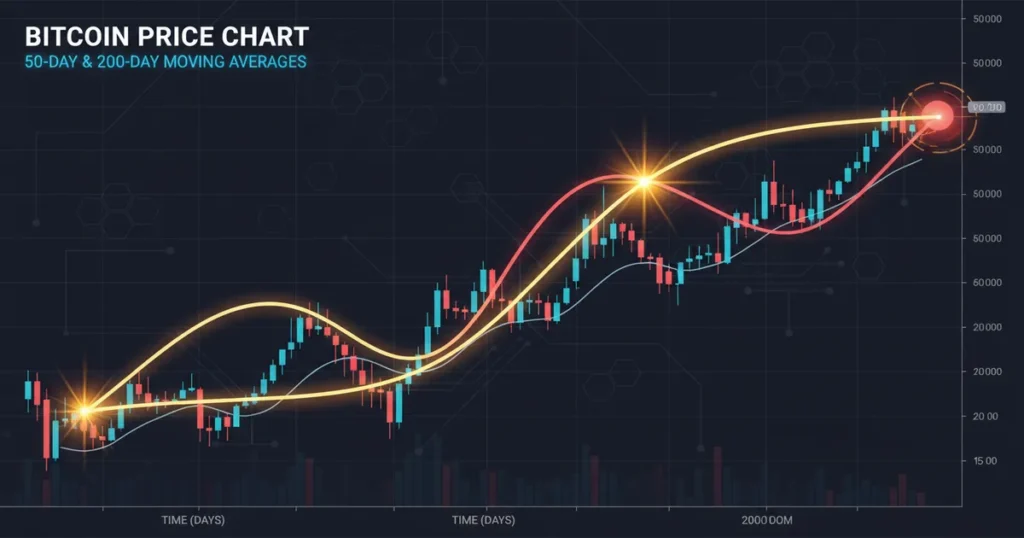
A golden cross happens when the 50-day simple moving average (SMA) crosses above the 200-day SMA. That’s it. Two lines on a chart crossing in a specific direction.
But what it signals matters. The 50-day SMA tracks recent price momentum. The 200-day SMA tracks the long-term trend. When the short-term average rises above the long-term one, it means buying pressure has been building for weeks. The trend is shifting from bearish to bullish.
This is why crypto swing trading strategies often use the golden cross as a green light. It’s not a “buy now” alarm. It’s a “the wind is at your back” signal.
The 3 Stages of a Golden Cross
- Stage 1 – Downtrend fades: The 50-day SMA is still below the 200-day, but the gap is shrinking. Selling pressure is losing steam.
- Stage 2 – The crossover: The 50-day SMA crosses above the 200-day SMA. This is the golden cross itself.
- Stage 3 – Uptrend confirmation: Price holds above both moving averages and starts trending higher. Volume typically increases.
Most beginners jump in at Stage 2. Experienced traders wait for Stage 3 because that’s where the false signals get filtered out.
What Bitcoin’s Golden Cross History Actually Shows
Bitcoin’s golden cross track record is impressive, but context matters. Here are the major ones:
- 2016 golden cross: BTC rallied 139% in the months that followed.
- 2017 golden cross: BTC surged over 2,200%, kicking off the legendary bull run.
- 2020 golden cross: BTC climbed 1,190% from the crossover point to the cycle top.
- October 2024 golden cross: Triggered a 72.55% price increase within months.
Those numbers are real. But they also came during favorable macro environments and aligned with crypto market cycles. The golden cross didn’t cause those rallies. It confirmed that momentum was already shifting.
What Is the Death Cross in Crypto?
The death cross is the golden cross in reverse. It forms when the 50-day SMA crosses below the 200-day SMA. This signals that short-term momentum is weakening and a potential extended downtrend may be ahead.
Here’s where I need to be honest: the death cross scares people more than it should. The name alone triggers panic selling. But not every death cross leads to a crash. Some are just noise in a sideways market.
How Traders Read a Death Cross Signal
Smart traders don’t automatically short when a death cross forms. Instead, they use it as a risk reduction signal. That means:

- Reducing position sizes on existing longs
- Tightening stop losses
- Avoiding new leveraged entries on the long side
- Watching trading volume to confirm the signal’s strength
A death cross on low volume is far less reliable than one backed by heavy selling. Volume is the signal behind the signal.
Famous Bitcoin Death Cross Examples
The June 2021 death cross is the textbook example. Bitcoin dropped from around $40,000 to $29,000 in the weeks that followed, a roughly 50% decline from the cycle high. That one worked.
But the 2019 death cross? It formed and then immediately reversed into a golden cross within weeks. Traders who panic-sold at the death cross got whipsawed. This is why I always tell newer traders: the signal is a data point, not a directive.
Golden Cross vs Death Cross: Key Differences at a Glance
| Feature | Golden Cross | Death Cross |
|---|---|---|
| Signal Direction | Bullish | Bearish |
| What Crosses | 50-day SMA above 200-day SMA | 50-day SMA below 200-day SMA |
| Historical Accuracy | ~64% (Schaeffer’s Research) | ~62% (Schaeffer’s Research) |
| Best For | Confirming bullish trend shifts | Risk reduction, avoiding longs |
| Key Weakness | Lags the actual bottom | Lags the actual top |
Both signals use the same two moving averages. The only difference is direction. And both share the same fundamental weakness: they’re lagging indicators. By the time the cross forms, Bitcoin may have already moved 20-30% from the actual turning point.
That lagging nature is a feature, not a bug. It filters out noise. But it also means you’re never catching the exact bottom or top. If you’re okay with that tradeoff, these signals become genuinely useful. According to Grayscale’s Bitcoin momentum research, trend-following strategies built on moving average crossovers have historically outperformed buy-and-hold during volatile periods.
How to Trade These Signals the Right Way
Here’s where most articles stop: “Golden cross = buy, death cross = sell.” That oversimplification gets people hurt. Let me walk you through how I actually use these signals.
Step 1: Confirm with Volume
A moving average crossover without trading volume confirmation is a suggestion, not a signal. If the golden cross forms while volume is declining, the move lacks conviction. You want to see rising volume during and after the crossover.
Think of volume as the fuel behind the engine. The crossover tells you the engine started. Volume tells you whether there’s enough gas to actually go somewhere.
Step 2: Check RSI and MACD First
Before entering any trade based on a golden cross or death cross, I check two things:
- RSI (Relative Strength Index): RSI above 50 at a golden cross means momentum is genuinely bullish. RSI below 50 at a death cross confirms bearish pressure.
- MACD indicator: A bullish MACD crossover happening near the same time as a golden cross is a much stronger signal than either one alone.
Combining these three indicators improves analytical accuracy to roughly 70-80%. That’s a meaningful edge over using any single signal. You can also check Bollinger Bands for volatility context, since crossovers during tight Bollinger squeezes often precede explosive moves.
Step 3: Set Your Stop Loss Before You Enter
Quick Risk Management Checklist
- Place your stop loss below the 200-day SMA for golden cross long entries
- Never risk more than 1-2% of your portfolio on a single crossover trade
- Scale into positions rather than going all-in on a lagging signal
- Define your invalidation point before you click “buy”
I learned this the expensive way. My stop loss strategy wasn’t always disciplined. Early in my trading career, I’d enter on a golden cross with full size and no exit plan. That’s gambling, not trading. Now I scale in with proper position sizing and always have a defined invalidation level.
The Big Problem With Both Signals (The 35% You Need to Know About)
Let’s talk about the elephant in the chart room. According to research from Quantifiable Edges, golden cross and death cross signals produce false results up to 35% of the time. That’s roughly one in three trades going against you. A Bitcoin financial forecasting study confirmed that while MA strategies can outperform buy-and-hold, they’re far from foolproof.
They’re Lagging Indicators by Design
Here’s the math most people don’t think about. The 50-day SMA needs 50 days of price data to calculate. The 200-day needs 200. For the 50-day to cross the 200-day, prices need to have been rising consistently for weeks. By the time that crossover prints on your chart, Bitcoin may already be 20-30% above its actual bottom.
“Bitcoin’s soon-to-form golden cross could act as a local market peak rather than a signal of a sustained rally.” – Benjamin Cowen, Crypto Analyst
That warning from Benjamin Cowen is worth tattooing somewhere visible. Sometimes the golden cross marks the end of the easy move, not the beginning. You can track the current status of Bitcoin’s moving averages on Bitcoin’s 50/200-day MA chart.
Sideways Markets Destroy These Signals
The golden cross and death cross work best in trending markets. In sideways, choppy conditions, both moving averages flatten out and cross each other repeatedly. Each cross triggers a signal that immediately fails.
I’ve been burned by this personally. During a three-month consolidation phase, I counted four crossovers that all reversed within days. Four trades, four stop-outs. That’s when I added the rule: if both MAs are flat, ignore the cross entirely. Check support and resistance levels instead to gauge range boundaries.
Real Bitcoin Golden Cross and Death Cross History
Let me put the full timeline in one place so you can see the pattern:
- 2016 golden cross: +139% rally. Preceded the steady climb into the 2017 bull run.
- 2017 golden cross: +2,200% rally. The signal that launched a thousand altcoins.
- 2020 golden cross: +1,190% rally. Post-COVID recovery turned into the biggest bull cycle yet.
- 2021 death cross (June): BTC fell from $40K to $29K. Legitimate warning signal.
- 2024 golden cross (October): +72.55% rally. Most recent major example.
The pattern is real. But notice something: every one of those golden crosses aligned with broader macro conditions, post-halving cycles, monetary easing, or institutional adoption waves. The signal works best when the fundamentals agree. When macro conditions are neutral or hostile, even a golden cross can fail.
Understanding crypto market cycles gives you the context that makes these signals actionable rather than misleading.
Bottom Line: Should You Trade Crypto Golden and Death Crosses?
Yes, but with guardrails. Here’s my honest take after years of using these signals:
I use the golden cross and death cross as a macro trend filter. If there’s no golden cross on Bitcoin’s daily chart, I’m cautious with leveraged longs. If a death cross is forming, I reduce exposure and tighten stops. I don’t use either signal as a standalone entry trigger.
The traders who get hurt are the ones who treat these crossovers like buy/sell buttons. They’re not. They’re one layer of a multi-indicator framework. Pair them with RSI, MACD, volume analysis, and solid trading psychology, and you’ve got a legitimate edge.
One more thing: always test before you trade. If you haven’t already, spend time backtesting your strategy on historical data for the specific asset you’re trading. Bitcoin’s golden cross history is compelling, but altcoins behave differently. What works on BTC might fail on a lower-cap token.
Frequently Asked Questions
How accurate is the golden cross for Bitcoin?
Historically, Bitcoin’s golden cross has preceded major rallies in about 64% of cases. The average 3-month return after a golden cross is roughly +16%. However, accuracy improves significantly when combined with volume confirmation and RSI/MACD signals.
Can you use the golden cross for altcoins?
You can, but results are less reliable. Altcoins have thinner order books and more erratic price action. The 50/200-day SMA crossover works best on high-liquidity assets like Bitcoin and Ethereum. Always backtest on the specific coin before committing capital.
What timeframe is best for golden cross and death cross signals?
Daily and weekly charts produce the most reliable signals. Avoid using these crossovers on sub-4-hour timeframes during volatile markets. The shorter the timeframe, the more false signals you’ll encounter.
Is the death cross always bearish?
No. The 2019 Bitcoin death cross reversed almost immediately into a golden cross. Death crosses in early-stage bull markets or during temporary corrections often fail. Always check the broader trend before acting on any single signal.