How to Use Support and Resistance in Crypto Trading (The Levels That Saved Me $15,000)
Learn how to identify and trade support and resistance levels in crypto. Master zones, breakouts, and role reversal with real Bitcoin examples from a trader who learned the hard way.

In this article
Learning how to use support and resistance in crypto trading saved my portfolio. I’m not exaggerating. Back in 2021, I watched a $15,000 profit evaporate because I didn’t understand why Bitcoin kept bouncing off certain price levels. I bought into what I thought was a breakout, only to get slapped back down three times in a row.
That painful lesson taught me something every successful crypto trader knows: support and resistance levels are the foundation of technical analysis. They’re not magic lines on a chart. They’re maps of where other traders made decisions before you—and where they’ll probably make them again.
What Are Support and Resistance Levels (And Why They Matter)
Before I started respecting these levels, I traded like I was throwing darts blindfolded. Let me break down exactly what these concepts mean and why the market keeps proving them right.
Support: The Floor Where Buyers Step In
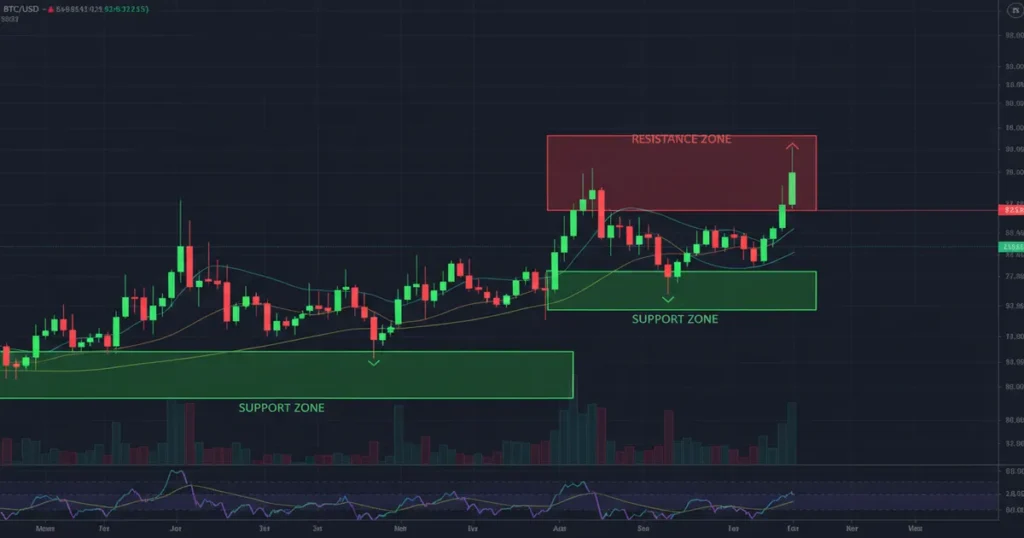
Support is a price level where buying interest is strong enough to stop a downtrend. Think of it as a floor. When price drops to support, buyers see value and step in. Demand exceeds supply, and price bounces.
I remember watching Bitcoin touch $30,000 during the 2021 summer correction. It bounced. Came back down. Bounced again. Three touches at the same level, each time with buyers flooding in. That’s support in action—a psychological and mathematical anchor where the crowd says “this is cheap enough to buy.”
Resistance: The Ceiling Where Sellers Take Over
Resistance is the opposite—a price ceiling where selling pressure overwhelms buyers. When price climbs to resistance, holders decide it’s high enough to take profits. Supply exceeds demand, and price gets rejected.
Ethereum at $4,000 in late 2021 was a textbook example. Every rally to that zone got smacked down. Sellers kept showing up at the same party, killing the momentum each time. Understanding this would have saved me from several impulsive buys into obvious resistance.
Why These Levels Exist (Market Psychology)
Here’s what clicked for me after years of trading: support and resistance aren’t random. They exist because of trading psychology—collective memory and emotional anchors shared by thousands of traders.
A Federal Reserve study on support and resistance found strong evidence that these levels help predict when trends will pause or reverse. Why? Because traders remember where they bought, where they sold, and where they got burned. Those memories cluster at specific price levels.
How to Identify Support Levels on Crypto Charts
Finding legitimate support isn’t about drawing lines everywhere. It’s about identifying where real buying pressure lives. Here’s my process.
Historical Price Floors (Where Price Bounced Before)
The most reliable support levels are where price bounced multiple times. I look for at least three touches at a similar price zone. According to academic research on support and resistance behavior, prices entering levels with more historical bounces are more likely to bounce again.
Pull up any daily Bitcoin chart. Look left. Find where price dropped, stalled, and reversed. Mark those levels. You’re mapping buyer conviction zones.

Round Number Support ($10k, $20k, $30k)
Crypto loves round numbers. When Bitcoin approached $20,000 for the first time, it became massive psychological support for years afterward. Same with $50,000, $100,000. These levels stick in traders’ minds.
I’ve seen altcoins bounce off $1.00, $10.00, and $100.00 like clockwork. Round numbers are easy to remember, easy to set orders at, and therefore become self-fulfilling support zones.
Volume-Confirmed Support Zones
Volume doesn’t lie. When price bounces from support on high volume, that bounce has conviction behind it. Use volume profile analysis to identify where heavy trading occurred. Those high-volume nodes often become future support.
How to Identify Resistance Levels on Crypto Charts
Resistance identification follows similar principles, but with a focus on where sellers take control.
Historical Price Ceilings (Where Price Got Rejected)
Look for price levels where rallies died. Multiple rejections at the same zone confirm sellers are defending that level. The more rejections, the stronger the resistance.
Previous All-Time Highs as Resistance
Old all-time highs become legendary resistance. Bitcoin’s 2017 high of ~$20,000 acted as resistance in 2020. Its 2021 high of ~$69,000 became resistance in subsequent rallies. When you see price approaching a previous ATH, expect a fight.
Psychological Resistance Zones
Just like support, resistance forms at psychologically significant numbers. The $100,000 Bitcoin level was—and remains—a massive psychological barrier. Traders set sell orders there. Media talks about it. It becomes a self-fulfilling ceiling.
Support and Resistance Zones vs. Lines (The Critical Distinction)
Here’s a mistake that cost me real money: treating support and resistance as exact prices instead of zones.
I now draw zones that are 1-3% wide, depending on the timeframe. Daily chart zones are wider than hourly zones. This approach keeps me from getting stopped out by wicks that briefly pierce a level before reversing.
A good rule: the higher the timeframe, the wider the zone. Weekly support zones might be 5% wide. Fifteen-minute zones might be 0.5%. Match your zone width to market volatility.
How to Trade Support and Resistance (3 Proven Strategies)
Identifying levels is step one. Trading them profitably requires specific strategies with clear rules.
Bounce Trading (Buying Support, Selling Resistance)
The simplest approach: buy when price touches support, sell when it touches resistance. But don’t buy blindly. Wait for confirmation.
- Entry: Price touches support zone and forms a bullish candlestick pattern (hammer, engulfing, morning star)
- Stop Loss: Below the support zone (see my guide on stop loss placement)
- Target: Previous resistance zone, minimum 1:2 risk-reward ratio
Breakout Trading (Trading the Break)
When support or resistance breaks, price often accelerates in the breakout direction. The key is confirming the breakout isn’t a fake-out.
- Entry: Wait for a candle to close beyond the level with above-average volume
- Confirmation: Price retests the broken level and holds
- Stop Loss: Back inside the previous range
- Target: Measure the range width and project it from the breakout point
Role Reversal Trading (Support Becomes Resistance)
This concept changed how I trade. When support breaks, it often becomes resistance. When resistance breaks, it often becomes support. This “polarity principle” creates high-probability re-entry points.
Example: Bitcoin breaks above $50,000 resistance. It rallies to $55,000, then pulls back. Where does it find support? Often at $50,000—the old resistance. I’ve made some of my cleanest trades waiting for these role reversals.
Advanced Support and Resistance Techniques
Once you master static levels, these advanced methods add another edge.
Dynamic S/R with Moving Averages
The 50-day and 200-day moving averages act as dynamic support and resistance in trending markets. During bull trends, the 50-day MA often acts as support. During corrections, the 200-day MA becomes the line in the sand.
Combine static S/R with dynamic S/R from Bollinger Bands or moving averages for higher-probability setups.
Fibonacci Retracement as S/R Levels
The Fibonacci sequence creates natural support and resistance zones. Draw Fibonacci retracement from a significant swing low to swing high. The 38.2%, 50%, and 61.8% levels often act as support during pullbacks.
I’ve seen Bitcoin respect the 61.8% Fib level with almost eerie precision during corrections. It’s not magic—it’s self-fulfilling prophecy because so many traders watch these levels.
Confluence Zones (Multiple S/R Types Aligning)
The highest-probability trades happen where multiple types of support or resistance align. When a horizontal level, a moving average, and a Fibonacci retracement all converge at the same price zone, pay attention.
A machine learning study on S/R profitability found that support and resistance features significantly improve price movement predictions. Confluence zones amplify this edge.
Common Mistakes to Avoid with Support and Resistance
I’ve made all of these. Learn from my expensive education.
- Drawing too many levels: If your chart looks like a spider web, you’ve lost the plot. Focus on 2-4 significant levels that actually matter.
- Treating S/R as exact prices: Use zones. Crypto will wick through your “perfect” level just to stop you out.
- Ignoring timeframe context: A support level on the 5-minute chart means nothing compared to daily support. Always map structural levels on higher timeframes.
- Trading blindly without confirmation: Never buy support or sell resistance without confirmation. Wait for chart patterns or volume signals.
- Recency bias: Don’t only look at the last few weeks. Scroll left. Zoom out. Major support from 2020 might still be relevant.
How to Combine Support and Resistance with Other Tools
S/R alone gives you context. Combined with other tools, it gives you conviction.
When price reaches support, check order book analysis for buy walls. Look for bullish candlestick patterns forming. Check if the MACD indicator is showing bullish divergence. Stack these confirmations for your highest-conviction trades.
This multi-factor approach is how professionals trade. One signal can be noise. Three signals pointing the same direction? That’s a setup worth taking.
Final Thoughts: Support and Resistance as Your Trading Foundation
Understanding support and resistance transformed my trading from gambling to strategic decision-making. These levels give you structure in a chaotic market. They tell you where to enter, where to exit, and where you’re wrong.
Start by practicing on historical charts. Pick any crypto and identify major support and resistance zones from the past year. Then watch how price behaves when it returns to those levels. You’ll start seeing the patterns everywhere.
Keep it simple. Don’t clutter your charts. Focus on the levels that really matter—where price reacted multiple times with conviction. Journal your S/R trades and review them monthly. That feedback loop is how you develop intuition for these levels.
The $15,000 lesson I mentioned at the start? It taught me that respecting support and resistance isn’t optional—it’s survival. These levels are where the market shows its hand. Learn to read that hand, and you’ll trade with confidence instead of hope.
Ready to build on this foundation? Dive deeper into candlestick patterns to understand what happens at these levels, or explore volume profile analysis to see where the real money is positioned.