How to Use Volume Profile in Trading (The Market X-Ray I Wish I’d Known in 2018)
Learn how to use volume profile to find high-probability trade entries. Step-by-step guide with crypto examples, common mistakes, and strategies that actually work.

In this article
Learning how to use volume profile in trading completely transformed the way I read charts. Back in late 2018, I watched Bitcoin grind down from $6,000 while staring at standard volume bars that told me absolutely nothing useful. I kept asking myself why price was bouncing at certain levels when my indicators showed no significance. The answer was hiding in plain sight—I just didn’t have the right tool to see it.
Volume profile changed that. It’s like getting an X-ray of the market instead of just looking at the surface. Today I’ll show you exactly how to set it up, read it, and use it for actual trade entries. No fluff, no magic promises—just a tool that’s earned its place in my trading arsenal.
What Is Volume Profile (And Why Traditional Volume Bars Lied to Me)
Here’s what nobody told me when I started trading: those volume bars at the bottom of your chart only show when trading happened, not where. That’s a massive blind spot.
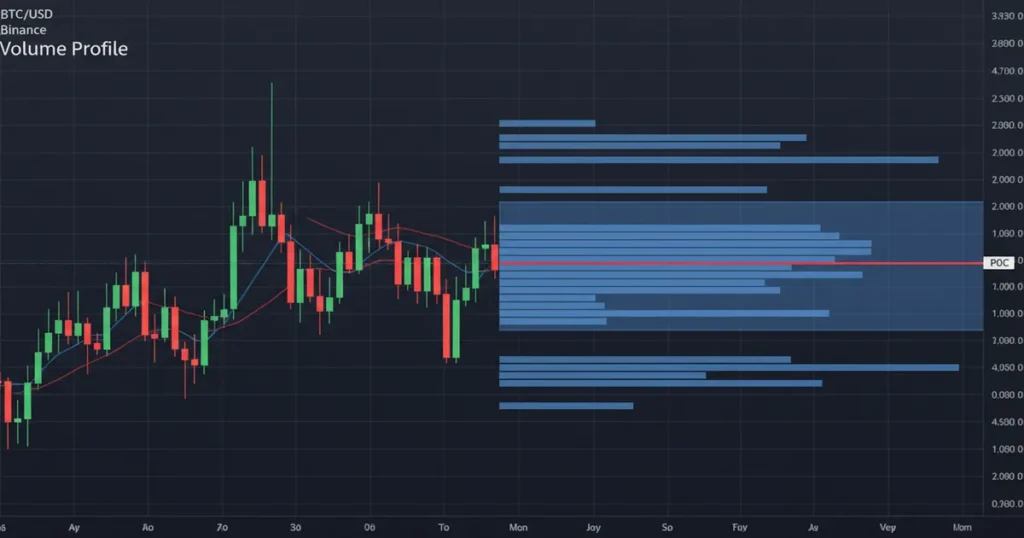
Traditional volume displays how much trading occurred during each candle—whether that’s a minute, an hour, or a day. But volume profile flips the script. It shows you how much volume traded at each price level. This matters because price tends to return to levels where significant volume occurred.
I remember staring at that Bitcoin chart in December 2018, wondering why $3,200 felt like a brick wall. Standard volume bars looked normal. But if I’d had volume profile on my chart, I would have seen a massive cluster of accumulation happening right at that level. That was the bottom. And I missed the entry because I was watching the wrong data.
According to research on volume analysis effectiveness, volume profile can help identify turning points in price movements. It’s not predictive magic—but it does show you where the actual battle between buyers and sellers took place.
The Core Components You Need to Understand
Before you start trading with volume profile, you need to understand three key concepts. Miss any of these and you’ll misread the chart.
Point of Control (POC) – The Market’s Fair Value
The Point of Control is the single price level where the most volume traded during your selected period. Think of it as the market’s consensus on fair value.
Price acts like a magnet around the POC. It tends to return there repeatedly, especially in ranging markets. When price moves away from the POC, you can often expect a reversion—unless there’s a strong trend breaking structure.
I use the POC as my first filter for trade entries. If price is far from the POC with no clear catalyst, I’m skeptical of the move lasting.
Value Area – Where 70% of Trading Happens
The Value Area contains roughly 70% of all traded volume for the period. It represents the zone where institutional traders and market makers see prices as fair.

- Value Area High (VAH): The upper boundary of the value area – acts as resistance
- Value Area Low (VAL): The lower boundary – acts as support
- Value Area: Everything between VAH and VAL
When price trades outside the Value Area, it’s in “unfair” territory. This doesn’t mean it can’t stay there—but there’s statistical tendency to return to fair value. Understanding trading volume basics is essential before diving into these concepts.
High Volume Nodes vs Low Volume Nodes
High Volume Nodes (HVNs) are price levels with concentrated trading activity. They represent areas of price acceptance—where both buyers and sellers agreed to transact heavily. HVNs often act as support and resistance because so many positions were established there.
Low Volume Nodes (LVNs) are the opposite. These thin areas show price rejection—levels where nobody wanted to trade. Price tends to move through LVNs quickly, which makes them important for spotting potential breakout zones.
Here’s a mental model that helps: HVNs are like traffic jams. Price gets stuck there, grinding back and forth. LVNs are like empty highways—price accelerates through them fast.
How to Set Up Volume Profile on Your Trading Platform
Getting volume profile on your chart is straightforward. Here’s how to do it on the most common platforms.
Setting Up on TradingView
TradingView has built-in volume profile tools that work well for most traders. Check out TradingView’s volume profile documentation for the official walkthrough.
- Click “Indicators” at the top of your chart
- Search “Volume Profile”
- Select “Volume Profile Visible Range” (most versatile option)
- Adjust the “Row Size” in settings—smaller rows give more detail
- Enable POC, VAH, and VAL lines in the style settings
Setting Up on Crypto Trading Terminals
Many top crypto trading platforms now offer volume profile natively. Bybit, Binance’s advanced trading interface, and most professional-grade terminals include it. The settings are similar—look for it under indicators or market profile tools.
Choosing the Right Timeframe for Your Strategy
This is where a lot of traders mess up. The timeframe you choose dramatically affects what the volume profile shows you.
- Day Trading: Use hourly or session-based profiles. Yesterday’s POC and Value Area become today’s key levels.
- Swing Trading: Weekly or monthly profiles work better for swing trading strategies. You’re looking for major accumulation and distribution zones.
- Position Trading: Fixed-range profiles covering the entire current market structure help identify macro levels.
I typically run two profiles simultaneously—a shorter timeframe for entry precision and a longer timeframe for overall context.
How to Read Volume Profile for Trade Entries
Now let’s get practical. Here are the three setups I use most often for crypto trades.
Trading the POC Bounce
When price pulls back to the POC from a recent move, it often bounces. The logic is simple: this is where the market agreed on fair value, and many traders have positions established here. They’ll defend those positions.
Entry criteria I look for:
- Price approaches POC from outside the Value Area
- Candlestick confirmation at the POC level—something like reading candlestick patterns that suggest rejection
- Lower timeframe structure shift in your direction
Stop goes just beyond the POC with cushion for wicks. Target the opposite side of the Value Area.
Low Volume Node Breakouts
When price approaches an LVN after consolidating in an HVN, watch for explosive moves. The thin liquidity in the LVN means price can travel quickly once it breaks through.
I got burned on this once by entering too early. Price touched the LVN boundary, I jumped in long, and then it reversed back into the HVN for three more hours before finally breaking. Now I wait for a candle close through the LVN before entering.
Value Area Extremes
The VAH and VAL act as natural support and resistance. When price tests these levels and rejects, you have a high-probability entry.
For swing trades, I’ll set limit orders at the VAL with stops below, targeting the POC or VAH. This approach works especially well in ranging markets where price oscillates within the Value Area.
Volume Profile Strategies That Actually Work in Crypto
Crypto markets trade 24/7, which creates unique opportunities with volume profile.
The Overnight Range Strategy
Asian and European sessions often build their own value areas while US traders sleep. When the US session opens, I look for price outside the overnight Value Area. A move back inside often leads to a full rotation to the overnight POC.
With global crypto trading volume statistics showing institutional participation at 46% of Bitcoin volume, these session-based rotations have become more predictable.
Confluence with Support and Resistance
Volume profile works best when layered with other tools. When an HVN aligns with a traditional support level from chart pattern recognition, that zone becomes significantly stronger.
I also combine it with order book analysis to see if the historical volume zone matches current bid/ask walls. When they align, confidence goes up.
Combining VP with Order Flow
Volume profile shows you where historical volume traded. Order books show you where current liquidity sits. When both point to the same level, you have serious confluence.
Don’t forget risk management either—use proper stop loss placement based on volume profile levels, not arbitrary percentages.
Common Mistakes I Made (And How to Avoid Them)
I’ve made every volume profile mistake in the book. Here are the ones that cost me the most.
Volume profile is a tool, not a strategy. Early on, I took trades just because price hit a POC. No price action confirmation. No trend context. Just “POC = trade.” I lost money until I learned to require multiple confirmations.
Mistake #2: Using Only One Timeframe
Looking at just the daily profile doesn’t show you the weekly structure. And the weekly profile won’t help with intraday entries. Multi-timeframe analysis isn’t optional.
Mistake #3: Assuming All HVNs Are Equal
A high volume node from three months ago matters less than one from last week. Recency matters. Fresh volume zones have more relevance because those positions are still active.
Mistake #4: Ignoring Market Context
During a strong trend, price will blow through HVNs and POCs like they don’t exist. Volume profile works best in ranging or weakly trending markets. In a parabolic move, step aside or use other tools. Managing your trading psychology is crucial when your indicators aren’t working.
Mistake #5: Not Updating Profiles
Markets evolve. A POC from a month ago might be irrelevant after a major range break. I update my profiles regularly, especially after significant moves or structure breaks.
Volume Profile Limitations You Need to Know
Let me be straight with you—volume profile isn’t a crystal ball. It has real limitations.
First, it’s purely historical. The profile shows where trading happened, not where it will happen. New information can make old volume zones irrelevant overnight.
Second, it doesn’t work well in thin markets. Low-cap altcoins with minimal liquidity produce messy, unreliable profiles. Stick to liquid assets like BTC and ETH where institutional volume creates meaningful patterns.
Third, news events can invalidate everything. When major catalysts hit, price blows through volume zones without hesitation. Don’t try to fade a move during high-impact news just because an HVN sits nearby.
Finally, volume profile can’t replace proper risk management. Position sizing, stop losses, and portfolio allocation still matter more than any indicator. I learned this lesson the hard way during my early trading disasters.
Start Using Volume Profile Today
Volume profile gave me something I desperately needed as a trader—context. Instead of guessing where support might be, I could see where actual trading occurred. Instead of hoping my entries were good, I could build trades around proven institutional levels.
Add it to your TradingView chart today. Start with a visible range profile on the daily timeframe. Identify the POC and Value Area. Watch how price interacts with these levels for a few days before trading them.
The tool won’t make you profitable overnight. Nothing does. But combined with solid risk management and price action skills, volume profile becomes a genuine edge in crypto markets.
Want to continue building your trading foundation? Check out our guides on reading candlestick patterns and order book analysis to round out your chart reading skills.