Short Squeeze Trading: How It Works and How to Spot the Next One
A short squeeze triggers explosive price spikes as short sellers panic-buy to cover losses. Learn the mechanics, key signals, and how to trade them safely.

In this article
So what is a short squeeze, really? It’s the financial market equivalent of someone running for the only exit in a burning building — except thousands of traders are sprinting at the same time. A short squeeze is a violent, self-reinforcing price spike that happens when traders who bet against a stock are forced to buy it back at higher and higher prices. The math compresses weeks of normal trading into a few brutal hours. I’ve been on the wrong side of one. I’ll tell you that story near the end, because it’s the reason I respect this setup more than almost any other in trading.
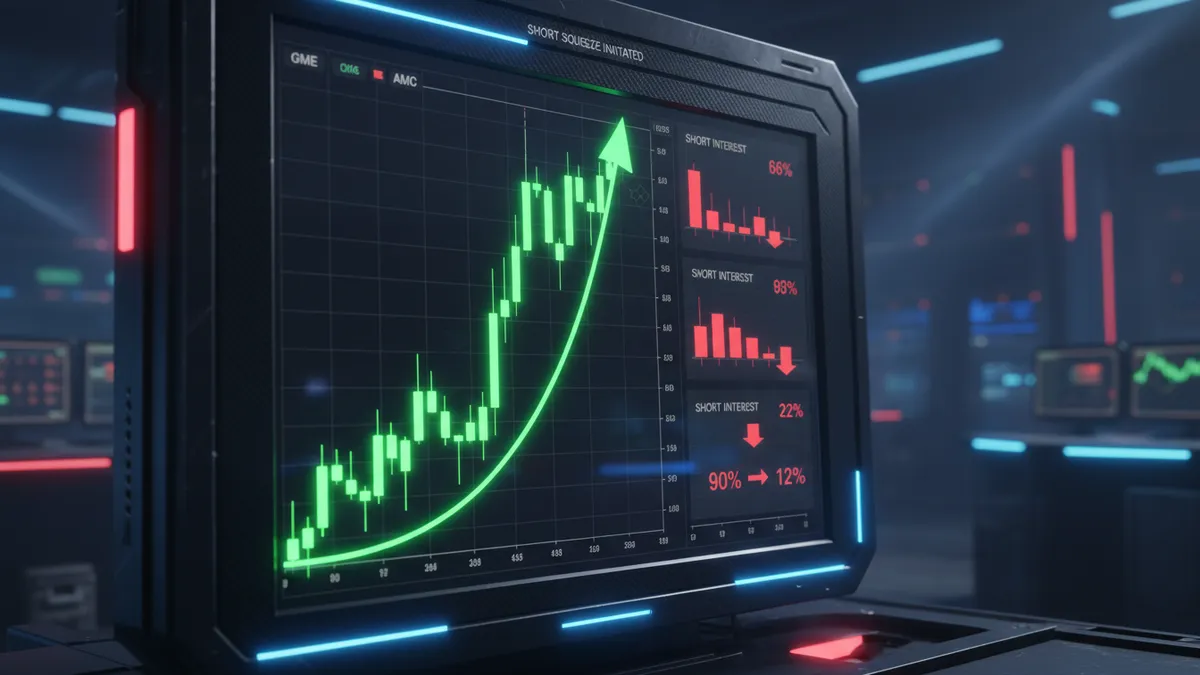
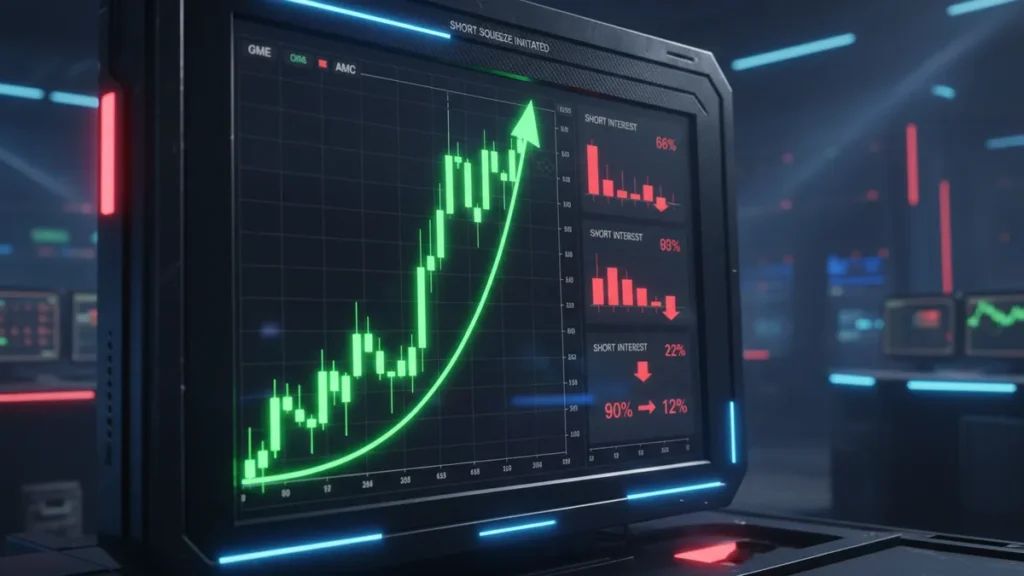
Quick answer: A short squeeze occurs when rising prices force short sellers to buy shares to close their losing positions. That forced buying drives the price even higher, triggering more short covering — a feedback loop that can send a stock or coin up 100%, 400%, or more in a matter of hours or days. The most famous modern example is GameStop in January 2021, which ripped from $17 to $483 and cost hedge funds nearly $20 billion.
What Short Selling Is (The Setup Behind Every Squeeze)
Before you can understand a squeeze, you have to understand the trade that gets squeezed. Short selling is the act of betting that a stock will fall. It’s the structural opposite of buying low and selling high — instead, you sell high first, then buy low later.
Borrowing Shares to Bet Against a Stock
Here’s the mechanic in plain English. A short seller borrows shares from a broker and sells them at the current market price. The plan is to buy those shares back later at a lower price, return them to the broker, and keep the difference as profit. If the stock drops from $100 to $70, the short seller pockets $30 per share minus borrowing fees.
It sounds clean on paper. Pros run trillions of dollars on this exact playbook every year. The trouble starts when the trade goes the wrong way.
The Hidden Time Bomb: Unlimited Upside Risk
When you buy a stock, the worst that can happen is it goes to zero. Your max loss is 100% of what you put in. Painful, but bounded.
Short sellers don’t get that luxury. If you short a stock at $100 and it rallies to $500, you’ve lost $400 per share. If it rips to $1,000, you’re down $900. There’s no theoretical ceiling. That asymmetric risk is the loaded spring at the heart of every short squeeze. The higher the price climbs, the more desperate short sellers become to close out before losses spiral. And the way they close is by buying. That’s the fuse.
What Actually Triggers a Short Squeeze
A short squeeze isn’t one event. It’s a chain reaction. Once the first dominoes fall, the rest go down on their own.
The Feedback Loop That Creates Violent Rallies
Picture a stock with heavy short interest. Price starts ticking up — maybe on news, maybe on technical buying. Some short sellers get nervous and start covering (which means buying back shares to close their position). That buying pressure pushes the price higher. Higher price means bigger losses for the shorts who are still in. They panic and cover too. More buying. Higher price. More panic. More buying.
That’s the feedback loop. It’s the same dynamic that makes wildfires jump highways. Once it has fuel and oxygen, it doesn’t need a reason to keep going.
Common Catalysts That Set Squeezes Off
The spark that lights the fuse usually comes from one of these:

- Earnings surprises: A heavily shorted company beats expectations and gaps up overnight.
- Positive news or analyst upgrades: A guidance raise, an FDA approval, an acquisition rumor.
- Social media momentum: Retail traders coordinate on Reddit, X, or Discord to bid a name.
- Technical breakouts: Price breaks a key resistance level on volume, triggering algorithmic buying. Candlestick charts often flash these breakouts before fundamentals catch up.
One detail matters more than the catalyst itself: float size. Small float stocks squeeze hardest because there are fewer shares available to absorb forced buying. When demand explodes against limited supply, the price has to move violently to clear orders. That’s market microstructure 101.
Two Short Squeezes That Changed Market History
You can read about the mechanics all day. The lesson sticks when you see what these things actually do to balance sheets.
GameStop 2021: When Reddit Broke Hedge Funds
I was watching this one in real time. GameStop opened January 2021 at $17.25. By January 28, it touched an intraday peak of $483. According to S3 Partners, hedge funds collectively lost $19.75 billion in January 2021 alone shorting that single stock.
The carnage by name:
- Melvin Capital Management: Down 49% in the first weeks of January. Required a $3 billion emergency capital injection from Citadel and Point72 to keep operating.
- Citron Capital: Andrew Left’s firm reportedly took a 100% loss on its GameStop short positions and announced it would stop publishing short-side research.
- White Square Capital: A London hedge fund that posted double-digit losses and ultimately shut down.
The full historical record on the GameStop short squeeze reads like a thriller. Brokers halted buying. Congressional hearings followed. The mechanics stayed the same as every squeeze before it — only the scale and the audience changed.
Volkswagen 2008: The 400% Two-Day Surge
Long before GameStop, there was VW. In October 2008, in the middle of the global financial crisis, Porsche SE quietly disclosed that it had accumulated call options on roughly 74% of Volkswagen’s shares. The German state of Lower Saxony already held about 20%. Do the math — that left roughly 6% of VW’s float freely tradeable.
The problem: short interest on VW was significantly larger than 6% of float. Short sellers couldn’t physically find enough shares to cover. The price surged approximately 400% in two trading days. At its October 28, 2008 peak, Volkswagen briefly held the world’s largest market capitalization. A car company. During the worst financial crisis since 1929. That’s what a real squeeze can do.
Short Squeezes in Crypto: A Different Animal
Most articles you’ll find on short squeezes stop at the equity market. That’s a gap I want to fill, because crypto squeezes have their own personality — and they happen far more often.
How Negative Funding Rates Signal a Short-Heavy Market
Crypto markets run 24/7. There’s no opening bell, no after-hours circuit breaker, no time for traders to sleep on their losses. A squeeze can erupt at 3 a.m. on a Sunday with zero warning.
The early-warning signal lives in crypto funding rates. Perpetual futures use funding payments to keep the perp price anchored to the underlying spot price. When shorts dominate the order book, funding flips negative — meaning short sellers pay long traders every 8 hours just to maintain their positions. Sustained negative funding is a flashing neon sign that the market is short-heavy and ripe for a reversal.
Liquidation Cascades: When the Squeeze Goes Vertical
Here’s where crypto squeezes turn brutal. Most crypto traders use leverage. When price ticks against a leveraged short, the position can get force-closed by the exchange — that’s a liquidation. Each liquidation is, mechanically, a market buy order. Each market buy pushes the price higher. Higher price triggers the next liquidation. And so on.
The cascade can chew through billions in open interest in minutes. In July 2025, a single squeeze event liquidated roughly 237,000 traders in one day, with over $1 billion in short positions wiped out. If you want to understand the wreckage, my piece on crypto liquidations walks through the mechanics in detail.
How to Spot a Short Squeeze Before It Pops
This is where most beginners want to skip ahead. Don’t. The data points below are the difference between trading the squeeze and being the squeeze.
Short Interest % Float: The 20% Rule of Thumb
Short interest as a percentage of float tells you how crowded the short side is. As Charles Schwab’s education team puts it, “A stock with 5% or 10% of its float sold short might not raise any alarms, but when that number climbs to 20%, 30%, or even 40%, it gets traders’ attention.”
Working benchmarks I use:
- 5–10% short float: Normal, unremarkable.
- 20%+ short float: Significant. Worth watchlisting.
- 30%+ short float: High squeeze risk.
- 40%+ short float: Extreme. Rare, dangerous in both directions.
Days to Cover: Measuring the Coiled Spring
The other metric that matters is Days to Cover (DTC). The formula is simple:
DTC = Total Shares Short ÷ Average Daily Trading Volume
DTC tells you, theoretically, how many trading days it would take all current short sellers to exit their positions at average volume. A DTC of 5 to 6 days starts catching attention. Anywhere from 8 to 10+ days is high squeeze potential — there simply isn’t enough daily volume for shorts to escape without bidding the price up against themselves.
The textbook setup is high short interest, plus high DTC, plus a pending catalyst. When all three line up, you don’t need to predict the spark. You just need to be ready when it lands.
Where to Find This Data for Free and Paid
You don’t need a Bloomberg Terminal to track this stuff. Here’s the toolkit I actually use:
Stock squeeze data:
- Free: Finviz (short float screening), Yahoo Finance, MarketWatch.
- Paid / institutional: ORTEX short interest tracker for near real-time borrow data and ML squeeze signals. Fintel’s short squeeze screener ranks setups across the market.
Crypto squeeze data:
- Coinglass for funding rates, open interest, and liquidation heatmaps.
- Native exchange data on Binance and Bybit for deeper order book context.
How to Trade a Short Squeeze Without Chasing the Top
If you’ve made it this far, you’re probably tempted to start hunting setups. Read this section twice before you do.
Enter at the Setup, Not the Explosion
The biggest mistake I see — and the one I personally made, which we’ll get to — is buying after a stock has already doubled or tripled. By that point the easy money has been made, and you’re providing exit liquidity for traders who got in early.
The play is to identify the setup before the catalyst hits. High short interest, small float, an upcoming event (earnings, conference, product launch). You’re positioning for the conditions, not chasing the move.
Take Partial Profits — Squeezes End Fast
Squeezes end as violently as they begin. Once the short covering demand exhausts itself, there’s no fundamental support holding the inflated price up. Selling cascades the other way.
I take partial profits aggressively in squeeze trades. Half the position when I’m up a defined amount, trail the rest. Waiting for “the perfect top” is how traders give back every dollar of paper profit they ever had. Position sizing matters even more here than usual — small size, defined risk, no exceptions.
Using Options to Limit Your Downside
For stock squeezes, call options can give you exposure to the upside with a defined maximum loss equal to the premium paid. That’s a different risk profile than holding shares outright, especially when volatility premiums explode mid-squeeze.
For both stocks and crypto, stop-loss orders are non-negotiable. Avoid leverage trading in squeeze setups — a reversal on margin can wipe an account in a single candle. The whole topic of risk management strategies deserves more weight here than the trade idea itself.
Why I Stopped Chasing Short Squeezes (And What I Do Instead)
Time for the personal bit I promised in the intro.
I watched GameStop in January 2021. My first reaction was the right one — dismissive. A brick-and-mortar video game retailer being bid up by a Reddit mob? I had a finance degree. I knew better. I shorted it on paper a few times in my head and felt smart about it.
By day five of the squeeze, when WSB was on every news network and people I hadn’t talked to since high school were texting me about it, my discipline cracked. I told myself I’d “just take a small position to play the momentum.” I bought near $280. I remember the exact feeling — the conviction that this time, the math was on my side. That was the day Robinhood halted buying. I held through the collapse to roughly $180 before I cut it.
That trade cost me money I didn’t need to lose. It also taught me something I couldn’t have learned from a textbook. The psychology of squeeze FOMO is uniquely dangerous because it feels intellectually justified. You can recite the short interest number. You can point to days to cover. You convince yourself you’re not chasing — you’re allocating to a thesis. You’re chasing.
That experience is what built my squeeze-awareness framework. I almost never trade squeezes directly anymore. What I do instead is keep high short-interest names on a watchlist as breakout candidates for confirmation trades. The setup tells me where coiled springs exist. I wait for the spring to release before I get involved, and I size like the move could reverse on me — because it can. The stuff I write about trading psychology traces directly back to that GameStop position.
Bringing It All Together
A short squeeze is one of the few trade setups where you can learn the mechanics in an afternoon and still get destroyed by your own emotions. The data points are simple: short interest above 20% of float, days to cover above 8 to 10, a pending catalyst, a small float to amplify the move. The execution is anything but simple.
Treat squeezes the way pilots treat thunderstorms. Respect them. Understand them. Build your radar to spot them. Then mostly fly around them. The setups that look like easy money in hindsight were not easy money in the moment — they were terrifying, fast, and full of traders convinced they had found the bottom or the top.
If you want to keep building the foundation, my breakdowns on swing trading and the dedicated piece on risk management are the next two stops I’d recommend. Subscribe to the Cave Creek newsletter if you want my weekly setups and post-mortems delivered straight to your inbox — including the trades I get wrong, which is the part most “trading educators” leave out.