Fibonacci Retracement in Crypto Trading: Find Exact Reversal Zones
Learn how to use Fibonacci retracement in crypto trading to spot key reversal zones. Master the 61.8% golden ratio and find precise entry points.

In this article
I remember the first time I drew Fibonacci retracement levels on a Bitcoin chart. It was late 2020, coffee getting cold, and I was skeptical. Then price pulled back and bounced at the 61.8% level like it hit an invisible wall. I sat there staring at my screen thinking, “There’s no way this actually works.” But it did. And it kept working. If you want to master fibonacci retracement crypto trading, you need to understand why millions of traders watch these exact same levels, and how to use them without falling into the traps that cost me real money early on.
Fibonacci retracement is one of the most powerful tools in swing trading. It helps you find high-probability entry points during pullbacks in trending markets. When you combine it with an understanding of crypto market cycles, you stop guessing and start trading with structure.
What Is Fibonacci Retracement?
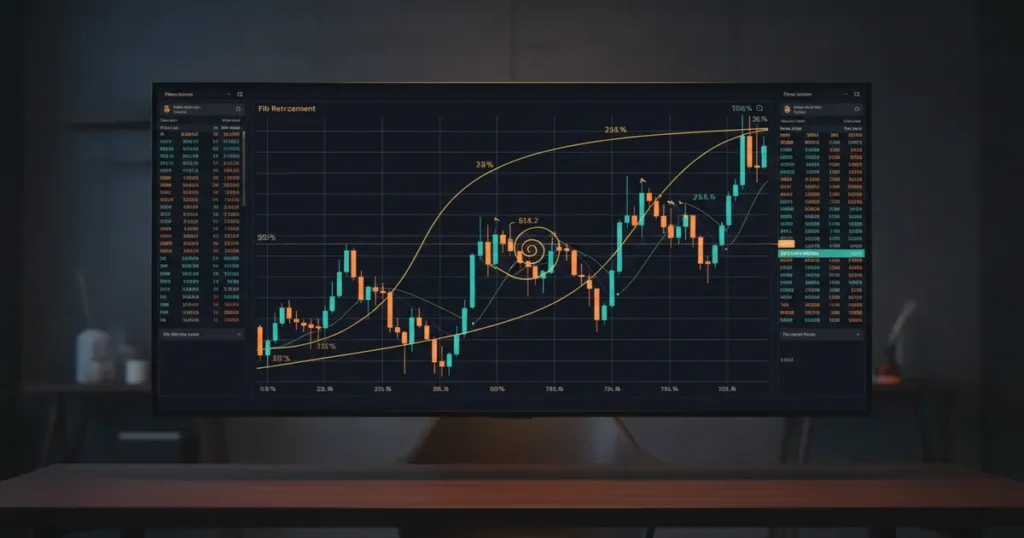
Fibonacci retracement is a technical analysis tool that identifies potential reversal zones during a price pullback. Traders draw it between a swing high and swing low. The tool then plots horizontal lines at key percentage levels where price is statistically likely to pause or reverse.
It sounds complicated. It’s really not. Let me break it down.
The Math Behind the Magic (Without the Boring Parts)
The Fibonacci sequence starts simple: 0, 1, 1, 2, 3, 5, 8, 13, 21, 34, 55, 89. Each number is the sum of the two before it. What makes it special for trading is the ratios hidden inside.
Divide any Fibonacci number by the next one in the sequence, and you get approximately 0.618. Divide it by the number two places ahead, and you get 0.382. These ratios, expressed as percentages (23.6%, 38.2%, 50%, 61.8%, 78.6%), become the retracement levels plotted on your chart.
The 61.8% ratio is called the Golden Ratio or phi. It shows up everywhere in nature, from sunflower spirals to galaxy formations. And, as it turns out, in price charts too.
Why It Actually Works in Crypto Markets
Here’s the honest answer: Fibonacci retracement works largely because everyone believes it works. That’s not a knock against it. It’s the key to understanding it.
Millions of traders and algorithmic bots watch the same Fibonacci levels simultaneously. When price approaches the 61.8% retracement, a flood of buy orders hits the market. That concentration of orders creates real support. It’s crowd psychology encoded as math.
And it’s not just anecdotal. According to research published in the Journal of Big Data, incorporating Fibonacci retracement levels into trading models yielded ROI improvements in up to 70% of configurations tested. The self-fulfilling prophecy has measurable teeth.
The 5 Fibonacci Retracement Levels You Need to Know
Not all Fibonacci levels carry the same weight. Here’s what each one signals and when to pay attention.
23.6% — Shallow Pullback in Strong Uptrends
This is a barely-there retracement. You’ll see price bounce here during explosive momentum moves, like altcoin breakouts or Bitcoin running after a major catalyst. It tells you the trend is incredibly strong, but it rarely offers a clean entry because the pullback is so shallow.

38.2% — The First Real Test
The 38.2% level is where healthy uptrends take a breather. If price holds here, the trend is solid. This is a good entry point in strong trending markets, especially when supported by rising moving averages underneath.
50% — Psychological Midpoint (Not Technically Fibonacci)
The 50% level isn’t a true Fibonacci ratio. It comes from Dow Theory. But it’s included on every Fibonacci tool because traders watch it religiously. When price retraces exactly halfway, it’s a tug-of-war between buyers and sellers. I think of it as the “coin flip” zone.
61.8% — The Golden Ratio, the Level That Matters Most
This is the level. If I had to pick one Fibonacci retracement level to watch for the rest of my career, it’s 61.8%. The Golden Ratio produces the highest probability bounces in trending markets. When price pulls back to 61.8% and holds, you’re looking at a prime entry.
78.6% — Deep Retracement or Early Warning
A 78.6% retracement is a deep pullback. The trend can still continue from here, but you’re approaching dangerous territory. If price blows through 78.6%, the original trend is likely dead. Bitcoin bottomed near the 78.6% Fibonacci level of its 2018-2021 cycle during the 2022 bear market. Deep retracements can work, but they require extra caution and tighter position sizing.
How to Draw Fibonacci Retracement on a Crypto Chart
Drawing Fibonacci levels is straightforward once you understand the process. Here’s exactly how to do it.
Step 1: Identify a Clear Swing High and Swing Low
Find an obvious price peak (swing high) and an obvious price trough (swing low). Don’t overthink this. If you’re squinting at the chart trying to decide where the swing point is, it’s probably not a clear one. Use obvious, clean peaks and troughs that anyone could spot.
Step 2: Apply the Tool — Uptrend vs. Downtrend
How to Apply Fibonacci in Each Direction
- Uptrend: Drag the tool from the swing LOW to the swing HIGH. Price retraces DOWN into the Fibonacci levels.
- Downtrend: Drag the tool from the swing HIGH to the swing LOW. Price bounces UP into the Fibonacci levels.
Getting this backwards is one of the most common beginner mistakes. The tool direction determines where your levels appear.
TradingView makes this incredibly easy. The Fibonacci retracement tool is built-in, free, and takes about three seconds to apply.
Step 3: Read the Levels as Zones, Not Precise Lines
This is critical. Fibonacci levels are not laser-precise price targets. They’re zones. Give each level a 1-2% buffer in either direction. Price might bounce at 60.5% or 62.3% and both count as a 61.8% reaction. If you wait for price to touch the exact number to the penny, you’ll miss trades constantly.
Also, stick to higher timeframes. Daily and weekly Fibonacci levels carry real weight. A Fibonacci level on a 15-minute chart is mostly noise.
The Golden Pocket: Why 61.8%–65% Is the Level Professional Traders Watch
The Golden Pocket is the zone between the 61.8% and 65% retracement levels. This is where the highest-probability reversals happen in trending markets. It’s where I focus most of my attention.
The Golden Pocket becomes especially powerful when it aligns with horizontal support and resistance levels. That confluence of Fibonacci math plus historical price action creates a zone where institutional orders tend to cluster.
Real Trade Example: Bitcoin Golden Pocket Bounce
In early 2024, BTC advanced from roughly $42,000 to $58,800. It then retraced to the 61.8% level near $48,400, right inside the Golden Pocket. A bullish engulfing candlestick confirmation appeared on the daily chart. Traders who entered with a stop below the 78.6% level (~$45,600) captured approximately a 4:1 reward-to-risk trade as BTC continued higher.
The key lesson: don’t blindly buy the Golden Pocket. Wait for a confirming candlestick pattern. And always define your stop loss placement before entering. I place mine just below the 78.6% level. That’s my invalidation point. If price gets there, my thesis is wrong and I take the loss.
Fibonacci Extensions: Predicting Targets, Not Just Entries
Fibonacci retracement tells you where to get in. Fibonacci extensions tell you where to get out.
Extensions project where price might travel after a retracement completes and the trend resumes. The key extension levels are 127.2%, 161.8%, and 261.8%. Bitcoin has historically stalled at major extension levels during bull runs, making them natural take-profit targets.
Think of it this way: retracements find your entry. Extensions plan your exit. They’re sister tools, and using both gives you a complete trade plan from open to close.
How to Combine Fibonacci Retracement with Other Indicators
Here’s my rule: I never trade a Fibonacci level alone. I need at least two confluences before I’ll risk capital. Fibonacci gives you a zone. Other indicators confirm whether that zone will hold.
Fibonacci + RSI: Confirming Momentum at Key Levels
When price reaches a Fibonacci retracement level and the RSI (Relative Strength Index) shows an oversold reading (below 40 on the daily), that’s a high-probability setup. The Fibonacci level identifies the zone. RSI confirms that selling pressure is exhausted.
Fibonacci + Support/Resistance: The Confluence Power Play
When a Fibonacci level lands on top of a horizontal support and resistance level, pay close attention. This confluence significantly strengthens the signal. Two independent methods pointing to the same price zone creates a much higher probability reaction.
You can add even more confidence by checking Volume Profile data. High-volume nodes sitting near a Fibonacci level confirm that significant trading activity has occurred at that price, increasing the chance of a strong reaction.
Fibonacci + Moving Averages: When the Lines Stack Up
Watch for moments when a key moving average (the 200 EMA or 50 EMA) sits near a Fibonacci retracement level. These zones act like magnets for price. I’ve also found that pairing Fibonacci with Bollinger Bands can highlight when price is stretched to an extreme right at a Fib level.
For additional confirmation, a MACD bullish divergence appearing at a Fibonacci level is one of the most reliable reversal signals I’ve found. Multiple tools agreeing on the same zone is how you build conviction without gambling.
And if you’re studying Wyckoff Method principles, you’ll notice that reaccumulation zones frequently overlap with Fibonacci retracement levels. It’s another layer of confluence worth tracking.
5 Fibonacci Mistakes That Cost Traders Money
I’ve made most of these mistakes myself. Here’s what to avoid.
- Drawing from the wrong swing points. Use obvious, clean peaks and troughs. If you have to squint, pick a different swing point.
- Using Fibonacci in sideways markets. Fibonacci is a trending market tool. I made this mistake obsessively in 2019. I drew Fib levels on everything and couldn’t figure out why nothing bounced cleanly. The market was ranging. Fibonacci doesn’t work in chop.
- Expecting price to stop on the exact level. Trade zones, not lines. A 1-2% buffer around each level is normal. Don’t get stopped out because price wicked 0.3% past “the level.”
- Entering without a stop loss plan. Know your invalidation before you click buy. If you enter at 61.8%, your stop goes below 78.6%. Period. Without proper stop loss placement, a single bad trade can erase weeks of gains.
- Ignoring higher timeframe context. A Fibonacci level on a 1-hour chart means nothing if the daily trend is against you. Always check the bigger picture first.
That second mistake cost me more than I’d like to admit. I was so excited about having a “system” that I applied it everywhere regardless of market conditions. Fibonacci is a scalpel, not a hammer. Use it when the context is right.
Fibonacci Retracement FAQ
What is the most important Fibonacci level?
The 61.8% level, known as the Golden Ratio. It produces the highest probability reversals in trending markets. According to a study from the National Center for Biotechnology Information, Fibonacci retracement captures meaningful price movements across multiple asset classes, including crypto.
Does Fibonacci retracement work in crypto?
Yes. Fibonacci retracement works particularly well in crypto’s trending markets with high liquidity. Bitcoin and Ethereum respond to Fibonacci levels consistently because millions of traders and bots watch the same levels. The self-fulfilling prophecy is strongest in high-volume assets.
What timeframe should I use for Fibonacci?
Daily and 4-hour charts provide the most reliable Fibonacci signals. Weekly charts are excellent for identifying major reversal zones in longer-term trends. Avoid using Fibonacci on timeframes below 1 hour, as the signals become unreliable.
What’s the difference between Fibonacci retracement and extension?
Retracements find entry points during pullbacks within a trend. Extensions predict where price might travel after the pullback completes and the trend resumes. Retracements answer “where do I buy?” Extensions answer “where do I take profit?”
Can I use Fibonacci retracement alone?
Not recommended. Fibonacci levels identify potential zones, but you need at least one confirming indicator, like RSI, horizontal support/resistance, or volume data, to filter out false signals. Confluence is what separates a guess from a trade.
Start Using Fibonacci Retracement in Your Trading
Fibonacci retracement isn’t magic. It’s a framework built on crowd psychology that gives you structure in an otherwise chaotic market. The key levels are 38.2%, 50%, 61.8%, and 78.6%. The Golden Pocket (61.8%–65%) is where the best trades live. And none of it means anything if you don’t combine it with confirming indicators and disciplined risk management.
I’ve been using these levels for years now, and they remain one of the most consistently useful tools in my trading toolkit. Not because the math is mystical, but because markets are made of people, and people are remarkably predictable at scale.
If you’re building out your technical analysis skills, I’d recommend starting with our guides on support and resistance levels and RSI next. Those two tools pair perfectly with Fibonacci and will give you a complete framework for finding high-probability entries.