What is a Crypto Market Cycle (And How to Trade Each Phase Without Getting Destroyed)
Learn the four phases of crypto market cycles and how to trade each one. Discover if Bitcoin's 4-year cycle is dead and avoid the mistakes that blow up portfolios.

In this article
I lost everything in 2018 because I didn’t understand crypto market cycles.
I bought Bitcoin at $18,000, watched it climb to $20,000, and felt like a genius. Then I watched it crash to $3,200 over the next year while I held on, convinced the bottom was “any day now.” By the time I sold in despair, I had lost 80% of my portfolio. The worst part? I bought right at the top of a distribution phase and sold right at the bottom of accumulation.
Most traders blow up their accounts for the same reason I did – they don’t know which phase of the market cycle they’re in. Understanding crypto market cycles won’t make you a fortune overnight. But it might save you from the devastation of making the same mistakes I made.
What is a Crypto Market Cycle?
A crypto market cycle is a repeating pattern of four distinct phases driven by supply dynamics and human psychology. If you’ve been in crypto longer than a year, you’ve felt these phases in your gut – even if you couldn’t name them.
The most famous version is Bitcoin’s 4-year cycle, which is directly tied to Bitcoin halving events. Every four years (roughly), the block reward that miners receive gets cut in half. The last halving happened on April 19, 2024, dropping rewards from 6.25 BTC to 3.125 BTC per block. The next one is expected around April 2028.
Why do cycles exist? Two forces:
- Supply shocks: Halvings reduce new Bitcoin entering circulation, creating scarcity
- Human emotions: Fear and greed drive predictable behavioral patterns at scale
These forces create four phases that repeat – though not with clockwork precision. Let me walk you through each one.
The Four Phases of a Crypto Market Cycle
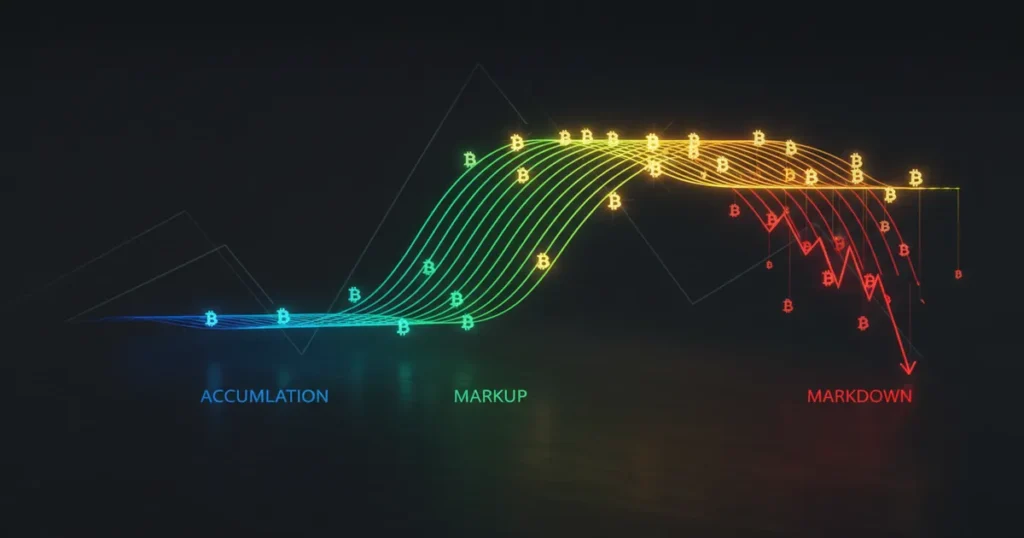
Every cycle moves through the same four phases: Accumulation, Markup, Distribution, and Markdown. The names sound clinical, but living through them feels anything but.
Phase 1: Accumulation (The Bottom)
This is where fortunes are made – and where almost nobody wants to buy.
What it looks like: Prices have crashed 70-80% from the all-time high. They stabilize and chop sideways for months. Trading volume dries up. Headlines declare crypto dead (again).
The psychology: Depression. Hopelessness. The public has given up entirely. Crypto Twitter is a ghost town. Your friends who bought at the top have unfollowed everyone and pretend they never owned Bitcoin.
Who’s buying: Smart money. Institutions. Whales accumulating quietly while retail investors nurse their wounds. If you check strategies for surviving bear markets, you’ll notice the common thread: patience and conviction.

- MVRV ratio below 1 (holders are underwater on average)
- Low trading volume across exchanges
- Negative social media sentiment everywhere
- Exchange outflows increasing (coins moving to cold storage)
Trading strategy: Dollar-cost average into positions. Make high-conviction buys with capital you can lock up for 1-3 years. Size positions for the long term, not quick flips. Patience isn’t optional here – it’s the whole game.
Phase 2: Markup (The Bull Run)
This is the phase everyone fantasizes about. And the phase where most retail traders still manage to lose money.
What it looks like: Prices rise consistently. Higher highs, higher lows. Volume increases. Your Uber driver asks about Bitcoin. Your mom texts you about Dogecoin.
The psychology: Optimism turns to enthusiasm, then euphoria. FOMO becomes a physical sensation. Everyone feels like a genius. “This time it’s different” becomes the mantra.
Who’s active: Retail investors flood in late. Momentum traders pile on. Institutions who didn’t accumulate earlier scramble to catch up. Altcoin season typically kicks off in the late markup phase, when Bitcoin profits rotate into smaller coins.
- Price breaking through major resistance levels
- Rising active addresses on-chain
- SOPR consistently above 1 (profit-taking happening)
- Fear & Greed Index pushing into “Greed” territory
Trading strategy: Ride the trend with trailing stops. Take partial profits along the way – don’t wait for the “perfect” exit. Avoid maximum leverage (yes, even when it feels like free money). The volatility spikes will humble you fast. Mastering crypto trading psychology becomes essential here because FOMO will scream at you to go all-in at exactly the wrong moment.
Phase 3: Distribution (The Top)
The most dangerous phase. And the hardest to identify in real-time.
What it looks like: Price peaks and starts chopping sideways. False breakouts trap eager buyers. Weaker, smaller coins pump hard – a sign that smart money is already exiting Bitcoin. Everything feels chaotic.
The psychology: A toxic mix of greed, fear, hope, and denial. People are conflicted. Some are taking profits. Others are doubling down, convinced the “real” rally is just starting.
Who’s active: Smart money is selling into strength. They’re not announcing it – they’re just quietly rotating into stablecoins and cash. Meanwhile, retail investors are buying the top, hoping for more gains. The difference in behavior is stark if you know what to look for.
- MVRV ratio above 3.5 (most holders sitting on massive gains)
- Extreme greed on the Fear & Greed Index (80+)
- Exchange inflows increasing (coins moving to exchanges to sell)
- Bitcoin dominance dropping as altcoins pump
Trading strategy: Scale out profits systematically. Learn how to take profits strategically before you need to. Reduce leverage dramatically. Tighten stop losses. Start rotating winners into stablecoins. You don’t have to time the exact top – you just need to not be fully invested when it comes.
Phase 4: Markdown (The Bear Market)
The phase where most traders give up on crypto forever. Also the phase that sets up the next accumulation opportunity.
What it looks like: Sharp declines – typically 70-80% from all-time highs. Lower lows become the pattern. Panic selling cascades. Projects that looked legitimate die. Exchanges fail (we saw this with FTX in 2022).
The psychology: Fear turns to despair. Despair becomes capitulation. Capitulation ends in depression. Regret dominates every conversation. “I should have sold at the top” becomes the universal refrain.
Who’s active: Forced sellers – people who overleveraged and are getting liquidated. Weak hands capitulating near the bottom. Some short sellers, but they need strict risk rules too.
- SOPR below 1 (people selling at losses)
- Extreme fear on the Fear & Greed Index (below 20)
- Declining active addresses
- Mainstream media declaring crypto dead
Trading strategy: Survival is the goal, not hero trades. Stay mostly in cash or stablecoins. Small DCA near confirmed bottoms only. If you short, do it with strict rules and small size. Understand that setting effective stop losses isn’t optional – it’s what keeps you alive to trade the next cycle.
This phase eventually transitions back to accumulation. The wheel turns again.
Key Indicators to Track Market Cycle Phases
Knowing the phases is one thing. Identifying them in real-time is another. Here are the indicators I actually use:
- MVRV Ratio: Market Value to Realized Value. Above 3.5 suggests tops. Below 1 suggests bottoms. This single metric has historically identified major turning points.
- SOPR: Spent Output Profit Ratio. Above 1 means sellers are taking profits. Below 1 means they’re selling at losses (capitulation signal).
- NVT Ratio: Network Value to Transactions. Measures whether the network is overvalued or undervalued relative to actual usage.
- Bitcoin Fear and Greed Index: A sentiment gauge that tracks emotion across the market. Extreme readings in either direction are useful signals.
- Bitcoin Dominance: Tends to rise early in cycles (flight to quality) and fall late in cycles (altcoin season).
- Exchange Flows: Outflows suggest accumulation (coins moving to cold storage). Inflows suggest distribution (coins moving to sell).
You can access live crypto market cycle indicators on CoinMarketCap, plus deeper data on Glassnode and LookIntoBitcoin.
Is Bitcoin’s 4-Year Cycle Dead?
This is the big debate right now – and I’ve been wrestling with it myself.
The 2024-2025 cycle broke the script. Bitcoin hit $73,000 (a new all-time high) before the April 2024 halving. That’s unprecedented. In every previous cycle, the halving came first, then the bull run.
What happened? Spot Bitcoin ETFs. In January 2024, the SEC approved multiple Bitcoin ETFs, and institutional money flooded in. By December 2025, Bitcoin ETFs had captured over $75 billion in total inflows. BlackRock’s IBIT alone hit $50 billion within its first year.
The expert community is split.
“The cycle is dead.” – Ki Young Ju, CryptoQuant Founder
“The action so far this time around lines up about perfectly with past four-year cycles.” – Jurrien Timmer, Head of Global Macro at Fidelity
According to Fidelity’s analysis on Bitcoin’s four-year cycle, the patterns are holding despite the noise. But the data also shows real changes:
- This cycle’s maximum year-over-year gain was only ~240% vs 1000%+ in prior cycles
- Bitcoin’s correlation with the S&P 500 hit 0.88 in early 2025 – it’s a macro asset now
- Volatility is dampening as institutions accumulate
Cathie Wood at ARK Invest argues that institutional adoption is fundamentally changing Bitcoin’s behavior, with the sharp 75-90% crashes becoming less likely as large players accumulate. ARK Invest’s research on Bitcoin cycles dives deep into this thesis.
My perspective? The cycle is evolving, not dead. The four phases still exist – I’ve traded through them. But the timeline is stretching, volatility is compressing, and macro factors matter more than ever. Grayscale’s State of the Crypto Cycle report suggests we’re in an intermediate stage, not yet at levels that marked prior tops.
The playbook is the same. The execution just requires more patience.
Common Mistakes Traders Make in Each Cycle Phase
Knowing the phases doesn’t mean you’ll trade them well. Trust me – I know this from painful experience.
Accumulation Mistakes
- Getting impatient and buying too early
- Refusing to buy when sentiment is at its worst (the best time)
- Waiting for “confirmation” that the bottom is in – and missing it
Markup Mistakes
- Buying late because FOMO finally overwhelmed logic
- Going all-in near tops
- Using reckless leverage because “it’s a bull market”
Distribution Mistakes
- Not taking any profits because “it’s going higher”
- Believing “this time is different”
- Ignoring clear distribution signals because hope feels better
Markdown Mistakes
- Panic selling near the bottom (I did this in 2018)
- Trying to catch falling knives with real size
- Refusing to accept that we’re in a bear market
The universal mistake across all phases? Not having a written plan in advance. When emotions run high, you need rules you wrote when you were calm.
How I Use Market Cycles in My Trading
My framework is simple: acknowledge the phase I’m in before making any trade.
This sounds obvious. It isn’t. When you’re in the middle of euphoria or despair, your brain lies to you. You convince yourself the trend will continue forever. Writing down “we are in distribution” forces me to trade like we’re in distribution – even when my gut screams to buy more.
Position Sizing by Phase
- Accumulation: Largest positions. This is where I build.
- Markup: Moderate positions. I’m riding, not loading.
- Distribution: Smallest positions. I’m selling, not buying.
- Markdown: Minimal positions. Cash is a position.
Risk management rules: Stops get tighter as the cycle matures. Leverage decreases in later phases. I don’t try to time exact tops and bottoms – I trade phases, not prices.
The most important tool? Journaling. Writing down my emotional state alongside my trades has helped me identify when fear or greed is overriding my strategy. Recovery taught me this discipline – the same principles that keep me sober keep my trading account alive.
Cycles are a framework for risk management. Not a crystal ball.
Final Thoughts: Cycles Don’t Guarantee Profits
Understanding crypto market cycles gives you an edge. It doesn’t eliminate risk.
Many traders know the theory but can’t execute because emotions override everything. I’ve been there. I blew up accounts knowing the phases existed – because knowing and doing are different skills.
Each cycle is unique. Past patterns don’t guarantee future results. The ETF-driven 2024-2025 cycle proved that structures can change even while the fundamental rhythm continues.
The real skill is adjusting your strategy to the current phase while maintaining discipline through the noise. Start small. Track your decisions. Learn from each cycle.
The goal is survival first, profits second. If you stay in the game long enough, the cycles will eventually work in your favor.
Want to dive deeper? Check out how Bitcoin halving drives these cycles, or explore bear market strategies for navigating the toughest phases. The more you understand the mechanics, the better positioned you’ll be when the next phase shift hits.