What is Crypto Basis Trading (And How Institutions Make 15-50% APY Without Betting on Price)
Learn what crypto basis trading is and how institutions generate 15-50% APY through market-neutral futures-spot strategies. Risk management and practical setup guide included.

In this article
The first time someone explained crypto basis trading to me, I thought they were describing some kind of exploit. “You mean I can make 15-20% a year without caring which direction Bitcoin moves?” It sounded like the financial equivalent of a perpetual motion machine. But after three years of running these trades myself and watching institutions pour billions into this exact strategy, I can tell you it’s very real. It’s also not as simple as the YouTube thumbnails would have you believe.
Here’s what crypto basis trading actually is, how institutions are quietly generating 15-50% APY from it, and whether it makes sense for your portfolio. I’ll share what works, what doesn’t, and the mistakes that cost me money learning this the hard way.
What is Crypto Basis Trading (The Market-Neutral Strategy Institutions Love)
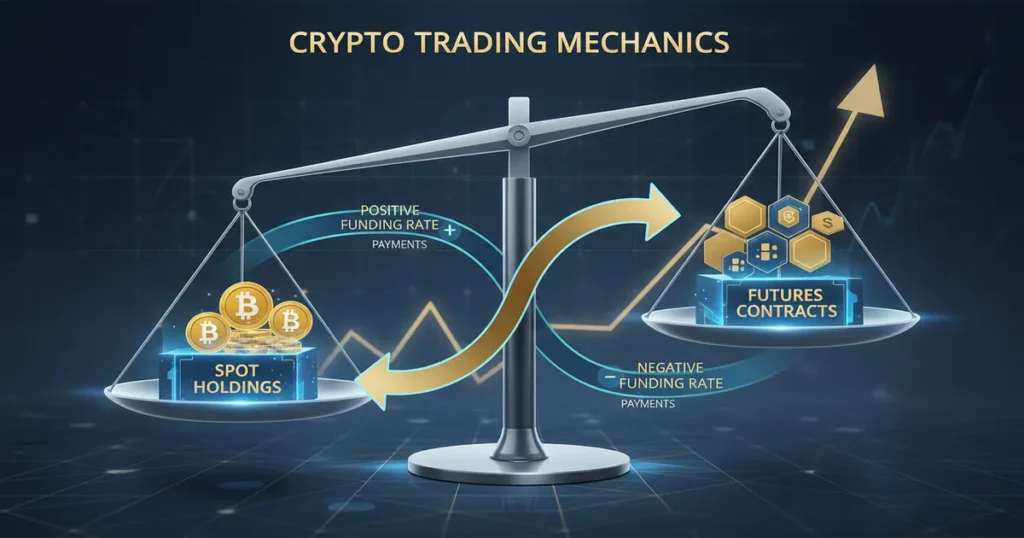
Crypto basis trading is a market-neutral strategy where you simultaneously hold a long position in spot crypto and a short position in perpetual futures. The “basis” refers to the price difference between these two positions.
Here’s the key insight: because your long and short positions cancel each other out directionally, you don’t profit from price movement. Instead, you profit from funding rate payments that perpetual futures traders pay every 8 hours to keep futures prices anchored to spot.
Since the approval of spot Bitcoin ETFs in January 2024, institutional adoption has exploded. Hedge funds, family offices, and treasury desks now view basis trading as their go-to approach for low-risk, non-directional crypto exposure. In 2025, CME actually overtook Binance in Bitcoin futures open interest. That’s institutions moving in at scale.
I remember my first basis trade in early 2022. I’d been burned badly by leveraged directional trades and was looking for something more sustainable. A friend who ran a small fund mentioned he was making steady returns “regardless of what Bitcoin did.” I was skeptical. Extremely skeptical. But watching my position slowly accumulate funding payments while the market chopped sideways for weeks finally made it click. This wasn’t gambling. This was yield farming market structure inefficiencies.
How Crypto Basis Trading Actually Works (Step-by-Step Breakdown)
The Basic Mechanics
The mechanics are straightforward once you understand the pieces:
- Buy spot crypto: You purchase actual Bitcoin (or ETH, or whatever asset) and hold it
- Short perpetual futures: Simultaneously, you open a short position of the exact same size on a perpetual futures contract
- Positions hedge each other: If BTC goes up $1,000, you make $1,000 on spot but lose $1,000 on futures. Net change: zero
- Collect funding payments: Every 8 hours, if funding is positive (longs pay shorts), you receive a payment on your short futures position
The entire strategy rests on one assumption: funding rates stay positive more often than negative. Historically, in bull markets and sideways chop, this holds true. Traders betting on higher prices (longs) consistently outnumber shorts, so they pay to hold their positions.
A Real-World Example with Numbers
Let’s say you have $10,000 to deploy:
- Step 1: Buy $10,000 worth of BTC at spot price
- Step 2: Short $10,000 worth of BTC perpetual futures
- Funding rate: Assume 0.01% every 8 hours (a typical baseline)
- Daily yield: 0.01% × 3 payments = 0.03% per day
- Monthly yield: ~0.9% (0.03% × 30 days)
- Annual yield: ~10.8% APY
Now, that’s a conservative scenario. During bullish periods, funding rates often hit 0.05% to 0.1% per 8-hour period. At 0.05%, you’re looking at ~54% annualized. Post-election in November 2024, ETH funding rates averaged 26% with spikes exceeding 50%.
The Key Component: Understanding Funding Rates
Funding rates are the engine that powers basis trading. If you don’t understand them, you’ll make costly mistakes. I’d strongly recommend reading our detailed guide on understanding funding rates before attempting any basis trades.
Here’s the simplified version: perpetual futures don’t expire like traditional futures. To keep their price close to spot, exchanges use a funding mechanism. Every 8 hours, one side pays the other:

- Positive funding: More traders are long. Longs pay shorts. (This is when basis trading profits)
- Negative funding: More traders are short. Shorts pay longs. (This is when basis trading loses)
Typical funding rates range from -0.1% to 0.3% per 8-hour period, with 0.01% being a common baseline. During extreme bull runs like December 2023, rates spiked to 30%+ annualized. During capitulation events, they can go deeply negative.
You can monitor real-time funding rates across exchanges using the CoinGlass funding rate dashboard. I check this daily. Sometimes hourly during volatile periods. It’s become a habit, like checking the weather before leaving the house.
Why Basis Trading Works in Crypto (Market Structure Explained)
Perpetual futures are unique to crypto. Traditional markets don’t have this exact instrument. According to CF Benchmarks research on Bitcoin basis drivers, “the bitcoin basis is driven by price momentum, market sentiment and financing costs, unlike physical commodities.”
This creates structural inefficiencies that experienced traders can harvest. Here’s why the opportunity persists:
- Regulatory barriers: CEPR economic research on crypto carry trades shows that regulatory fragmentation and margining frictions create “limits to arbitrage” that prevent perfect price alignment
- Retail speculation imbalance: Retail traders overwhelmingly bet long, creating persistent demand for leverage that funds shorts
- ETF expansion: The approval of spot Bitcoin and Ether ETFs in 2024 gave institutions a regulated, liquid spot leg. CME Group analysis on spot ETFs and basis trading details how this made basis trading more scalable for institutional capital
- CME vs. offshore exchanges: CME Bitcoin futures consistently trade at an annualized premium to spot, making them “the cleanest and most scalable vehicle for harvesting basis yield”
Understanding market makers and how they operate also helps explain why these inefficiencies exist. The crypto market is still maturing, and that maturation process creates opportunities.
Crypto Basis Trading Returns: What to Actually Expect
Conservative Strategies (10-20% APY)
If you’re running a basic spot-futures hedge on a single exchange with major assets like BTC or ETH, expect 10-20% APY over a full market cycle. Research shows average returns of 19.26% APY in 2025, up from 14.39% in 2024, with maximum drawdowns under 2%.
This is the “boring but effective” approach. You’re not chasing spikes. You’re compounding steady payments while managing risk carefully.
Aggressive Strategies (25-50%+ APY)
More aggressive approaches can hit 25-50%+ APY by:
- Trading during volatile periods when funding spikes
- Using lower-liquidity altcoins with higher funding rates
- Cross-exchange arbitrage (adds 3-5% annualized returns, with peak opportunities exceeding 20% APR)
- Timing entries around major events (ETF approvals, halving, elections)
December 2023 funding rates hit 30%. Post-election ETH funding exceeded 50% in November 2024. These windows exist, but they don’t last.
Market Condition Impact
Your returns depend heavily on market regime:
- Bull markets: High positive funding, excellent basis trading conditions (15-50%+ APY possible)
- Sideways markets: Moderate positive funding, solid returns (10-20% APY typical)
- Bear markets: Often negative funding, strategy may lose money or require reversal
The Risks Nobody Talks About (And How to Manage Them)
Basis trading gets marketed as “risk-free yield.” It’s not. It’s lower-risk than directional trading, but it carries real risks that can wipe out months of gains in hours.
Funding Rate Risk
Funding rates can flip from positive to negative within hours. During a sharp selloff, everyone rushes to short, and suddenly you’re paying funding instead of collecting it. In severe bear markets, negative funding can persist for weeks.
Exchange Risk
FTX taught us this lesson. Your spot holdings and futures positions typically live on the same exchange. If that exchange goes insolvent, you lose everything. Diversifying across exchanges helps, but adds complexity and execution challenges.
Liquidation Risk
Even though your position is hedged, extreme volatility can still trigger liquidation on your futures short if you’re not properly margined. Understanding crypto leverage trading mechanics is essential before attempting basis trades.
During the March 2020 crash, Bitcoin dropped 50% in a day. Properly hedged basis traders should have been fine in theory. In practice, exchange overload, liquidation cascades, and delayed spot sales created significant losses for many.
Execution Risk
Opening and closing basis positions simultaneously requires precise timing. Slippage between your spot buy and futures short can eat into profits. Closing positions is even trickier. You need to wait for the spread to equalize, or you’ll book unnecessary losses.
I learned this the hard way in 2022. I needed to unwind a position during a volatile period, and the 15-minute delay between closing my spot and futures positions cost me nearly two weeks of accumulated funding. Now I practice setting stop losses and have strict protocols for unwinds.
Common Mistakes Retail Traders Make with Basis Trades
I’ve made most of these mistakes myself. Here’s what to watch for:
- Using outdated funding rate data: Rates change every 8 hours. What was profitable yesterday might not be today. Always check current rates before entering
- Poor position sizing: Under-margining your futures position is the fastest way to get liquidated during volatility spikes
- Believing it’s “risk-free”: The moment you start treating this as guaranteed yield is when the market will remind you it isn’t
- Chasing unsustainable rates: 100%+ APY on some random altcoin perpetual? There’s a reason that rate is so high, and it’s not because the market is handing out free money
- Closing positions at the wrong time: You can’t just exit whenever. You need to wait for the spot-futures spread to converge, or you’ll lock in losses
- Ignoring fees: Trading fees, withdrawal fees, and transfer costs add up. On small positions, fees can eat 30-50% of your yield
- Blockchain congestion: When you need to move funds during network congestion, delays can mean missed funding payments or forced liquidations
When NOT to Use Basis Trading
This strategy isn’t always appropriate. Skip it when:
- Funding rates are negative or near zero: No funding income means no point. Consider bear market strategies instead
- Extreme volatility: Liquidation risk outweighs potential funding income during chaotic periods
- Insufficient capital: Below $5,000, trading fees erode returns significantly. Realistically, you need $10,000+ for this to make sense
- Illiquid altcoins: Wide spreads and thin order books create execution nightmares
- You can’t monitor regularly: This requires daily attention. Sometimes hourly. It’s not set-and-forget
- You lack futures experience: If you don’t understand margin, liquidation, and perpetual mechanics, learn those first
How to Set Up Your First Basis Trade
Choosing Your Exchange
You need an exchange that offers both spot trading and perpetual futures. Ideally one with a strong reputation and deep liquidity. Check our guide on best crypto exchanges for trading for detailed comparisons.
Key criteria:
- Both spot and perp markets for your target asset
- Reasonable trading fees (0.1% or lower)
- Strong security track record
- Sufficient liquidity to avoid slippage
Position Sizing Calculator
Here’s my conservative approach:
- Determine total capital you’re willing to deploy
- Allocate 50% to spot, 50% to futures margin (leaves buffer for volatility)
- Never use more than 2-3x leverage on the futures side
- Keep 10-20% in reserve for margin top-ups during drawdowns
Monitoring and Management
Set up alerts for:
- Funding rate changes (especially drops toward zero or negative)
- Margin ratio approaching warning levels
- Large spot-futures spread divergences
Tools I use daily: CoinGlass for funding rate monitoring, exchange native dashboards for position management, and TradingView for spread charts.
Is Crypto Basis Trading Worth It?
After three years of running basis trades alongside my directional positions, here’s my honest assessment:
Best for: Intermediate-to-advanced traders with $10,000+ capital who want steady returns without directional risk. It’s also ideal for institutions seeking regulated crypto exposure without speculation.
Not for: Beginners, small accounts under $5,000, or anyone who can’t commit to daily monitoring.
My take: Basis trading is not passive income. It’s active risk management that happens to generate yield. The returns are real. So are the risks. If you approach it with discipline, proper position sizing, and realistic expectations, it can be a valuable addition to your crypto strategy.
If you’re still building your crypto knowledge foundation, start with researching crypto projects and understanding the basics before attempting advanced strategies like basis trading.
The most successful basis traders I know aren’t the ones chasing the highest yields. They’re the ones who minimize mistakes, manage risk obsessively, and compound steady returns over time. That’s the boring secret nobody puts in YouTube thumbnails. But it’s the truth.