What is Order Flow in Trading (And Why Reading the Tape Changed Everything for Me)
Order flow reveals the real-time battle between buyers and sellers that price charts can't show. Learn how reading the tape helps traders spot institutional activity and make smarter entries.

In this article
I spent my first two years of trading staring at candlestick charts like they held some kind of secret. I memorized patterns, drew trend lines, and still got wrecked on entries. Then a buddy in a Discord group told me to stop watching the chart and start watching the tape. That single shift taught me what order flow in trading really means, and honestly, it changed everything about how I read markets.
Order flow is the real-time stream of buy and sell orders hitting the market. It shows you who is aggressive, who is passive, and where the actual conviction lives. Price charts show you what already happened. Order flow shows you why it happened and what might happen next.
In this guide, I’ll break down how order flow works, the tools you need to read it, and the mistakes that trip up most traders. Whether you trade futures, crypto, or stocks, understanding this concept gives you a massive edge over traders who only watch candles.
What Order Flow Actually Means
At its core, order flow is the continuous stream of market orders and limit orders entering an exchange. Every time someone hits “buy” or “sell,” that action becomes part of the order flow. It’s the raw data underneath every price move you see on a chart.
Think of it this way. A candlestick on your chart is a summary. It tells you where price opened, closed, and the high and low. But it tells you nothing about the 10,000 individual decisions that created that candle. Order flow cracks open that candle and shows you the battle inside.
Order Flow vs Price Action (The Critical Difference)
Price action trading is like reading a box score after a basketball game. You know the final score and some stats. Order flow is like watching the game live. You see every play, every momentum shift, and every timeout.
Here’s the practical difference. A price action trader sees a green candle and thinks “buyers are in control.” An order flow trader sees that same green candle and notices that sellers were absorbing buy orders the entire time. The candle closed green, but the real story is that sellers are loading up. That’s information you can’t get from a chart alone.
The Battle Inside Each Candle
“Order flow shows you the battle happening inside each price level: who’s aggressive, who’s absorbing, and which side has conviction. Charts show what happened. Order flow reveals why it happened and who’s actually in control.”
Every price level is a micro-battlefield. Aggressive buyers are hitting the ask with market orders. Sellers are sitting on the bid with limit orders, absorbing that aggression. When you can see this in real time, you stop guessing and start reading. If you’re already familiar with how to read order books, you have a head start on understanding this dynamic.
Why Order Flow Matters More Than Most Indicators
Most technical indicators are lagging. They’re formulas applied to past price data. Moving averages, RSI, MACD: all of them tell you where price was. Order flow tells you where the pressure is happening right now.
What Charts Don’t Show You
Charts don’t show you the 2,000-lot iceberg order sitting on the bid at a key support level. They don’t show you that the rally you’re chasing is driven by 90% small retail orders with no institutional participation. And they don’t show you that the big players, the market makers and institutions, are quietly selling into the strength.
According to a Journal of Political Economy study on order flow and exchange rates, order flow models account for roughly 60% of daily changes in exchange rates. Traditional macro models? They rarely explain even 10% of monthly changes. That’s a staggering difference. And research from the Bank for International Settlements order flow research backs this up across multiple currency pairs.

How Institutions Use Order Flow
Here’s something that stuck with me. A research study on retail vs institutional order flow usage found that high-frequency traders’ orders contain twice as much information as retail orders. Why? Because institutions build their strategies around order flow data. They don’t trade patterns on charts. They trade imbalances in the book.
This is the world of smart money concepts in action. When you understand how institutions operate, you stop being the liquidity they’re hunting and start reading their footprint.
The Main Order Flow Tools Traders Use
You don’t need to buy expensive software on day one. Start with one tool, learn it deeply, then add more as your understanding grows. Here’s what’s available.
Time and Sales (The Tape)
The tape is the oldest order flow tool. It’s a scrolling list of every trade that executes: price, size, and whether it was a buy or sell. Tape reading involves closely monitoring this data for patterns in size, speed, and direction. When I first started reading the tape, I felt like I was watching the Matrix. Eventually the numbers slow down and you start seeing patterns.
Depth of Market (DOM/Order Book)
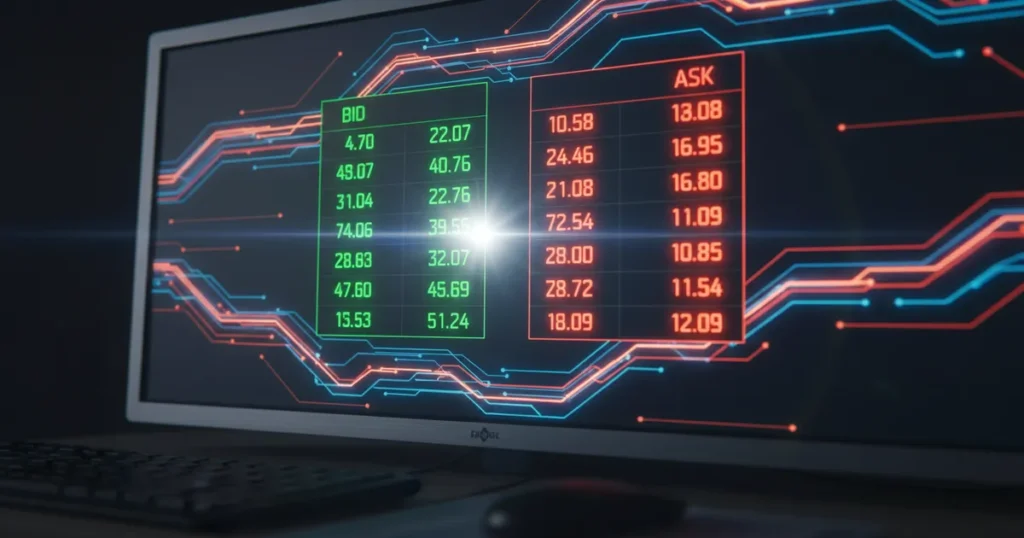
The DOM shows open orders and quantities at each price level. It’s a live snapshot of supply and demand. You can see where buyers and sellers have stacked their limit orders. If you’re newer to this concept, I wrote a full walkthrough on how to read order books that covers the basics.
Quick Tip: DOM Reading
If the same size order keeps getting replenished at the same price level, that’s likely institutional activity. Regular traders don’t reload 500-lot orders instantly. Watching for this pattern is one of the fastest ways to spot the big players.
Footprint Charts
Footprint charts visualize order flow inside each candlestick. They show how volume is distributed across individual price levels, making it easy to see where the aggression concentrated. Think of footprint charts as an X-ray of a candle. You see the skeleton of buyer vs. seller activity at each tick.
Volume Delta
Volume delta is the difference between aggressive buying volume and aggressive selling volume. Positive delta means more market buy orders hit the ask. Negative delta means more market sell orders hit the bid. When combined with understanding volume context, delta becomes a powerful confirmation tool. Pair it with volume profile analysis and you start seeing the full three-dimensional picture of market activity.
How to Read Order Flow (The Basics)
Reading order flow takes practice. I won’t sugarcoat it. The learning curve is steep, and the first few weeks feel like drinking from a firehose. But once the patterns click, you’ll never want to trade without this data again.
Identifying Aggressive Buyers vs Sellers
The key distinction is between market orders and limit orders. Market orders are aggressive. They say “I want in NOW, at whatever price.” Limit orders are passive. They say “I’ll wait here at this price.” When aggressive buyers overwhelm passive sellers, price moves up. When aggressive sellers overwhelm passive buyers, price drops.
Your job is to watch where the aggression concentrates. If buyers are slamming the ask at a resistance level and sellers keep absorbing it, the buyers are burning energy. That often means a reversal is coming.
Spotting Absorption
Absorption is one of the most valuable order flow signals. It happens when large limit orders absorb aggressive market orders without letting price move. If you see heavy buying but price isn’t rising, someone with deep pockets is selling into that demand. That’s a warning sign.
Warning: Absorption Can Fool You
Not every absorption pattern leads to a reversal. Sometimes institutions absorb and then let price continue. Context matters. Always check the higher timeframe trend and consider moving averages for the bigger picture before acting on absorption alone.
Reading Large Prints
In S&P 500 futures, prints of 500+ lots typically signal institutional activity. In crypto, the threshold is different, but the concept is the same. Filter out the noise of small retail orders and focus on the big prints. These are the orders that actually move markets.
I keep a filter on my tape that highlights anything over a certain size threshold. When a cluster of big prints shows up at a key level, I pay attention. Combined with VWAP indicator levels, these large prints often mark institutional entry zones.
Order Flow in Different Markets
Order flow works everywhere there’s a live order book. But each market has its own quirks.
Futures Markets
Futures are the gold standard for order flow trading. Centralized exchanges like the CME provide complete, transparent data. Every trade is reported. There’s no hidden volume or off-exchange dark pools muddying the picture.
This is why legendary futures traders like Morad Askar (FuturesTrader71) built entire careers around order flow, volume profiles, and tape reading. The data quality is unmatched.
Crypto Markets
Crypto order flow has gotten dramatically better over the past two years. CME overtook Binance in Bitcoin futures open interest during 2024-2025, showing that institutional players are bringing professional order flow analysis to crypto.
Big news for 2026: CME Group’s cryptocurrency futures and options will begin trading 24 hours a day, 7 days a week, pending regulatory approval. Check the latest CME Bitcoin futures data for current volumes. This closes the gap between crypto’s always-on nature and traditional futures infrastructure.
On the decentralized side, perpetual futures on exchanges offer order flow data, but it’s fragmented. You’re looking at one exchange’s order book, not the full picture. Still useful, just keep the limitation in mind.
Stocks and Options
Stock order flow is trickier because of dark pools and payment for order flow. A huge percentage of retail stock orders never touch the lit exchange. You’re seeing an incomplete picture. Options flow, however, can reveal institutional positioning when you track unusual volume and large block trades.
Common Order Flow Trading Mistakes
I’ve made all of these. Hopefully you can skip a few by learning from my track record of doing things the hard way.
Overcomplicating the Analysis
When I first discovered order flow tools, I wanted all of them on one screen. Tape, DOM, footprint, delta, cumulative delta, heatmap. My screen looked like a NASA control center, and I was paralyzed by information overload. Master one tool first. Then add another. The trading psychology around simplicity is real: the more inputs you watch, the slower and worse your decisions get.
Ignoring the Bigger Trend
This one cost me money. Reading order flow on a 1-minute chart means nothing if you’re trading against the daily trend. I once saw aggressive buying on the tape during what I thought was a reversal. Took a long. Turns out it was just a short squeeze inside a massive downtrend. Price rolled right back over me. Always check your moving averages and higher timeframe structure before acting on micro order flow.
Falling for Spoofing
Spoof orders are large orders placed in the DOM with zero intention of being filled. They appear on one side to create the illusion of support or resistance, then get pulled before execution. New order flow traders see a massive bid wall and think “support is strong.” Then the wall disappears, and they’re left holding a losing position. If a big order appears and disappears quickly, it was probably a spoof. Watch for it.
Key Reminder
Positive delta does not guarantee price will rise. It only means more buying than selling occurred during that period. Context matters. If price is falling on positive delta, sellers have the upper hand because their limit orders are absorbing all that buying aggression. Always pair order flow signals with setting stop losses to protect against misreads.
My First Order Flow Trade (When I Finally Got It)
I remember the moment order flow clicked for me. It was a Tuesday afternoon, and I was watching ES futures at a key support level. The chart said “bounce.” Every indicator said “oversold.” I probably would have gone long on autopilot.
But the tape told a different story. Large sell orders were hitting the bid in clusters. The bid was refreshing, which looked like absorption, but the size was shrinking each time. The wall was thinning. I watched three waves of selling eat through what looked like strong support on the chart.
I didn’t buy. I waited. Ten minutes later, the level broke, and price dropped 15 points in a waterfall. If I’d relied on the chart alone, I would have been long into a cliff. Instead, the tape kept me out. That single moment of reading the order flow probably saved me more than most trades I’ve won.
That was the day I stopped treating order flow as an add-on and started treating it as my primary input. Charts became secondary context. The tape became my truth.
Getting Started with Order Flow
If you’re ready to add order flow to your trading toolkit, here’s my honest advice on where to begin.
- Start with the tape. Time and sales is free on most platforms. Watch it for a week without trading. Just observe patterns in size and speed.
- Paper trade first. Use a sim account to practice reading order flow without risking real money. I cannot stress this enough.
- Master one market. Pick futures or crypto. Don’t try to read flow in five markets at once. Focus builds skill.
- Journal everything. Screenshot the tape when you see something interesting. Note what happened next. Review weekly. This habit is what separates traders who improve from those who plateau.
- Learn proper risk management. Order flow gives you better entries, but no edge works without discipline. Read up on setting stop losses before you go live.
Platforms like Bookmap, Sierra Chart, and Jigsaw offer dedicated order flow tools. Many have free trials. For crypto-specific trading, check out the best crypto exchanges that support advanced order data and depth of market features.
Order flow trading isn’t easy. The learning curve is real, and it’s better suited for traders who already understand basic technical analysis. But once you can read the tape? You’ll wonder how you ever traded without it.
If you want to keep building on these concepts, explore volume profile analysis for the next layer of market structure, or dive into smart money concepts to understand the institutional playbook behind the flow. Both complement everything you’ve learned here.