What is Crypto Day Trading (And Why 97% of People Lose Money Doing It)
Crypto day trading promises quick profits from 24/7 markets. But research shows 97% lose money. Learn what it really takes, why most fail, and smarter alternatives.

In this article
Let me be honest with you before we go any further. Crypto day trading nearly destroyed my life. Not in the dramatic, made-for-TV way. In the quiet, slow-bleeding way where you check charts at 3 AM, convince yourself the next trade will be the one, and wake up to a margin call. I’ve been on both sides of this game, and if you’re searching “what is crypto day trading,” I want to give you the truth that most articles won’t.
This guide covers what crypto day trading actually is, how it works, why the overwhelming majority of people lose money doing it, and what you need if you’re still determined to try. I’m not here to sell you a course or a signal group. I’m here because I wish someone had written this for me in 2018.
Quick Answer: What is Crypto Day Trading?
Crypto day trading means buying and selling cryptocurrency within a single 24-hour period to profit from short-term price swings. Unlike stock markets, crypto trades 24/7/365. Research shows 97% of day traders lose money, and less than 1% consistently profit after fees.
What is Crypto Day Trading?
Crypto day trading is the practice of buying and selling cryptocurrency within the same day to profit from short-term price movements. You’re not holding for weeks or months. You’re in and out, sometimes within minutes.
The goal is simple on paper: buy low, sell high, repeat. The reality is anything but simple.
Unlike traditional stock markets that operate from 9:30 AM to 4:00 PM Eastern, cryptocurrency markets never close. They run 24 hours a day, 7 days a week, 365 days a year. That sounds like opportunity. It’s also a trap. Because if the market never sleeps, it means you have to decide when you stop watching.
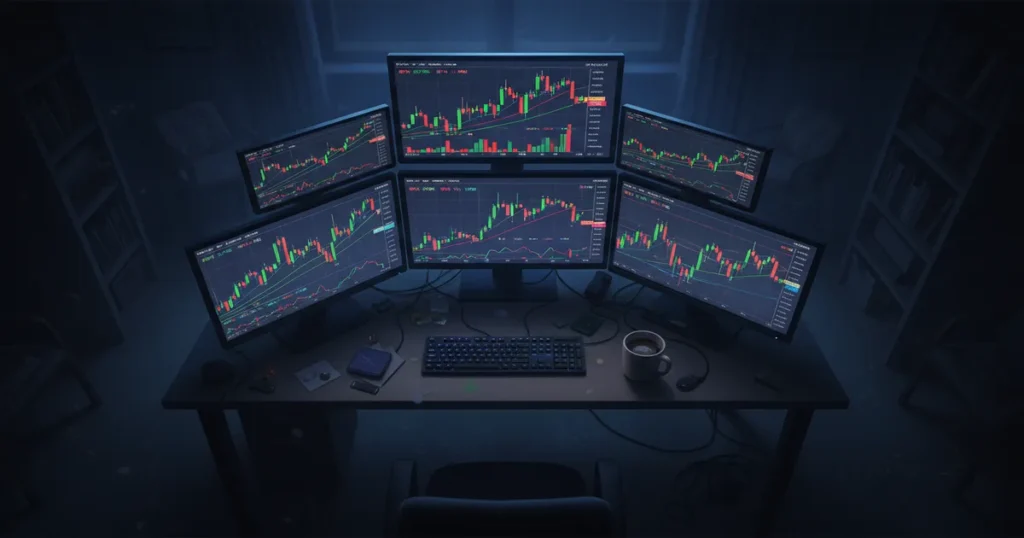
I remember my first real attempt at crypto day trading. It was late 2018, Bitcoin was sliding from its all-time high, and I thought I could scalp the volatility on the way down. I set up three monitors, had TradingView on one, the exchange on another, and Crypto Twitter on the third. I felt like a Wall Street trader. I was actually a retail gambler with a finance degree and too much confidence. Within two weeks, I’d turned a $4,000 account into $1,200.
That was my expensive education. Let me save you the tuition.
How Crypto Day Trading Works
The Mechanics of a Day Trade
A crypto day trade follows a straightforward sequence. You identify an opportunity based on price action or news. You open a position by buying (going long) or short-selling. You monitor the trade. Then you close it before the end of your trading session.
The key distinction: day traders don’t hold overnight positions. Everything gets closed within that trading window. This limits exposure to surprise overnight moves, but it also means you need to find enough intraday volatility to make the fees worthwhile.
To execute trades, you need to understand crypto trading pairs and how orders flow through an exchange. Most day traders use limit orders rather than market orders to control their entry and exit prices.
Crypto vs Stock Day Trading (Key Differences)
If you’re coming from stock trading, crypto is a different animal. Here’s what catches most people off guard:

- 24/7 markets: No opening bell, no closing bell. Price can move 5% while you sleep.
- Higher volatility: Cryptocurrencies regularly swing 10% or more in a single day. That volatility creates opportunity, but it also magnifies losses.
- No pattern day trader rule: In stocks, you need $25,000 to day trade freely. In crypto, there’s no minimum. This low barrier actually makes it more dangerous for undercapitalized traders.
- Whale manipulation: Large holders can move prices dramatically. A single wallet dumping millions in tokens can trigger cascading liquidations.
- Less regulation: Fewer protections for retail traders. If an exchange goes down during a volatile move, that’s on you.
Common Day Trading Strategies
Most cryptocurrency day trading falls into a few core approaches:
- Scalping: Making dozens of small trades to capture tiny price movements. This is the most intense style and requires razor-sharp execution. Learn more about crypto scalping and whether it fits your personality.
- Range trading: Identifying support and resistance levels, then buying near support and selling near resistance. Works best in sideways markets.
- Breakout trading: Entering positions when price breaks above resistance or below support on high volume. Our full guide on the breakout trading strategy covers the details.
- News-based trading: Reacting to announcements, partnerships, regulatory changes, or macro events. Requires speed and access to real-time information.
Each strategy has a specific risk profile. The mistake most beginners make is jumping between strategies after a few losing trades instead of mastering one approach first.
The Brutal Reality: Why Most Crypto Day Traders Fail
Here’s where I’m going to be the friend who tells you what you don’t want to hear. Because I needed someone to tell me this, and nobody did.
The Statistics Nobody Wants to Talk About
According to a comprehensive study on day trading statistics, 97% of day traders lose money in futures markets. Not break even. Lose.
Berkeley research on day trader profitability found that less than 1% of day traders consistently profit after accounting for transaction fees. Only about 17% earn minimum wage from their trading. As an income source, the success rate hovers around 4%.
“There’s no way to think of this as anything else but a flip of a coin.” — Hilla Skiba, Associate Professor, Colorado State University
Those are sobering numbers. And they get worse: 40% of day traders quit within one month. Only 15% remain active after three years. The market is essentially a meat grinder for retail accounts.
The Emotional Trap
The numbers alone don’t explain why people fail. The reason they fail is emotional decision-making. I’ve been deep in this and know exactly how it works from the inside.
You take a loss. It stings. So you increase your next position size to “make it back.” That’s revenge trading. Or you see a token pumping 30% and jump in because everyone on Twitter is celebrating. That’s crypto FOMO, and it’s how retail traders consistently buy tops.
Understanding trading psychology isn’t optional. It’s the single biggest factor separating the 3% who survive from the 97% who don’t. I spent more time working on my emotional responses than I ever spent on chart patterns. That work, honestly, came from my recovery journey. The same discipline I learned getting sober applied directly to not blowing up my account.
The Cost of Overtrading
Every trade costs money. Exchange fees, spread costs, and slippage add up fast when you’re making 10, 20, or 50 trades per day. A 0.1% fee per trade doesn’t sound like much until you realize that 20 round-trip trades per day means you’re paying 4% of your capital in fees daily.
Over a month, that’s your entire account eaten by fees alone. The house always gets paid, win or lose.
What You Actually Need to Day Trade Crypto
If you’ve read everything above and still want to try, here’s what it actually takes. No sugarcoating.
Minimum Capital Requirements
You’ll hear people say you can start day trading with $100. Technically true. Practically useless. With proper risk management (risking 1-3% per trade), a $100 account means risking $1-3 per trade. After fees, your potential profit per trade is negligible.
A realistic minimum is $3,000 to $5,000. This gives you enough room to manage risk properly, absorb losing streaks, and generate meaningful returns if your strategy works. Anything less and you’re just donating to the exchange.
Essential Tools and Platforms
You need reliable infrastructure. Cheap tools cost you in slippage and missed opportunities:
- Exchange: Start with reputable crypto exchanges that offer low fees and fast execution. Understanding the difference between choosing between centralized and decentralized exchanges matters for your trading style.
- Charting software: TradingView is the standard. You need clean charts with customizable indicators.
- Portfolio tracker: Use portfolio tracking tools to monitor performance across all your positions.
- News feeds: Real-time crypto news aggregators. By the time something hits mainstream media, the move is already over.
- Trading journal: Non-negotiable. Every entry, exit, reason, and emotion gets logged.
Technical Analysis Skills
You can’t day trade on vibes. You need to understand price action and the tools that help you read it:
- Reading candlestick charts is your foundation. Every pattern tells a story about buyer and seller pressure.
- The RSI (Relative Strength Index) helps identify overbought and oversold conditions.
- The MACD indicator tracks momentum shifts and trend direction.
- Moving averages smooth out noise and help identify the prevailing trend.
- Reading order books shows you where real liquidity sits and where large orders might push price.
None of these tools work in isolation. The skill is learning to combine them into a coherent trading thesis for each setup.
Risk Management Rules That Actually Work
This is the section that matters most. I’ve seen traders with mediocre strategies survive for years because their risk management was bulletproof. I’ve also watched brilliant analysts blow up because they sized one trade too big.
Position Sizing (The 1-3% Rule)
Never risk more than 1-3% of your total trading capital on a single trade. Here’s what that looks like in practice:
Position Sizing Example
Account size: $5,000
Risk per trade (2%): $100
Stop-loss distance: 5% below entry
Maximum position size: $2,000
With this sizing, even 10 consecutive losses only cost you 20% of your account. Painful, but survivable. Without it, one bad trade can end your career.
Stop-Loss Orders Are Non-Negotiable
Every single trade gets a stop-loss. Set it before you enter the position. Not after. Not “mentally.” An actual order sitting on the exchange.
I learned this the hard way. Early in my trading career, I had a “mental stop” on a Bitcoin short. Price blew through my level, I froze, told myself it would come back. It didn’t. That one trade wiped out three weeks of careful gains. Now I don’t even look at my screen until the stop-loss is placed. Our guide on how to set proper stop-losses covers the mechanics.
Daily Loss Limits
Set a maximum daily loss that triggers an automatic stop to your trading day. I use 5% of my account. If I hit that number, the computer gets shut off. No exceptions.
This rule has saved me more money than any chart pattern ever made me. Some days the market is simply not cooperating with your strategy. Recognizing that early and walking away is a skill, not weakness.
Common Mistakes That Will Destroy Your Account
Trading Without a Plan
If you don’t know your entry criteria, exit criteria, position size, and maximum risk before clicking “buy,” you’re not trading. You’re gambling. And the house edge in crypto is steeper than Vegas.
Write your trading plan down. Print it out. Tape it to your monitor. Every trade should fit the plan or it doesn’t get taken.
Overleveraging
Leverage is the fastest way to destroy a trading account. At 10x leverage, a 10% price drop means total liquidation. That’s not hypothetical. In February 2025, nearly $1.7 billion in crypto positions were liquidated in a single day. Most of those were leveraged traders who thought they could handle the risk. They couldn’t.
If you’re new to trading, understand leverage trading thoroughly before touching it. Better yet, stick to spot trading for your first year. Learn how liquidations work so you understand exactly what’s at stake.
Chasing Pumps and FOMO
When a token is pumping 40% and your timeline is full of rocket emojis, every fiber of your being screams “buy now.” That impulse is exactly what experienced traders are counting on. They need retail buyers at the top to sell into.
I’ve been that retail buyer. More times than I’d like to admit. The dopamine hit of watching a position go green momentarily is real, but it’s followed by the sickening drop when you realize you bought the local top. FOMO isn’t a strategy. It’s a psychological exploit.
Should You Actually Day Trade Crypto?
Here’s my honest take after years of doing this, losing money, getting sober, rebuilding, and finding what actually works for me.
Crypto day trading is not for most people. That’s not elitism. It’s math. If 97% lose money, the odds are not in your favor. The question isn’t whether you’re special enough to beat those odds. It’s whether the risk-reward of trying makes sense given your situation.
Day trading might make sense if you have:
- At least $5,000 in capital you can afford to lose entirely
- Three to six months of paper trading with a proven, profitable strategy
- Emotional discipline (and honesty about whether you actually have it)
- The ability to treat losses as data, not personal failures
- A stable income source that doesn’t depend on trading profits
For everyone else, consider these alternatives:
- Swing trading captures larger moves over days or weeks with far less screen time and stress.
- Dollar-cost averaging removes timing from the equation entirely and builds positions steadily over time.
- Long-term holding with strong research focuses your energy on picking the right assets rather than timing entries and exits.
I shifted from day trading to swing trading about two years into my journey, and it changed everything. My stress levels dropped. My returns actually improved. And I got my mornings back instead of staring at 1-minute candles before the sun came up.
If You’re Going to Try Anyway
Paper trade for at least three months. Use a demo account on your chosen exchange and treat it like real money. Track every trade in a journal. Only move to real capital when you have at least 100 logged trades with a positive expectancy. Start with spot trading only. No leverage. And use money you’ve already mentally written off.
The market will always be there. There’s no rush to lose your money faster.
Frequently Asked Questions
How much money do you need to start crypto day trading?
While you can technically start with any amount, a realistic minimum is $3,000 to $5,000. This allows proper position sizing at 1-3% risk per trade and gives you enough capital to absorb losing streaks without blowing up your account.
Is crypto day trading profitable?
For the vast majority of people, no. Studies show 97% of day traders lose money and less than 1% consistently profit after fees. About 4% earn enough to consider it an income source. The people who do succeed typically have years of experience, strict risk management, and significant capital.
What is the best strategy for crypto day trading?
There’s no single “best” strategy. Scalping, range trading, and breakout trading each work in different market conditions. The best strategy is the one you’ve tested extensively, that fits your personality, and that you can execute consistently without emotional decision-making.
Can you day trade crypto without leverage?
Yes, and you should. Spot trading (no leverage) is significantly safer for beginners. You can only lose what you put in. With leverage, you can lose more than your initial investment and face liquidation. Stick to spot trading until you have at least a year of profitable track record.
The Bottom Line
Crypto day trading is one of the hardest ways to make money in markets. The 24/7 access, extreme volatility, and lack of regulation create an environment that chews up underprepared traders and spits them out. I know because it happened to me before I learned the discipline to survive.
If you take anything from this article, let it be this: the money you don’t lose is more valuable than the money you make. Master risk management first. Everything else is secondary.
Want to build a stronger foundation before jumping in? Start with our guides on reading candlestick charts, understanding trading psychology, and choosing reputable crypto exchanges. Build the skills first. The market isn’t going anywhere.