What is a Crypto Fork (And Why I Woke Up to ‘Free’ Bitcoin Cash in 2017)
Learn what crypto forks are, the difference between hard forks and soft forks, and what happens to your coins. Real examples like Bitcoin Cash and Ethereum Classic explained.

In this article
I still remember the morning of August 1, 2017. I woke up, checked my phone, and Crypto Twitter was on fire. Bitcoin had just split in two. Suddenly, for every Bitcoin I held, I also owned something called “Bitcoin Cash.” Free money, right? Well, not exactly. That morning taught me more about how crypto actually works than any textbook ever could. If you’ve ever wondered what a blockchain fork is and why it matters to your portfolio, you’re in the right place. Let me break down what a crypto fork really means, plain and simple.
What is a Crypto Fork?
The Simple Definition
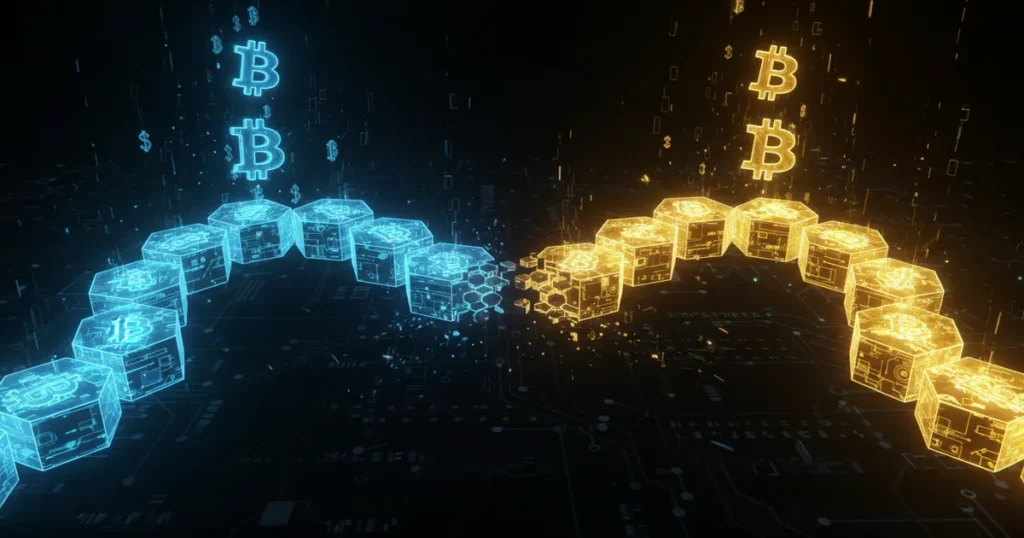
A crypto fork happens when a blockchain technology network changes its rules. Think of it like a road that splits into two paths. Before the fork, everyone followed the same route. After the fork, there are two versions of the chain running with different rules.
At its core, a fork is a protocol upgrade or change. The blockchain’s code is open-source, meaning anyone can propose changes. When the community can’t agree on those changes, things get interesting.
Why Forks Happen (It’s Usually About Money or Philosophy)
Forks don’t happen randomly. They’re triggered by real disagreements. Maybe the network is too slow. Maybe there’s a security flaw that needs fixing. Or maybe two camps have totally different visions for the project’s future.
Here are the most common reasons:
- Scaling disputes: The network can’t handle enough transactions (this caused the Bitcoin Cash fork)
- Security incidents: A hack forces the community to decide whether to reverse transactions
- Feature upgrades: Adding smart contracts or new consensus mechanisms like Proof of Stake
- Governance conflicts: Developers and miners disagree on the project’s direction
I’ve watched dozens of these play out over the years. The heated ones always come down to the same thing: money and control. Who gets to decide how the network evolves? That tension is baked into decentralization itself.
Hard Fork vs Soft Fork: The Critical Difference
What is a Hard Fork
A hard fork is a permanent split. The new rules are not backward compatible. If you don’t upgrade your software, you’re stuck on the old chain. This creates two separate blockchains, each with its own history from the split point forward.
Think of it this way. A hard fork is like a language evolving until two groups can no longer understand each other. They become two distinct languages, two distinct chains.
The result? A brand-new cryptocurrency is born. Bitcoin Cash, Ethereum Classic, Bitcoin SV: all products of hard forks.
What is a Soft Fork
A soft fork is more like a software update. The new rules are backward compatible. Nodes that don’t upgrade can still participate in the network. They just can’t use the new features.
Soft forks tighten existing rules rather than creating entirely new ones. Bitcoin’s SegWit upgrade in 2017 was a classic soft fork. It improved transaction efficiency without splitting the chain.
The Backward Compatibility Factor
Quick Reference: Hard Fork vs Soft Fork
- Hard fork: Not backward compatible. Creates two chains. All nodes must upgrade or get left behind.
- Soft fork: Backward compatible. Single chain. Old nodes still work but miss new features.
- Key question: Does the change break the old rules? If yes, it’s a hard fork.
This distinction matters for your wallet. During a hard fork, you might receive new coins. During a soft fork, your existing coins just get an upgrade. No new tokens, no claiming process, no drama (usually).

The Biggest Crypto Forks in History
Bitcoin Cash: The Great Block Size War of 2017
This is the one that woke me up that August morning. Bitcoin’s blocks were limited to 1MB, processing only 7-8 transactions per second. As adoption grew, fees skyrocketed and transactions crawled.
One camp wanted bigger blocks. The other wanted off-chain solutions like the Lightning Network. Neither side would budge. On August 1, 2017, Bitcoin Cash was born with 8MB blocks (now 32MB), capable of handling roughly 200 transactions per second.
I was glued to my screen that day. The trading psychology around it was wild. Fear, greed, confusion, all swirling together. People were panic-selling BTC to buy BCH. Others were dumping BCH the second they claimed it. The market makers had a field day.
Ethereum Classic: When $60 Million Got Stolen
In 2016, a hacker exploited a vulnerability in the DAO (Decentralized Autonomous Organization) and drained $60 million worth of ETH. The Ethereum community faced a brutal choice: hard fork to reverse the hack, or let the thief keep the money to preserve “code is law.”
They voted to fork. The new chain became Ethereum as we know it. The old chain, where the hack stood, became Ethereum Classic (ETC). It was a philosophical war as much as a technical one.
“A hard fork is a way for the community to express its opinion on the development of the cryptocurrency.”
— Andreas Antonopoulos, as Andreas Antonopoulos explains
Bitcoin Gold, Bitcoin SV, and the 100+ Other Attempts
After Bitcoin Cash proved you could fork Bitcoin and create value, everyone wanted a piece. Bitcoin Gold forked in October 2017 to make mining accessible without ASIC hardware. Bitcoin SV split from Bitcoin Cash in November 2018 over yet another block size disagreement.
Here’s the reality: over 100 Bitcoin forks exist. Most are worthless. Many were outright scams. Bitcoin Gold itself suffered a devastating 51% attack in 2018, proving that smaller fork chains often lack the hashpower to stay secure.
I tracked about two dozen of these forks back in 2017-2018. My spreadsheet was a graveyard. Maybe three or four held any value after six months. The lesson? Don’t chase fork coins just because they’re “free.” Evaluate the tokenomics and market capitalization before getting excited.
Recent Fork Trends in 2025
The landscape has shifted. In 2025, forks are less about contentious splits and more about governance upgrades. Cardano’s Plomin hard fork enabled on-chain voting, letting token holders directly influence protocol decisions. Vitalik Buterin has even proposed a quantum-resistant hard fork strategy for Ethereum.
These aren’t angry community splits. They’re coordinated protocol upgrades that happen to use the hard fork mechanism. It’s a sign the space is maturing.
What Happens to Your Coins During a Fork
Do You Get “Free” Coins? (Yes, But…)
During a hard fork, a snapshot is taken at a specific block height. If you held 1 BTC at that moment, you received 1 BCH on the new chain. Same for every other hard fork. Your original coins stay untouched on the original chain.
Sounds great, right? Free money. But here’s what nobody tells beginners: those “free” coins come with strings attached. You need to be in the right place at the right time, and claiming them can be risky if you don’t know what you’re doing.
Where Your Coins Need to Be
To receive fork coins, you need to hold your crypto in a crypto wallet where you control the private keys, or on an exchange that supports the fork. If your coins are in a wallet you don’t control, you might miss out entirely.
The claiming process is similar to receiving crypto airdrops, but with higher stakes. You’re dealing with your actual private keys, not just connecting a wallet to claim free tokens.
The Claiming Process (And Why I Almost Got Scammed)
I need to be honest here. After the Bitcoin Cash fork, I got cocky. When Bitcoin Gold launched a few months later, I found a website that claimed to help you “claim your BTG instantly.” All I had to do was enter my seed phrase.
I almost did it. My finger was hovering over the submit button. Something felt off. I searched the site name on Reddit and found a thread from 30 minutes earlier warning it was a phishing scam. If I’d entered my seed phrase, I would have lost everything. Not just the fork coins. Everything.
Safety Rules for Claiming Fork Coins
- Never share your private keys or seed phrase with any website, tool, or person.
- Move your original coins to a new wallet first. Then use the old wallet’s keys to claim fork coins safely.
- Wait for exchange support. If your exchange lists the fork coin, claiming is automatic and risk-free.
- Verify everything. Use official project channels, not random links from Telegram or Twitter.
The Risks of Crypto Forks (That Nobody Talks About)
Replay Attacks and Double-Spending
When a chain splits, transactions on one chain can sometimes be “replayed” on the other. This means someone could trick the network into duplicating your transaction. Not every fork implements replay protection, which is a major red flag. For a deeper look at these vulnerabilities, Britannica covers comprehensive fork risks worth reading.
The 51% Attack Problem
Forked chains start with less hashpower than the original. This makes them vulnerable to 51% attacks, where a bad actor controls enough mining power to manipulate the blockchain. Bitcoin Gold learned this the hard way in 2018 when attackers double-spent over $18 million worth of BTG.
This is why I always check on-chain analysis data before touching any fork coin. If the network hashrate is tiny, the risk is enormous.
Scam Forks and Fake Projects
Remember Bitcoin Platinum? It was announced as a legitimate Bitcoin fork. People got excited. The whole thing was a scam designed to steal users’ real Bitcoin during the “claiming process.” Learn to spot scam projects before they spot you.
Market Manipulation Around Fork Events
Forks create chaos, and chaos creates opportunity for manipulators. I’ve seen coordinated pump-and-dump schemes around fork announcements more times than I can count. Traders buy the rumor, pump the price, then dump their fork coins the moment they’re distributed. Don’t let FOMO push you into emotional trades. Sometimes the safest move is parking funds in stablecoins until the dust settles.
Should You Care About Crypto Forks in 2025?
Forks as Governance Tools (Not Just Splits)
The narrative around forks has changed. In 2017, a fork meant war. In 2025, forks are often planned upgrades. Think of them as the crypto equivalent of a software update. Cardano, Ethereum, and other major protocols use hard forks as governance tools to roll out new features with community consensus.
Vitalik Buterin has noted that if a minority disagrees with a fork, the onus is upon them to “exert great effort to coordinate a hard fork to preserve a blockchain’s existing properties.”
Tax Implications You Need to Know
Here’s one most people miss. In the US, the IRS treats fork coins as taxable income. When you receive coins from a hard fork, you owe taxes on their fair market value on the day you receive them. Even if you never sell. Even if the coins end up worthless later.
I made this mistake my first year. Didn’t report my BCH from the 2017 fork. My accountant was not thrilled. Keep records of every fork coin you receive, even the obscure ones.
How to Evaluate Fork Announcements
After years of watching forks come and go, here’s my personal research framework for evaluating them. Understanding how institutional investors view hard forks can also sharpen your perspective.
My Fork Evaluation Checklist
- Team credibility: Who’s behind it? Anonymous teams are red flags.
- Community support: Is there real developer activity, or just hype?
- Exchange listings: Will major exchanges support it? No listings = no liquidity.
- Technical merit: Does the fork solve a real problem, or is it a cash grab?
- Replay protection: Does it implement replay protection? If not, walk away.
If a fork doesn’t pass at least four of these five checks, I don’t touch it. Period. Compare this approach to evaluating a Bitcoin ETF opportunity: sometimes the boring, institutional route carries far less risk than chasing fork coins.
Final Thoughts: Forks Are Crypto’s Democracy (Messy, Chaotic, and Sometimes Brilliant)
Crypto forks represent something bigger than technical upgrades. They’re how decentralized communities make decisions when they can’t agree. It’s democracy at the protocol level: messy, chaotic, and occasionally brilliant.
The Bitcoin Cash fork taught me that disagreement isn’t a bug in crypto. It’s a feature. When developers, miners, and users can’t align, the chain splits and the market decides who’s right. That’s powerful, even when it’s painful.
Here’s what I want you to take away: most forks fail. The “free coins” usually aren’t worth the risk of claiming them. But the mechanism itself? It’s one of the most important ideas in decentralized governance. It means no single entity can hold the network hostage.
If you’re still building your understanding of this space, start with the fundamentals. Learn how blockchain technology works. Understand what smart contracts do. Study tokenomics before chasing the next fork announcement. The more you understand the foundations, the better you’ll navigate the chaos.
And if someone ever asks you to enter your seed phrase to “claim free fork coins?” Close the tab. Trust me on that one.