What Are Crypto Market Makers (And Why They Control Every Price You See)
Discover how crypto market makers control prices through bid-ask spreads, liquidity provision, and algorithmic trading—plus the dark side of wash trading and manipulation.

In this article
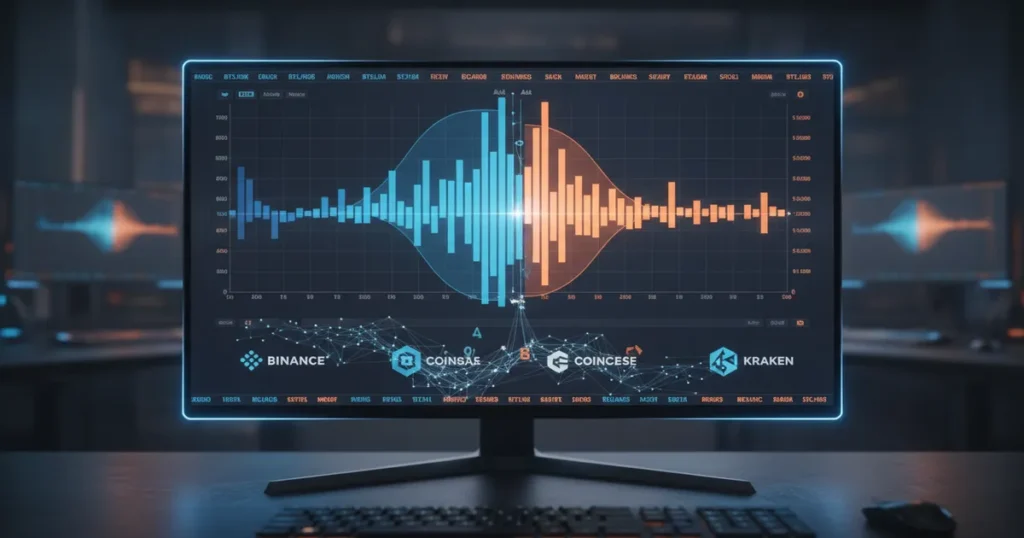
Ever wonder why a crypto token’s price moves differently on Binance versus Coinbase? Or why some coins trade smoothly while others jerk around like a caffeinated squirrel? The answer almost always traces back to crypto market makers – the invisible hands shaping every price you see.
I spent three years watching order books before I truly understood what I was looking at. Those mysterious walls of buy and sell orders aren’t random. They’re placed by sophisticated firms running algorithms faster than you can blink. And understanding how they work changed how I trade forever.
Let’s pull back the curtain on these entities, including how they profit, why they matter, and yes – how some of them manipulate prices.
What is a Crypto Market Maker?
At its core, a crypto market maker is an entity that provides continuous buy and sell orders on exchanges. They’re always willing to buy from you when you want to sell, and sell to you when you want to buy. This sounds simple, but it’s the backbone of every liquid market.
Think of them as the middlemen who keep the market moving. Without them, you might place a sell order and wait hours for a buyer. With them, your trade executes instantly.
Market makers evolved from traditional market makers on Wall Street, but crypto versions operate 24/7 across dozens of trading pairs and multiple exchanges simultaneously. Some of the biggest firms manage liquidity across 60+ platforms.
The key difference from traditional finance? Crypto market makers operate in a largely unregulated Wild West. That creates both opportunities and serious risks we’ll explore shortly.
How Do Market Makers Actually Work?
The mechanics of market making are deceptively simple in concept but incredibly complex in execution. Let me break it down.
The Bid-Ask Spread: Where Market Makers Make Money
Every asset has two prices: the bid (highest price someone will pay) and the ask (lowest price someone will sell for). The gap between them is called the spread.
Market makers profit by buying at the bid and selling at the ask. If Bitcoin’s bid is $60,000 and the ask is $60,020, they pocket that $20 difference on each round trip.
Quick Math: On a spread of just $0.08 per trade, a market maker handling $8 million in buy/sell volume can earn $8,000. It’s a volume game – small margins, massive scale.
In crypto, spreads typically range from 0.5% on major coins to 10% or more on illiquid tokens. That’s why slippage hits so much harder on small-cap coins.

Order Book Placement and Liquidity Provision
If you’ve ever studied reading order books, you’ve seen market makers at work. Those layered walls of orders at various price points? That’s them providing liquidity.
They place orders at multiple price levels simultaneously – not just one bid and one ask. This creates depth. When a large buy order comes in, it doesn’t eat through all the liquidity and spike the price 20%. It gets absorbed across those stacked orders.
High-Frequency Trading and Algorithms
Modern crypto market makers don’t manually place orders. They deploy high-frequency trading (HFT) algorithms using ultra-low latency systems. These bots can place, cancel, and rebalance thousands of orders per second.
The algorithms constantly adjust based on:
- Price movements: If Bitcoin jumps, all quotes get updated instantly
- Inventory levels: Holding too much BTC means shifting quotes to encourage selling
- Volatility: Spreads widen during wild price swings to compensate for risk
- Cross-exchange prices: Exploiting arbitrage opportunities across platforms
Why Market Makers Matter in Crypto Trading
Here’s the thing most traders don’t appreciate: market makers make your trading experience possible. Without them, crypto markets would be chaos.
They reduce slippage on large orders. They stabilize prices during normal market conditions. They enable efficient price discovery by constantly updating quotes based on real supply and demand.
“Liquidity and stability go hand in hand, especially in crypto trading environments. A market with abundant liquidity is much more resistant to wild price swings.” – XBTO Market Analysis
There’s even academic research backing this up. Amihud and Mendelson’s research from NYU and Stanford demonstrated that asset prices depend on both risk and liquidity. More liquid assets command higher prices – which is why top market makers are so valuable to exchanges and token projects.
Market makers also provide liquidity across perpetual futures markets, affecting funding rates and enabling the derivatives trading that many traders rely on.
The Dark Side: Market Maker Manipulation
Now for the part that keeps me up at night. Not all market makers play fair. Some have turned manipulation into an art form – and a business model.
Wash Trading and Fake Volume
According to Chainalysis’s 2025 market manipulation report, roughly 70% of volume on unregulated crypto exchanges is suspected wash trading. Let that sink in. Seven out of ten trades you see on some platforms aren’t real.
Wash trading is when an entity trades with itself to create fake volume. It makes a token look popular and liquid when it’s anything but.
I learned this lesson the hard way in 2022. I found what looked like a promising new token with solid daily volume – around $2 million. Seemed legitimate. But when I started digging into the on-chain data, 90% of that volume came from just three wallets trading back and forth. The real organic volume? Maybe $150,000. I dodged that bullet, but it taught me to never trust volume numbers at face value.
Front Running and MEV (Maximal Extractable Value)
In decentralized markets, some actors watch pending transactions and jump ahead of large orders. If they see you’re about to buy 100 ETH, they buy first, push the price up, then sell to you at the higher price.
This is called front running, and in DeFi it’s evolved into “MEV extraction” – a sophisticated industry extracting value from regular traders through automated market makers in DeFi pools.
SEC Enforcement Actions (2024 Cases)
The regulators are finally catching up. In October 2024, the SEC’s October 2024 enforcement action charged four crypto market makers – ZM Quant, Gotbit, CLS Global, and MyTrade – for running “market manipulation-as-a-service.”
These firms weren’t just passively making markets. They were hired by token projects to create artificial trading activity. The FBI investigation found that some manipulators yielded up to 22x their initial ETH investment in roughly 10 days through coordinated wash trading.
The message is clear: the days of blatant manipulation without consequences are ending – at least on regulated platforms.
Top Crypto Market Makers You Should Know
Not all market makers are shady operators. The legitimate firms provide genuine liquidity and work with major exchanges. Here are the names you should recognize:
- Wintermute: One of the largest, trading billions daily across spot and derivatives
- GSR: Works with Kraken, Coinbase, and Gemini – regulated exchange focus
- Cumberland DRW: Traditional finance background, institutional-grade operations
- DWF Labs: Manages 750+ blockchain projects, trades on 60+ exchanges including Binance and Bybit
- Jump Trading: Traditional HFT firm that expanded heavily into crypto
- Keyrock: Expanded to the US market in 2025
- Acheron Trading: First to secure a CASP license under Europe’s MiCA regulations
The 2025 trend? AI-driven liquidity optimization and cross-exchange arbitrage are becoming standard tools for top-tier market makers.
How to Spot Market Maker Activity
Learning to identify market maker behavior gave me an edge in trading low-cap tokens. Here’s what to look for.
Check the order book for telltale patterns. Large walls at round numbers often indicate market maker support or resistance levels. Layered orders with precise spacing suggest algorithmic placement rather than organic traders.
Watch for volume anomalies. If a token’s volume spikes at the same time every day, or stays suspiciously constant regardless of price action, you might be looking at manufactured activity.
Use on-chain analysis to track known market maker wallets. When you see large transfers from these addresses, it often precedes significant price movements.
Pro Tip: Compare a token’s on-exchange volume to its actual on-chain transfer volume. Major discrepancies suggest wash trading.
Protecting Yourself as a Trader
After years of navigating these waters, here’s my playbook for trading in a market maker-dominated environment:
- Trade on regulated exchanges only: Platforms like Coinbase, Kraken, and Gemini have market manipulation surveillance. Unregulated exchanges are a minefield.
- Use limit orders instead of market orders: You control your price rather than hitting whatever the market maker quotes.
- Check bid-ask spreads before large orders: Wide spreads mean low liquidity and higher trading costs.
- Verify volume legitimacy: Use multiple data sources. If CoinGecko and on-chain metrics show vastly different numbers, be skeptical.
- Avoid freshly listed tokens: These are most vulnerable to market maker manipulation schemes.
I once avoided a complete wipeout by simply checking a token’s real order book depth before buying. The top-of-book spread looked tight, but the next $5,000 of buy liquidity sat 8% below current price. Without genuine market maker support, any sell pressure would have crashed my position. I passed, and watched the token drop 40% the following week.
The Bottom Line
Crypto market makers are neither heroes nor villains – they’re essential infrastructure. Legitimate firms make trading possible, reduce costs, and stabilize prices. Bad actors exploit the same tools to manipulate markets and steal from retail traders.
Your job isn’t to fight them. It’s to understand how they operate so you can trade smarter. Stick to regulated exchanges, verify volume data, read order books carefully, and never trust a token just because it shows impressive trading numbers.
Want to go deeper on the mechanics? Check out my guides on reading order books and on-chain analysis – they’ll give you the tools to see what’s really happening behind the trades.