How to Use Bollinger Bands in Crypto Trading (The Volatility Indicator That Caught the Bitcoin Top)
Learn how to use Bollinger Bands for crypto trading. Discover proven strategies, optimal settings, and how to avoid the mistakes that cost me $8,000.

In this article
The first time I saw Bollinger Bands on a chart, I thought they were broken. The lines kept expanding and contracting like the market was breathing. It took me losing about $8,000 on a premature Bitcoin exit to finally understand what they were trying to tell me.
Learning how to use Bollinger Bands in crypto trading changed the way I read volatility. These bands aren’t magic lines. They’re a framework for understanding when markets are overextended and when explosive moves are brewing. If you’ve been struggling to time entries and exits, this indicator might be the missing piece.
In this guide, I’ll break down exactly how Bollinger Bands work, share four proven strategies, and explain the settings that actually make sense for crypto’s wild price swings. Plus, I’ll tell you about the mistake that cost me real money so you don’t repeat it.
What Are Bollinger Bands? (And Why Every Crypto Trader Should Know Them)
Bollinger Bands are a volatility indicator created by John Bollinger in the early 1980s. If you’re comfortable reading candlestick charts, you’re ready to add this tool to your arsenal.
The beauty of Bollinger Bands is simplicity. You’re looking at three lines that adapt to market conditions in real-time. Unlike fixed support and resistance levels, these bands move with volatility.
The Three Components: Upper Band, Middle Band, Lower Band
Here’s what you’re looking at:
- Middle Band: A 20-period simple moving average (SMA). This is your baseline.
- Upper Band: The middle band plus 2 standard deviations. This represents “expensive” relative to recent prices.
- Lower Band: The middle band minus 2 standard deviations. This shows “cheap” relative to recent prices.
The standard deviation calculation means about 95% of price action stays within the bands. When price breaks outside, something significant is happening.
How Bollinger Bands Measure Volatility
Here’s what clicked for me after months of confusion. The bands aren’t static. They breathe.
When volatility spikes, the bands expand. During quiet consolidation, they contract. This visual representation of volatility is incredibly useful for crypto. You can literally see when the market is coiling up for a big move.
How Bollinger Bands Work in Crypto Markets
Crypto isn’t stocks. A 5% daily move that would make headlines on Wall Street is just Tuesday in Bitcoin. This matters for how you interpret and configure Bollinger Bands.
Why Volatility Matters in Crypto
Traditional Bollinger Bands settings were designed for stock markets. Crypto volatility is 4-5x higher on average. This means default settings might trigger false signals more frequently.
I learned this the hard way. Using stock-market settings on altcoins gave me whiplash. Price would touch the upper band, I’d think “overbought,” and then watch it climb another 40%.

The indicator wasn’t wrong. My settings were wrong for the asset class.
Reading Band Width and Price Position
Two things to watch constantly:
- Band Width: How far apart are the upper and lower bands? Narrow means low volatility. Wide means high volatility.
- Price Position: Where is price relative to the bands? Hugging the upper band? Riding the middle? Bouncing off the lower?
As John Bollinger’s official website explains, the bands provide a relative definition of high and low. Price at the upper band is relatively high. Price at the lower band is relatively low. Simple, but profound once you internalize it.
4 Proven Bollinger Bands Trading Strategies for Crypto
Not all strategies work in all market conditions. Here’s when to use each one.
Strategy 1: The Bollinger Bounce (Mean Reversion)
This is the strategy most beginners learn first. Price tends to return to the middle band like a rubber band snapping back.
When it works: Ranging, sideways markets with no clear trend.
How to trade it:
- Buy when price touches the lower band and shows signs of bouncing
- Sell when price touches the upper band and shows rejection
- Target the middle band for exits
- Set stops just outside the bands
Proper setting stop losses is non-negotiable here. Mean reversion fails spectacularly in trending markets.
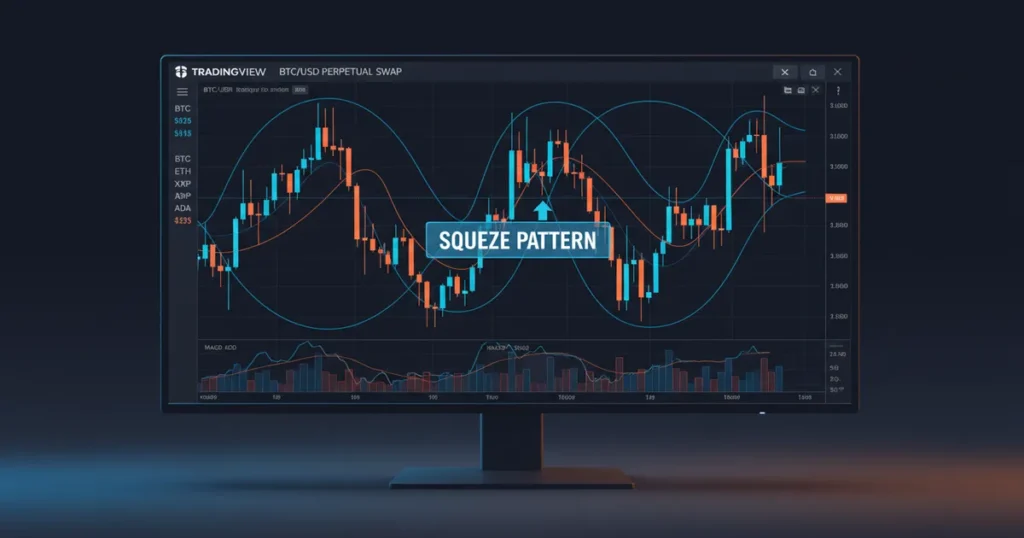
Strategy 2: The Bollinger Squeeze Breakout
This is my favorite setup. When bands contract tightly, volatility is compressing. The market is coiling like a spring.
When it works: After prolonged consolidation periods.
How to trade it:
- Identify periods where bands are unusually narrow
- Wait for price to break above the upper band (bullish) or below the lower band (bearish)
- Enter in the direction of the breakout
- Use the middle band as your trailing stop reference
The squeeze pattern preceded Bitcoin’s 2020-2021 bull run. Those tight bands in October 2020 were screaming that something big was coming.
Strategy 3: Band Walking in Strong Trends
This is where I lost $8,000. Let me save you from the same mistake.
During strong trends, price doesn’t bounce off the bands. It walks along them. Upper band walks happen in bullish trends. Lower band walks happen in bearish trends.
My $8,000 mistake: Bitcoin was climbing in early 2021. Price touched the upper band, and I thought, “Overbought. Time to sell.” I sold around $42,000. Bitcoin kept walking that upper band all the way to $64,000.
I left roughly $8,000 in unrealized gains on the table because I treated a band touch as a sell signal instead of a continuation signal.
How to trade band walks:
- Identify the trend direction first (use the MACD indicator for confirmation)
- In uptrends, buy dips to the middle band instead of selling upper band touches
- In downtrends, sell rallies to the middle band instead of buying lower band touches
- Exit only when price crosses through the middle band decisively
Strategy 4: Double Bottoms and M-Tops
Bollinger Bands help identify W-bottoms and M-top reversal patterns.
W-Bottom (Bullish Reversal):
- Price makes a low at or below the lower band
- Bounces to the middle band
- Makes a second low that stays above the lower band
- Breaks above the middle band
M-Top (Bearish Reversal):
- Price makes a high at or above the upper band
- Pulls back to the middle band
- Makes a second high that stays below the upper band
- Breaks below the middle band
The key is that second touch. If it’s weaker than the first (doesn’t reach the band), momentum is fading. Confirmation comes when price breaks the middle band.
Optimal Bollinger Bands Settings for Crypto Trading
Default settings are 20-period SMA with 2 standard deviations. For stocks, this works great. For crypto, you might need adjustments.
Default Settings vs Crypto-Adjusted Settings
| Setting | Period | Standard Deviation | Best For |
|---|---|---|---|
| Default | 20 | 2.0 | Large caps, Bitcoin |
| High Volatility | 20 | 2.5-3.0 | Altcoins, meme coins |
| Day Trading | 10 | 1.5 | Scalping, quick trades |
| Swing Trading | 50 | 2.5 | Multi-week positions |
Day Trading vs Swing Trading Settings
For day trading, a 10-period SMA with 1.5 standard deviations gives you more signals. The bands are tighter and more responsive to short-term moves.
For swing trading strategies, bump up to 50-period SMA with 2.5 standard deviations. This smooths out noise and focuses on significant moves.
Adjusting for High-Volatility Coins
Trading Solana or Dogecoin? Widen those bands to 2.5 or 3 standard deviations. These assets can stay “overbought” or “oversold” for extended periods.
Don’t over-optimize though. I’ve watched traders tweak settings endlessly, chasing past performance. Find settings that work for your timeframe and stick with them.
Combining Bollinger Bands with Other Indicators
Bollinger Bands should never be your only indicator. They measure volatility and price position. You need other tools for confirmation.
Bollinger Bands + RSI (Overbought/Oversold Confirmation)
This is my go-to combination. The RSI indicator confirms what Bollinger Bands suggest.
Strong buy signal: Price at lower band AND RSI below 30.
Strong sell signal: Price at upper band AND RSI above 70.
When both indicators agree, probability shifts in your favor. When they disagree, stay cautious.
Bollinger Bands + MACD (Trend Confirmation)
Before using the Bollinger Bounce strategy, check MACD. Is it showing a trending or ranging market?
Mean reversion works in ranges. Band walking happens in trends. MACD helps you identify which environment you’re in.
Bollinger Bands + Volume (Breakout Validation)
Squeeze breakouts need volume confirmation. A breakout on low volume is suspect. A breakout with volume 2-3x average? That’s conviction.
I’ve been faked out by countless low-volume breakouts. Now I wait for volume to validate the move before committing capital.
Common Bollinger Bands Mistakes (And How to Avoid Them)
Every mistake on this list cost me or someone I know real money. Learn from our pain.
Mistake 1: Treating Bands as Simple Support/Resistance
The bands aren’t fixed levels. They’re dynamic. Price touching the upper band today means something different than touching it last week because the bands have moved.
Don’t set limit orders at band levels like you would at horizontal support. Context matters.
Mistake 2: Selling on Upper Band Touch in Strong Trends
I already told you about my $8,000 lesson. Price can walk along the upper band for weeks during strong trends. A touch is not a signal. It’s information.
Good trading psychology means accepting that you’ll miss some tops and bottoms. Trying to catch every reversal is a losing game.
Mistake 3: Ignoring Market Context
Bollinger Bands during a bear market mean something different than during a bull market. The same pattern can have opposite implications depending on the broader trend.
Always zoom out. What’s the weekly chart saying? Monthly? Don’t trade lower timeframe Bollinger signals against higher timeframe trends.
Mistake 4: Using Bollinger Bands in Isolation
No single indicator wins consistently. Bollinger Bands tell you about volatility and relative price position. They don’t tell you trend direction or momentum strength.
Combine them. Confirm them. Use proper risk management strategies regardless of how good the setup looks.
Real Example: Using Bollinger Bands on Bitcoin
Let me walk you through a setup I would take today.
The Setup: Bitcoin has been consolidating for three weeks. Bollinger Bands have contracted to their tightest point in 60 days. This is a textbook squeeze.
What I’m Watching For:
- A 4-hour close above the upper band with increased volume
- RSI crossing above 50 to confirm bullish momentum
- MACD histogram turning positive
Entry: On the confirmed breakout above the upper band.
Stop-Loss: Below the middle band (20-period SMA). If price falls back through, the breakout failed.
Take-Profit: I typically use 1.5x to 2x the width of the bands at breakout as my initial target.
An academic study on Bitcoin halving patterns found a 92.47% success rate using Bollinger Bands with proper entry confirmation. That’s exceptional for any technical indicator.
Best Platforms and Tools for Bollinger Bands Analysis
You don’t need expensive software. Here’s what works:
TradingView: My primary charting platform. Free tier is sufficient for Bollinger Bands analysis. The indicator library is excellent.
Exchange Built-In Charts: Binance and Coinbase Pro have decent built-in charting with Bollinger Bands. Not as customizable as TradingView, but functional.
Adding Bollinger Bands to Your Charts:
- Open your charting platform
- Click “Indicators” or the fx button
- Search “Bollinger Bands”
- Adjust settings based on your trading style (refer to the table above)
Recommended Timeframes:
- Day trading: 15-minute to 1-hour charts
- Swing trading: 4-hour to daily charts
- Position trading: Daily to weekly charts
Frequently Asked Questions
What are the best Bollinger Bands settings for crypto?
For Bitcoin and large caps, stick with the default 20-period, 2 standard deviations. For volatile altcoins, widen to 2.5 or 3 standard deviations. Day traders can tighten to 10-period, 1.5 standard deviations for more signals.
Can you day trade with Bollinger Bands?
Yes. Use tighter settings (10-period, 1.5 SD) on 15-minute or 1-hour charts. Focus on squeeze breakouts and mean reversion during ranging periods. Always confirm with volume and a secondary indicator like RSI.
Do Bollinger Bands work in bear markets?
Absolutely. In bear markets, watch for lower band walks during downtrends and M-top patterns at resistance. The same principles apply, just inverted. Mean reversion to the middle band often provides short-selling opportunities.
How do you combine Bollinger Bands with RSI?
Look for agreement between the two indicators. Price at the lower band with RSI below 30 is a stronger buy signal than price at the lower band with RSI at 50. Divergences between price making lower lows while RSI makes higher lows can signal reversals.
What is a Bollinger Squeeze?
A Bollinger Squeeze occurs when the bands contract tightly, indicating low volatility. This compression often precedes explosive breakouts in either direction. Identify squeezes by looking for the narrowest band width in the past 50-100 periods.
Ready to Apply Bollinger Bands to Your Trading?
Bollinger Bands won’t make you profitable on their own. But combined with proper risk management, confirmation indicators, and the discipline to wait for quality setups, they’re a powerful tool for reading volatility.
Start with paper trading. Get comfortable identifying squeezes, bounces, and band walks before risking real capital. The patterns repeat across all timeframes and all crypto assets.
If you found this guide helpful, I’d recommend diving into my breakdown of the RSI indicator next. It pairs perfectly with Bollinger Bands for confirmation signals. And if you’re serious about managing risk, my piece on risk management strategies covers the framework that’s kept me in the game through multiple bear markets.
The indicator is just a tool. Your edge comes from how you use it.