What is Relative Strength Index (RSI) in Crypto (And Why I Stopped Trusting It Blindly)
Learn what RSI (Relative Strength Index) means in crypto trading. I'll explain overbought/oversold signals, divergence strategies, and the mistakes that cost me $6,000.

In this article
The Relative Strength Index (RSI) is one of the first indicators every crypto trader learns. It’s also one of the first that cost me money. Understanding what RSI means in crypto trading seems straightforward: it measures momentum on a scale of 0 to 100. But the real question isn’t what it is. It’s knowing when to trust it and when it’s lying to you.
I remember staring at my screen in early 2021, watching RSI hit 72 on Bitcoin. Every YouTube video I’d consumed told me that meant “overbought.” So I sold. Then I watched BTC climb another 40% without me. That lesson cost me roughly $6,000 in missed gains. And it taught me something the textbooks never will: RSI is a tool, not a crystal ball.
Let me break down what this momentum indicator actually tells you, how to read it correctly, and the specific mistakes I made so you don’t have to repeat them.
The RSI Indicator Explained (Created by a Legend in 1978)
J. Welles Wilder created the RSI in 1978 and published it in his book New Concepts in Technical Trading Systems. Forbes called him “the premier technical trader publishing his work today” in 1980. The man knew what he was doing.
Here’s the thing about Wilder: he wasn’t just some academic. He was a mechanical engineer who applied mathematical rigor to markets. And he gave us a warning that most traders ignore:
“Letting your emotions override your plan or system is the biggest cause of failure.” — J. Welles Wilder Jr.
That quote hit different after my 2021 mistake. I had no plan. I just saw a number and reacted.
How RSI is Calculated (The Formula Behind the Numbers)
The RSI formula looks intimidating but it’s actually simple logic:
RSI = 100 – [100 / (1 + Average Gain / Average Loss)]
By default, it measures the past 14 periods. Whether that’s 14 candles on a 5-minute chart or 14 days on a daily chart depends on your timeframe. The calculation compares the size of recent gains against recent losses to measure momentum.
Understanding the 0-100 Scale
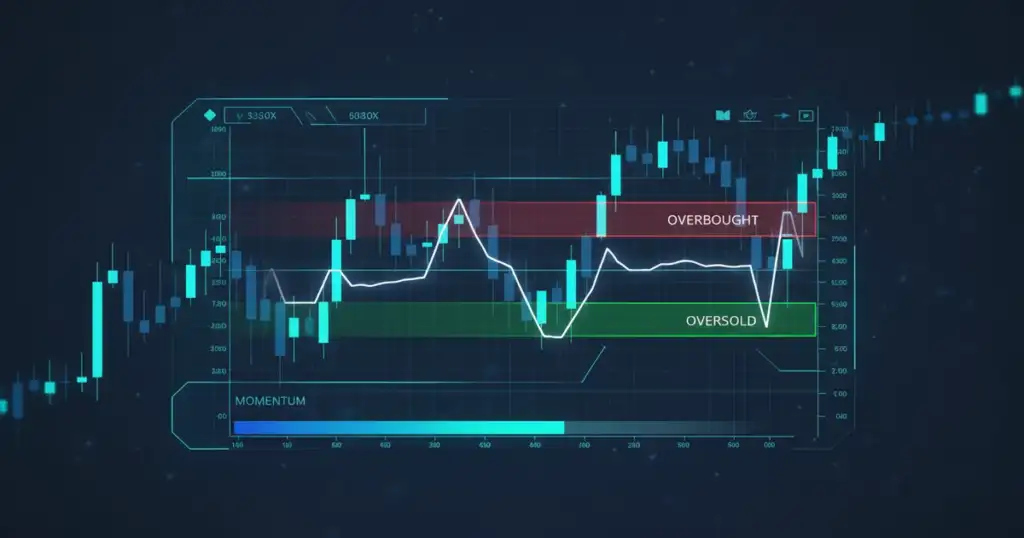
RSI ranges from 0 to 100:
- 0-30: Traditionally considered oversold (price may bounce)
- 30-70: Neutral zone (no strong directional signal)
- 70-100: Traditionally considered overbought (price may drop)
But here’s where crypto gets weird. These traditional levels were designed for stocks. Crypto doesn’t play by the same rules.

How to Read RSI in Crypto Trading
Reading RSI seems straightforward until you try to trade with it. The nuance matters more than the number.
The Classic 70/30 Rule (And Why It Fails in Crypto)
Traditional technical analysis teaches that RSI above 70 means “overbought” and below 30 means “oversold.” In stable markets like the S&P 500, this works reasonably well.
In crypto? Those numbers are almost useless.
Bitcoin has spent weeks with RSI above 70 during bull runs. Selling at 70 during the 2020-2021 cycle meant missing the entire move from $20,000 to $60,000. Many experienced traders now use 80/20 or even 90/40 thresholds for volatile assets.
Overbought vs Oversold Conditions
Here’s what these conditions actually mean:
Overbought (RSI above 70-80): Recent gains have been larger than losses. Price momentum is strong to the upside. This is a warning, not a sell signal.
Oversold (RSI below 20-30): Recent losses outpace gains. Price momentum is weak. This is an alert, not a buy signal.
The key word is “momentum.” RSI measures the speed and magnitude of price changes. It doesn’t predict where price will go next.
RSI Timeframe Settings (5-Minute vs Daily Charts)
Your timeframe changes everything about RSI signals:
- 5-minute charts: More signals, more noise, more false positives. Good for scalping, but expect whipsaws.
- 1-hour charts: Balanced signal frequency. Popular for day trading and swing trades.
- Daily charts: Fewer signals, higher reliability. Best for position trades and macro analysis.
I stick to 4-hour and daily timeframes for most of my RSI analysis. The shorter timeframes just generate too much noise for my trading psychology to handle.
Real Bitcoin RSI Examples (November 2024 Peak Analysis)
Let me show you RSI in action with recent data that’s still fresh in my memory.
When RSI Hit 76 at $110,000 BTC
On November 22, 2024, Bitcoin’s daily RSI reached 76 as price peaked near $110,000. This was a textbook overbought reading. If you’d been following the classic 70/30 rule, you’d have been nervous.
And in this case, the signal worked.
The $78,500 Drop That Followed
Within weeks, Bitcoin dropped to $78,500. That’s roughly a 29% correction. Traders who respected the overbought warning and either took profits or tightened stops protected their capital.
But here’s the context that matters: by April 2025, RSI crossed back above 50 as Bitcoin broke above $100,000 again. That RSI cross above 50 confirmed bullish momentum had returned. The indicator gave both the warning and the confirmation.
Historical examples show similar patterns. The 2017 peak near $20,000 and the 2021 peak near $65,000 both showed bearish divergence on RSI before major corrections.
RSI Divergence (The Signal That Actually Works)
If there’s one RSI technique worth mastering, it’s divergence. This is where price and RSI tell different stories, and that conflict often predicts what happens next.
Bullish Divergence Explained
Bullish divergence happens when price makes a lower low, but RSI makes a higher low. This suggests selling pressure is weakening even as price keeps falling.
November 2022 gave us a perfect example. Bitcoin hit its cycle bottom around $15,500. The price was making a lower low compared to June. But RSI? It showed a higher low. That divergence signaled the selling exhaustion before the 2023-2024 rally began.
Bearish Divergence Explained
Bearish divergence is the opposite. Price makes a higher high, but RSI makes a lower high. This shows momentum is fading even as price climbs.
Both the November 2017 peak and April 2021 peak displayed bearish divergence. Price kept pushing higher, but RSI couldn’t confirm the strength. Within weeks of each divergence, significant corrections followed.
Hidden Divergence (Trend Continuation)
Hidden divergence is less talked about but equally useful. It signals trend continuation rather than reversal:
- Hidden bullish: Price makes a higher low while RSI makes a lower low (uptrend continues)
- Hidden bearish: Price makes a lower high while RSI makes a higher high (downtrend continues)
Divergence works best on 1-hour or higher timeframes. On lower timeframes, you’ll get too many false signals to trade profitably.
Common RSI Mistakes That Cost Me Money
I’ve made every RSI mistake in the book. Let me save you from the same expensive lessons.
Selling Too Early in Strong Trends
This was my $6,000 mistake. In early 2021, I saw RSI hit 72 on Bitcoin and sold my position. Classic “overbought” reading, right?
Bitcoin then rallied from around $40,000 to $64,000 without me. RSI stayed above 70 for weeks. In strong bull markets, overbought can stay overbought for a very long time.
The lesson: overbought doesn’t mean “sell now.” It means “momentum is hot, so be careful.” There’s a difference.
Using RSI in Isolation
Research on RSI effectiveness in crypto concluded that relying on RSI as your only momentum indicator “entails significant risk.” That’s academic-speak for “you’ll lose money.”
RSI needs confirmation. It works best when combined with candlestick patterns, support and resistance levels, volume analysis, and broader market context.
Ignoring Market Context
Using the same RSI thresholds in a bear market and a bull market is a recipe for disaster. I adjust my expectations based on the regime:
Bull market thresholds: Consider 40 as oversold and 80-90 as overbought. Strong trends push extremes further.
Bear market thresholds: Stick closer to 30/70 or even 25/65. Rallies fail faster in downtrends.
How to Use RSI Effectively (My Personal Framework)
After years of trial and expensive error, here’s the framework I actually use.
Adjusting Thresholds for Volatile Crypto (80/20 Strategy)
For high-volatility assets like Solana, Dogecoin, and most altcoins, I use 80/20 thresholds instead of 70/30. This filters out false signals during normal volatility and only flags truly extreme conditions.
For Bitcoin and Ethereum, I use 75/25. They’re less volatile than altcoins but still more volatile than traditional markets.
Combining RSI with Other Indicators
RSI is one input in my decision-making process. Here’s what I combine it with:
- Support/resistance levels: RSI oversold at a major support level is stronger than RSI oversold in a vacuum
- Volume: RSI divergence confirmed by declining volume adds conviction
- Candlestick patterns: A hammer candle with RSI oversold is a stronger signal than either alone
- Sentiment indicators: I check the Fear and Greed Index alongside RSI for sentiment confirmation
Position Sizing Based on RSI Strength
When RSI gives a signal, I don’t go all-in. My position sizing depends on signal quality:
- Strong signal (RSI extreme + divergence + support/resistance): Larger position, maybe 3-5% of portfolio
- Moderate signal (RSI extreme + one confirmation): Standard position, 1-2% of portfolio
- Weak signal (RSI extreme alone): Small position or no trade at all
I also set stop losses based on price invalidation levels, not RSI reversals. If price breaks below support, I’m out regardless of what RSI says.
And when RSI does signal a potential top, I have a clear take profits strategy ready to execute. No more watching gains evaporate because I didn’t have a plan.
RSI FAQs
What is a good RSI for crypto?
There’s no universal “good” RSI number. In bull markets, RSI between 45-75 often indicates healthy upward momentum. In bear markets, RSI between 30-55 is more normal. Context matters more than absolute numbers.
Can RSI predict crypto prices?
No. RSI measures current momentum, not future prices. It tells you how strong recent price movement has been, which can hint at potential reversals or continuations. But it’s not a crystal ball.
What’s better, RSI or MACD?
They serve different purposes. RSI measures momentum strength. MACD measures trend direction and momentum changes. I use both. RSI for extremes and divergence, MACD for trend confirmation.
How accurate is RSI for crypto?
Research shows RSI has limited standalone accuracy in crypto markets. The high volatility creates more false signals than traditional markets. RSI works best when combined with other analysis tools and adjusted thresholds.
Start Using RSI the Right Way
RSI is a powerful tool when you understand its limitations. It shows momentum, not direction. It warns of extremes, not reversals. And it works best as one piece of a larger analytical framework.
The $6,000 lesson I learned in 2021 came down to this: I treated RSI as a trading signal when it’s really just market commentary. Once I shifted my mindset, my results improved dramatically.
If you’re building out your technical analysis toolkit, start with the basics. Learn to read candlestick patterns alongside RSI. Develop solid trading psychology so you don’t override your system when emotions spike. And make sure you’re trading on platforms with proper charting tools, like the best crypto exchanges for trading.
RSI isn’t magic. But used correctly, it’s one of the most useful indicators in your arsenal. Just don’t make my mistake of treating a warning like a command.