How to Read Bitcoin Fear and Greed Index (The Sentiment Tool That Saved Me from FOMO)
Learn how to read the Bitcoin Fear and Greed Index with this step-by-step guide. Discover how I use this sentiment tool to time entries and exits, avoid FOMO, and spot market extremes.

In this article
Introduction
I’ll never forget November 2021. Bitcoin was pumping toward $68,000, my portfolio was up more than I ever imagined, and the Bitcoin Fear and Greed Index sat at 84. Extreme greed. Every fiber of my trading education screamed “take profits.” But I didn’t listen. I was high on hopium, convinced we’d hit $100K by Christmas.
Three months later, I watched half those gains evaporate. That painful lesson taught me something I should have already known: learning how to read the Bitcoin Fear and Greed Index isn’t just about understanding a number on a screen. It’s about mastering fear and greed in trading within yourself.
Today, I’m going to show you exactly how this sentiment tool works. You’ll learn what the index measures, how to interpret its signals, and most importantly, how to actually use it without making the same mistakes I did. Because trust me, this indicator has saved me from countless FOMO trades since that humbling November.
What is the Bitcoin Fear and Greed Index?
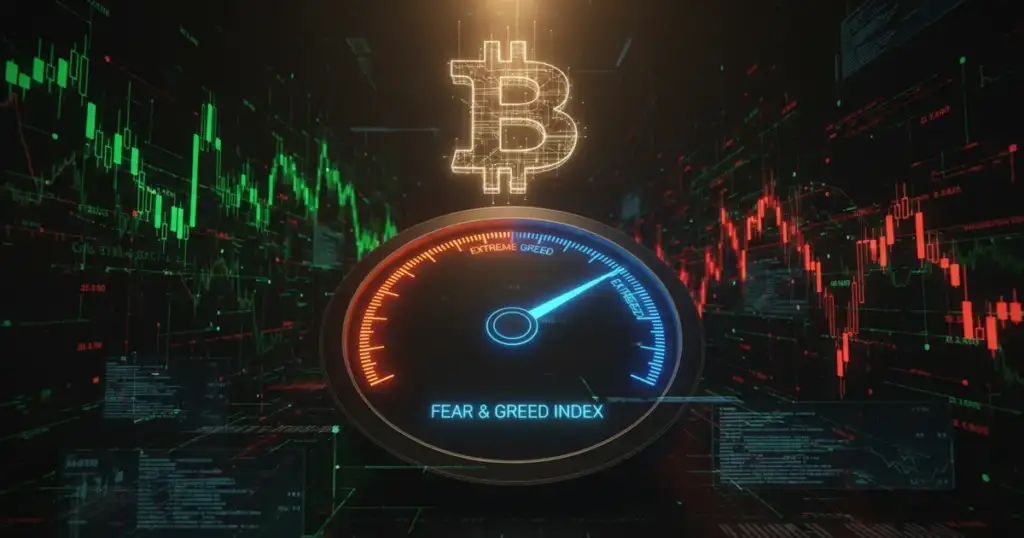
The Bitcoin Fear and Greed Index is a daily snapshot of market sentiment in the crypto space. It runs on a simple scale from 0 to 100, where lower numbers mean fear and higher numbers mean greed.
The original version was created by Alternative.me. They adapted the concept from CNN’s stock market Fear and Greed Index. The idea is straightforward: when investors are fearful, they sell. When they’re greedy, they buy aggressively. Both extremes often create opportunities for patient traders.
Why do traders care about this thing? Because emotions drive short-term price movements more than most people admit. Bloomberg, Reuters, and CNBC regularly cite the Fear and Greed Index as a trusted measure of crypto market sentiment. It’s become one of those indicators that serious traders at least glance at before making moves.
The real power isn’t in the daily number though. It’s in understanding what drives that number and how to read it in context. Let me break down exactly how this thing is calculated.
How the Fear and Greed Index is Calculated
The index isn’t just measuring vibes. There’s actual methodology behind the madness, and understanding each component helps you read the index more intelligently.
The Six Components That Drive the Index
Here’s what goes into the calculation:
- Volatility (25%): Compares current volatility and max drawdowns to 30-day and 90-day averages. Higher volatility signals fear.
- Market Momentum/Volume (25%): Looks at buying volume and momentum. Strong buying pressure indicates greed.
- Social Media (15%): Analyzes Twitter sentiment, hashtag engagement, and interaction rates. Hype equals greed.
- Bitcoin Dominance (10%): When money flows from Bitcoin into altcoins, that signals speculation and greed. Rising dominance suggests fear as investors seek safety. This component is closely tied to altcoin season patterns.
- Google Trends (10%): Tracks search queries related to Bitcoin. Spikes in searches for “Bitcoin crash” signal fear. Spikes for “Bitcoin price prediction” suggest greed.
- Surveys (15%): Currently paused, but historically polled crypto investors directly about their sentiment.
Each component gets weighted and combined into that single 0-100 number you see. Understanding this helps you interpret why the index moves. If you see a spike in social media hype but stable volatility, you know what’s driving the reading.
Understanding the Index Levels
The index breaks down into five zones:
- Extreme Fear (0-24): Panic selling, maximum pessimism, potential buying opportunity
- Fear (25-49): Caution in the market, investors are nervous
- Neutral (50): Balanced sentiment, neither fear nor greed dominates
- Greed (51-74): Optimism rising, buyers getting aggressive
- Extreme Greed (75-100): Euphoria, FOMO everywhere, potential selling opportunity
Memorize those ranges. They’re your roadmap for reading the index quickly.

How to Read the Fear and Greed Index (Step-by-Step)
Reading the index isn’t complicated, but there’s a right way to do it. Here’s my process after years of using this tool.
Step 1: Access the Index
Your go-to source is the Alternative.me Fear and Greed Index. It’s free, updates daily, and shows you the current reading with a nice visual gauge.
You can also find versions on most major exchanges and on CoinMarketCap (which we’ll cover later because they use different methodology). I prefer Alternative.me for consistency, but checking multiple sources doesn’t hurt.
Step 2: Check the Historical Chart
Here’s where beginners mess up. They look at today’s number in isolation. That’s like checking the weather once and planning your whole week around it.
Scroll down to the historical chart. Look at the past 30 days minimum. Better yet, look at the past 90 days. You’re looking for trends, not snapshots.
Ask yourself: Is the index trending up or down? Has it been stuck in one zone for a while? Are there sudden spikes that might be temporary reactions to news?
Step 3: Compare to Bitcoin Price Action
This is where things get interesting. Pull up a Bitcoin price chart alongside the Fear and Greed Index history. Look for divergences.
If Bitcoin price is dropping but fear isn’t increasing much, that could signal the selloff is running out of steam. If price is rising but greed is cooling off, buyers might be getting cautious despite higher prices.
Divergences often precede trend changes. I’ve learned to pay close attention when sentiment and price tell different stories.
Step 4: Look at Time Duration
Single readings mean almost nothing. Duration matters enormously.
During the 2022 bear market, the index stayed in Extreme Fear for over 70 consecutive days. That wasn’t a signal to buy every dip. It was a signal that we were in a prolonged downturn requiring bear market survival strategies.
When sentiment stays extreme for extended periods, respect that. Markets can stay irrational longer than you can stay solvent.
How to Use the Fear and Greed Index in Trading
Now we get to the practical stuff. How do you actually trade around this indicator?
The Contrarian Approach
“Be fearful when others are greedy and greedy when others are fearful.” – Warren Buffett
This quote is the foundation of contrarian investing. The Fear and Greed Index essentially quantifies what Buffett was talking about.
The logic is simple. When everyone is panicking and selling (extreme fear), prices often get pushed below fair value. When everyone is euphoric and buying (extreme greed), prices often exceed fair value. Patient traders can profit from these emotional extremes.
But here’s what the textbooks don’t tell you: contrarian trading is psychologically brutal. Buying when everyone screams “sell everything” takes serious conviction. Selling when your portfolio is pumping and Twitter is celebrating takes even more discipline.
Timing Your Entries
When the index drops into Extreme Fear (0-24), I start paying very close attention. This doesn’t mean I immediately buy with both hands. It means I start building positions through dollar-cost averaging.
My personal rule: when fear goes below 25, I start my DCA buys. When it drops below 15, I get more aggressive. Below 10 is rare and usually marks significant bottoms. The index hit 6 in June 2022, and that turned out to be near the bear market low.
The key is spreading your entries. Don’t try to catch the exact bottom. Nobody can time it perfectly.
Timing Your Exits
Extreme greed (75-100) is my warning sign. This is when I start thinking about taking profits systematically.
I don’t sell everything the moment greed hits 75. Markets can stay greedy for weeks. But I do start scaling out. Maybe I take 10-20% profits when we enter extreme greed. If it stays elevated, I continue trimming.
Remember my November 2021 story? The index stayed above 75 for several days before the crash. There was plenty of time to take profits. I just didn’t. Don’t be like old me.
Combining with Other Indicators
The Fear and Greed Index works best when combined with other tools. I never trade on sentiment alone.
Here’s what I use alongside it:
- Technical analysis: Support/resistance levels, moving averages, RSI. If extreme fear hits right at a major support level, that’s a stronger signal than fear alone.
- On-chain analysis: Whale movements, exchange flows, miner behavior. These metrics tell you what big players are actually doing, not just feeling.
- Position sizing strategy: I adjust my position sizes based on sentiment. Smaller positions during neutral periods, larger during extremes when conviction is higher.
No single indicator should drive your decisions. Build a toolkit and look for confluence.
Common Mistakes When Reading the Fear and Greed Index
I’ve made all of these mistakes. Learn from my expensive education.
Mistake #1: Using It as Your Only Signal
The index is one data point. It doesn’t know about upcoming regulatory announcements, protocol upgrades, or macroeconomic shifts. Using it in isolation is like driving while only looking at your speedometer.
Mistake #2: Expecting Immediate Reversals
Extreme readings don’t trigger instant price reversals. I’ve seen traders buy the moment fear goes extreme, then watch prices drop another 20%. The index tells you sentiment, not timing.
Mistake #3: Ignoring Extended Fear/Greed Periods
Sometimes extreme sentiment is justified. During genuine bear markets or euphoric bull runs, the index can stay at extremes for months. Don’t fight the trend just because the index looks extreme.
Mistake #4: Trading Against Your Risk Tolerance
Just because the index says “extreme fear” doesn’t mean you should bet the farm. Your stop-loss discipline and risk management rules should never be overridden by sentiment indicators. Personal risk tolerance trumps any indicator reading.
Real Examples: Fear and Greed Index at Market Extremes
Let me show you how this played out in actual markets. These examples are burned into my memory.
November 2021: Extreme Greed (84) Before the Crash
Bitcoin hit $68,000 on November 10, 2021. The Fear and Greed Index reached 84. Twitter was celebrating. Everyone was calling for $100K. I remember the exact feeling. Pure euphoria.
Within three months, Bitcoin crashed over 50%. That 84 reading was one of the clearest warning signs imaginable. The index was screaming “take profits” and most of us, including me, ignored it.
June 2022: Extreme Fear (6) at the Bottom
Fast forward to June 2022. Bitcoin had crashed to around $17,000. The index hit an all-time low of 6. Not 16. Six. Absolute maximum fear.
If you were following contrarian principles, this was a generational buying opportunity. The index stayed in Extreme Fear for over 70 days that summer. Patient buyers who accumulated during that period are sitting on massive gains today.
January 2025: Bitcoin at $126K with Index at 71
Here’s something interesting about the current cycle. As I write this in 2025, Bitcoin has reached approximately $126,000. You’d expect extreme greed, right? But the index sits around 71. That’s greed, but not extreme greed.
This suggests the market is more cautious this time around. Institutional money has matured the market. Fewer retail traders are YOLOing their life savings. The sentiment is bullish but measured. Whether that means more upside remains or a top is forming, only time will tell.
Alternative Fear and Greed Index Tools
Alternative.me isn’t the only game in town. CoinMarketCap’s Fear and Greed Index uses a completely different methodology.
Their version focuses on:
- Price Momentum: Tracking the top 10 cryptocurrencies
- Volatility: Using BVIV and EVIV for Bitcoin and Ethereum
- Derivatives Market: Put/Call ratio analysis
- Market Composition: Stablecoin supply ratio
Neither methodology is “right.” They measure different aspects of sentiment. I check both when making significant decisions. Divergences between the two can be informative.
Some exchanges also provide their own sentiment tools. Binance has sentiment trackers. These can give you platform-specific insights about what traders on that exchange are doing.
Limitations of the Fear and Greed Index
Let me be real with you. This indicator has serious limitations.
It’s a lagging indicator. The index reflects what happened recently, not what’s about to happen. By the time extreme fear shows up, the selloff has already occurred.
It can stay extreme for extended periods. Markets don’t respect your timeline. Extreme readings can persist for weeks or months before reverting.
It doesn’t account for black swan events. The index couldn’t predict the FTX collapse or Terra/Luna implosion. Unexpected catalysts can override any sentiment reading.
It’s more reactive than predictive. The index responds to news events and short-term changes. It’s less useful for identifying long-term trend shifts.
Use it as one tool among many. Never let it override your fundamental risk management principles.
Conclusion
The Bitcoin Fear and Greed Index is a powerful contrarian tool when used correctly. It quantifies market emotions that would otherwise be hard to measure. It gives you a framework for thinking about when to buy, when to sell, and when to wait.
But here’s what I’ve learned the hard way: the index is only as good as your discipline. In November 2021, I had all the information I needed. The index was screaming extreme greed. I just didn’t want to listen.
Today, I treat extreme readings as mandatory action triggers. Not panic buttons, but prompts to execute my pre-planned strategy. When fear goes extreme, I start my DCA buys. When greed goes extreme, I start taking profits. No emotions, just execution.
Combine this indicator with proper technical analysis, on-chain data, and solid risk management. Don’t use it alone. Don’t expect perfect timing. And definitely don’t override your rules just because the index tells you what you want to hear.
Ready to Build Better Trading Habits?
If you found this guide helpful, check out my deep-dive on crypto trading psychology to understand why we make emotional trading decisions. You might also want to explore position sizing strategies to protect your capital during volatile markets.