Web3 Explained: Crypto, DeFi, and the Future of the Internet
Web3 explained simply: the decentralized internet built on blockchain, DeFi, NFTs, and DAOs — and what it actually means for your money.

In this article
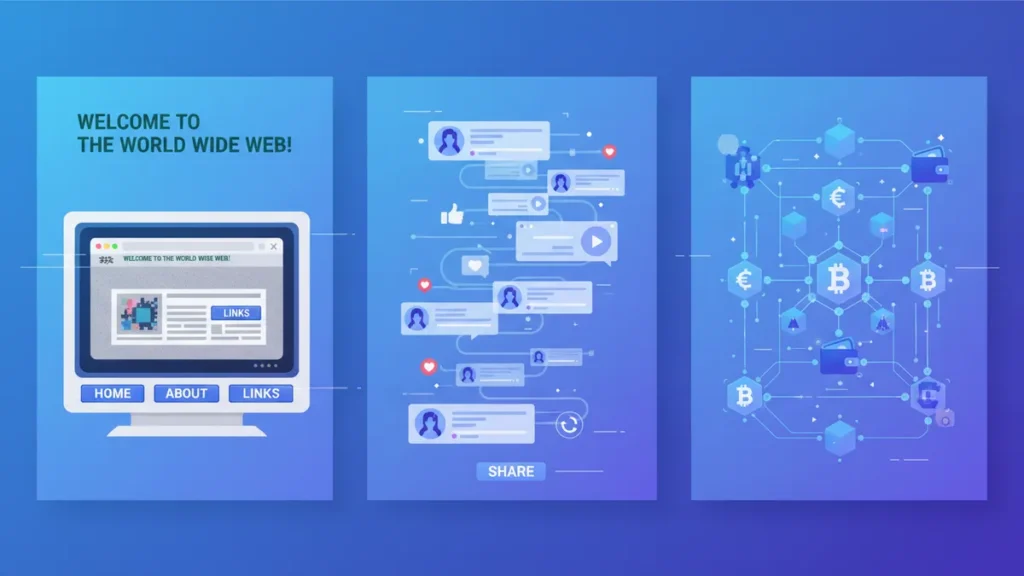
If you’ve spent any time in crypto circles, you’ve probably heard the term Web3 thrown around like it’s the second coming. But what does Web3 actually mean? I remember sitting in a Discord voice chat back in 2021, listening to someone explain it for twenty minutes, and walking away more confused than when I started. So let me do what that person didn’t: give you Web3 explained in plain English, with real examples, honest downsides, and zero hype. The concept was first coined by Gavin Wood, Ethereum’s co-founder, back in 2014. His vision? A decentralized internet where users own their data, their assets, and their identity.
There’s one thing most Web3 explainers get wrong, though. They either sell you a utopia or scare you off entirely. I’m going to give you the middle ground, because that’s where the truth actually lives. And in the final section, I’ll share where I think this is all headed in 2026 and beyond.
The Internet’s Three Eras: Web1, Web2, and Web3
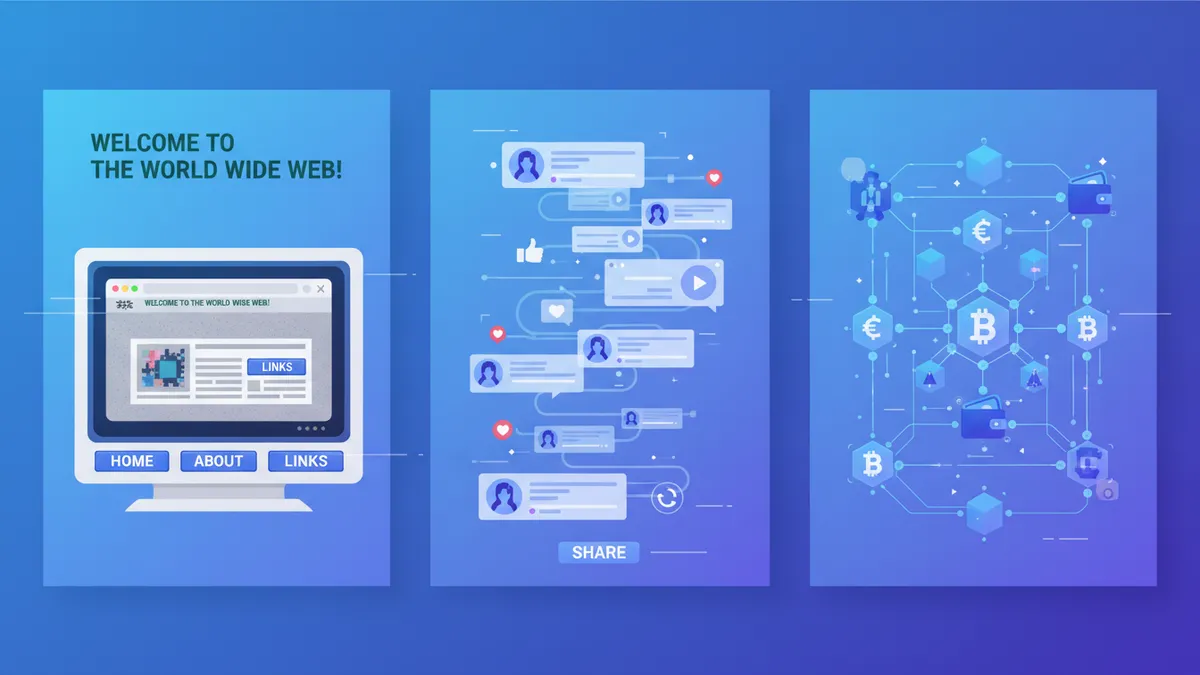
To understand Web3, you need to see where it came from. The internet has evolved through three distinct phases, and each one fundamentally changed how we interact with information.
Web1: Read-Only (1991-2004)
The early internet was basically a digital library. You could read pages, click links, and that was about it. No comments. No profiles. No algorithms deciding what you see. If you’re old enough to remember GeoCities or AltaVista, you lived through this era. It was simple, clunky, and honestly kind of beautiful in its rawness.
Web2: Read-Write and the Data Trap (2004-Present)
Then came the platforms. Facebook, YouTube, Twitter, Instagram. Suddenly you weren’t just reading the internet. You were creating it. Blog posts, status updates, photos, videos. The problem? You were building on rented land.
I learned this the hard way. Back in 2021, I was building a following on a social platform sharing trade analysis. One day, my content got shadowbanned with zero explanation. Months of work reaching an audience, gone overnight. The platform owned the audience I built. They owned my content distribution. They even owned my data. That was the moment Web2’s bargain clicked for me: free tools in exchange for total control.
Web3: Read-Write-Own
Web3 flips that model. Instead of platforms owning your data, you own it. Instead of trusting a company to keep your account active, you hold the keys yourself. The core idea is simple: add a layer of ownership and trust to the internet using blockchain technology. No middlemen. No gatekeepers. Your content, your assets, your rules.
The Building Blocks of Web3
Web3 isn’t one single technology. It’s a stack of interconnected pieces that work together. Here are the four you need to understand.
Blockchain: The Immutable Public Ledger
A blockchain is a shared record book that no single company controls. Every transaction gets recorded, verified by a network of computers, and locked in permanently. Think of it like a Google Doc that everyone can read but nobody can secretly edit. If you want to understand how blockchains reach consensus on what’s true, that’s a whole topic on its own. But the key takeaway: blockchains create trust without needing a trusted middleman.
Smart Contracts: Code That Enforces Itself
Smart contracts are programs that run on the blockchain. They execute automatically when conditions are met. No lawyers. No paperwork. No “the check is in the mail.” If A happens, then B happens. Period. Ethereum’s programmable blockchain is where most smart contracts live today. They power everything from lending platforms to insurance protocols to NFT marketplaces.
Decentralized Apps (dApps): No Server, No CEO
Regular apps run on company servers. If Facebook’s servers go down, Facebook goes down. dApps run on the blockchain itself. No single point of failure. No CEO who can change the rules overnight. Examples you can use right now include Uniswap’s decentralized exchange for trading and Aave’s lending protocol for borrowing and lending crypto.

Crypto Wallets: Your Web3 Identity
In Web2, your identity is your email and password. In Web3, it’s your crypto wallet. No username. No password reset button. Just a pair of cryptographic keys that prove you are who you say you are. This is incredibly powerful and incredibly unforgiving. Lose your keys, lose everything. There’s no customer service hotline to call.
Web3 in Action: Five Real Use Cases Right Now
Web3 isn’t just theory. People are using it today to do things that were impossible five years ago. Here are five use cases that actually matter.
Decentralized Finance (DeFi): Banking Without Banks
Decentralized finance (DeFi) is probably the most mature Web3 use case. It lets you lend, borrow, trade, and earn interest on your crypto without a bank or broker in the middle. Want to earn yield on your holdings? Yield farming and liquid staking are two popular ways to put your crypto to work in DeFi.
I started experimenting with DeFi lending protocols in early 2022. The first time I deposited stablecoins into a lending pool and watched interest accrue in real time, no bank involved, it felt like the first time I sent an email in the ’90s. A genuine “wait, this actually works?” moment.
NFTs: True Digital Ownership
I know, I know. You’re picturing overpriced monkey JPEGs. But NFTs and digital ownership go way beyond profile pictures. An NFT is simply a unique token on the blockchain that proves you own something. That “something” could be art, a concert ticket, a software license, a real estate deed, or a membership pass. The technology is sound even if the 2021 speculation got ridiculous.
DAOs: Organizations Governed by Code
DAOs and decentralized governance are one of Web3’s most fascinating experiments. A DAO is an organization where decisions are made by token holders voting on proposals. No board of directors. No executive override. The rules are written in smart contracts that execute automatically. It’s messy, it’s slow, and it’s genuinely democratic in a way traditional corporate structures aren’t.
Real-World Asset (RWA) Tokenization
This is where Web3 starts touching the “real” economy. Real-world asset (RWA) tokenization means putting physical assets like real estate, bonds, or invoices onto the blockchain. Projects like RealT let you buy fractional ownership of rental properties. Centrifuge tokenizes business invoices. These aren’t concepts. They’re live, generating real returns today.
Decentralized Identity and Data Ownership
Imagine controlling your own digital credentials without relying on Google or Apple. Self-sovereign identity lets you prove your age, your qualifications, or your credit history without handing your entire data profile to a corporation. It’s early, but it’s one of Web3’s most important long-term promises.
The Honest Downsides Nobody Talks About Enough
I wouldn’t be doing my job if I only gave you the highlight reel. Web3 has serious problems, and pretending otherwise would be dishonest.
Security: $3.1 Billion Stolen in H1 2025 Alone
The first half of 2025 saw over $3.1 billion stolen across Web3 platforms. Access control exploits accounted for $1.83 billion. Phishing attacks spiked to $600 million. NIST’s security perspective on Web3 highlights just how much work remains on the security front.
I speak from experience here. In late 2022, I clicked a phishing link disguised as a dApp approval and watched my wallet get drained in real time. It was a gut-punch lesson in what “you are your own bank” really means. The accountability cuts both ways. For more on how things can go wrong in DeFi, my articles on impermanent loss are worth reading.
User Experience Is Still Clunky
Gas fees. Seed phrases. Wallet setup. Chain bridging. The average person trying Web3 for the first time faces a wall of complexity that makes 1990s internet look user-friendly. Until someone builds the “iPhone moment” for Web3, mainstream adoption will stay limited.
Regulation Uncertainty
Governments worldwide are still figuring out how to regulate Web3. Some countries embrace it. Others ban it. Most are somewhere in between. This uncertainty creates real risk for builders and investors alike. Clear rules would actually help the space grow, but we’re not there yet.
My Honest Take: Hype vs. Reality in 2026
We’re past the hype cycle. The “Web3 will replace everything” crowd from 2021 has largely gone quiet. What’s left is actually more interesting: quiet infrastructure building by serious developers solving real problems.
The numbers tell a compelling story. The global Web3 market is projected to grow from $6.94 billion in 2026 to $176.32 billion by 2034, according to Web 3.0 market size projections from Fortune Business Insights. That’s a CAGR of nearly 50%. Gartner predicts 25% of enterprises will use Web3-wrapped services by 2027.
“Web3 is really sort of an alternative vision of the web, where the services that we use are not hosted by a single service provider company, but rather they’re sort of purely algorithmic things that are, in some sense, hosted by everybody.” – Gavin Wood, Ethereum Co-founder
My take? Web3 isn’t replacing the internet tomorrow. It’s adding a trust and ownership layer on top of the internet we already have. And that’s actually more useful than a full replacement. Position your Web3 exposure alongside your existing crypto portfolio, not instead of it. Diversification still matters, even in the decentralized world.
If you’re ready to start participating, check out our guide to the best crypto staking platforms as a practical first step. Staking is one of the simplest ways to earn yield in Web3 while supporting network security. And if you want to understand the broader DeFi landscape before jumping in, our breakdown of decentralized finance (DeFi) is a solid starting point.
The future of the internet is being built right now. It’s messy, risky, and genuinely exciting. And for the first time, you get to own a piece of it.