What Is RWA in Crypto: Real World Assets Tokenization Explained
Real world assets (RWA) in crypto are changing finance. Learn what RWA tokenization is, how it works, and why BlackRock and major banks are all in.

In this article
The Day I Realized Crypto Was Finally Growing Up
I was sitting in the back row at Bitcoin Miami 2023, nursing an overpriced cold brew, when a BlackRock executive took the stage and started talking about tokenizing U.S. Treasury bonds. Half the audience rolled their eyes. The other half pulled out their phones to check if BlackRock’s stock was moving. I remember thinking: “This is either the most boring thing crypto has ever done, or it’s the most important.” Turns out, understanding what is RWA in crypto would change how I think about this entire industry.
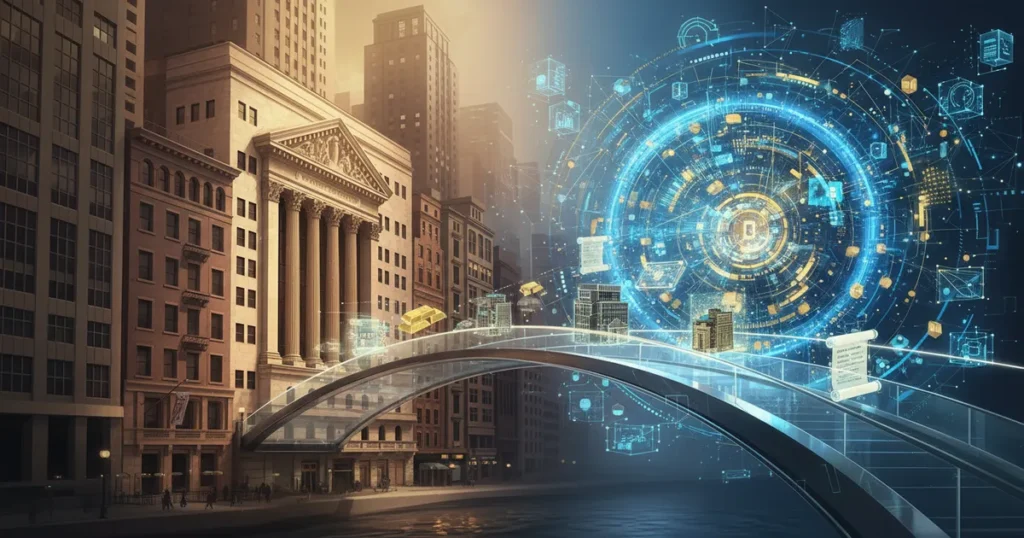
Real world assets in crypto aren’t just another narrative cycle. They’re the bridge between traditional finance and decentralized finance (DeFi), and the numbers behind them have grown from a rounding error to billions of dollars in locked value. This isn’t theoretical anymore. It’s live, it’s institutional, and it’s growing faster than almost any other sector in crypto.
Let me walk you through what RWA tokenization actually is, how it works under the hood, and whether it deserves a spot in your portfolio.
What Are Real-World Assets (RWA) in Crypto?
From Physical to Digital: The Core Concept
Real-world assets (RWA) in crypto are exactly what they sound like: tangible or financial assets from the traditional world, represented as digital tokens on a blockchain technology network. We’re talking about bonds, real estate, gold, private credit, equities, art, and more.
Here’s the key distinction most people miss. Unlike Bitcoin or Ethereum, which are native to blockchain, tokenized real-world assets derive their value from something that exists in the physical or financial world. The token is a digital representation of ownership, not the asset itself.
Think of it like a digital deed. You know the paper deed to a house? A tokenized RWA works the same way, except it can be transferred globally in seconds, divided into fractions, and tracked transparently on a public ledger.
What Counts as a Real-World Asset?
The range is broader than most people expect:
- U.S. Treasury bonds and government debt
- Real estate (commercial and residential)
- Gold and commodities
- Private credit and lending agreements
- Equities and fund shares
- Art, intellectual property, and invoices
If it has value in the real world and can be legally documented, someone is probably working on tokenizing it right now.
How Does RWA Tokenization Actually Work?
This is where most articles get vague. Let me break the process into three concrete steps, because understanding the mechanics matters when you’re evaluating risk.
Step 1: Off-Chain Formalization — Proving the Asset Is Real
Before anything touches a blockchain, the asset’s value and legal ownership must be verified in the real world. That means property valuations, legal documentation, custodial arrangements, and third-party audits.
Typically, a special purpose vehicle (SPV) or trust is created to hold the asset. This legal wrapper is critical. The SPV isolates the asset from the issuer’s other liabilities, which matters a lot if something goes wrong. I learned this lesson the hard way back in my early trading days: counterparty risk isn’t abstract until the counterparty disappears.
Step 2: Information Bridging — The Oracle Problem
Once the asset is legally structured, off-chain data like price, ownership status, and reserve verification needs to be fed onto the blockchain. This happens through oracle networks, with Chainlink being the dominant provider.

Here’s what most beginners don’t realize: the token is only as trustworthy as the data feeding it. If the oracle providing price data gets manipulated or goes offline, the on-chain token can freeze or show the wrong valuation. This is a real vulnerability, and it’s one reason on-chain analysis tools matter for tracking RWA health.
Step 3: Token Minting and Deployment on the Blockchain
Smart contracts mint tokens representing fractional ownership of the underlying asset. These tokens are deployed on-chain and become tradeable. Many RWA protocols deploy on Layer 2 networks like Polygon or Arbitrum to keep gas costs low.
One important nuance: when you buy a tokenized asset, the blockchain records the transfer. But the legal ownership change happens through the SPV or trust structure. Token holders typically hold a contractual claim, not direct title to the asset. That’s a distinction worth understanding before you put real money in.
What Types of Assets Are Being Tokenized Right Now?
Let me give you the actual numbers, because the growth here surprised even me.
Tokenized Treasuries and Bonds
$7.5 billion on-chain. This is the fastest-growing segment, up 539% from January 2024 to April 2025. BlackRock’s BUIDL fund leads with $2.88 billion in total value locked (TVL). These products offer yields comparable to traditional money market funds and index funds, but on programmable rails.
Private Credit
$14+ billion on-chain as of late 2025. This is the largest category by value. Centrifuge, Maple Finance, and Goldfinch are the key players. Think of it as on-chain lending to real businesses, backed by real collateral.
Commodities (Gold)
$2.9+ billion in tokenized gold alone. PAXG and XAUT account for over 80% of tokenized commodity activity. If you want gold exposure without storing bars in a safe, this is the on-chain version.
Real Estate
Fractional ownership of income-producing properties. Still early-stage, but the appeal is obvious: you could own a slice of a Manhattan commercial building for a few hundred dollars.
Equities and Emerging Categories
Tokenized stocks, intellectual property rights, and invoice financing are the next frontier. The CoinGecko 2025 RWA Report tracks nearly 650 RWA projects with a combined market cap of roughly $66.9 billion.
The Institutions Are Already Here — And the Numbers Prove It
When I first started covering crypto back in 2019, “institutional adoption” was a meme. Everyone talked about it. Nobody could prove it. That’s changed.
“The next generation for markets, the next generation for securities, will be tokenization of securities.” — Larry Fink, CEO, BlackRock
Larry Fink isn’t saying this from the sidelines. BlackRock launched BUIDL, a tokenized Treasury fund that now holds $2.88 billion in TVL and keeps growing. Franklin Templeton, Fidelity, and VanEck all have tokenized products live or in development. JPMorgan processes billions in tokenized repo transactions through its Kinexys platform.
The trajectory is hard to ignore. The on-chain RWA market grew from roughly $5.5 billion in early 2025 to $18.6+ billion by year-end, more than tripling. You can track these flows in real time on the RWA.xyz analytics dashboard.
Looking further out, McKinsey projects the tokenized RWA market could reach $2 trillion by 2030. Ripple and BCG forecast $18.9 trillion by 2033. Even the conservative estimate represents massive growth from where we are today. The parallel to how Bitcoin ETF strategies brought institutional capital into crypto is hard to miss.
The Real Risks of RWA Crypto (Don’t Skip This Section)
I wouldn’t be doing my job if I painted this as all upside. I’ve been burned enough times to know that understanding risks is more important than chasing returns. Here’s what can go wrong.
Regulatory and Legal Ambiguity
In most jurisdictions, RWA tokens are treated as securities. That means KYC/AML requirements apply, and the regulatory landscape is still evolving. Europe’s MiCA framework provides some clarity. The U.S. is catching up with the GENIUS Act for stablecoins, and the SEC roundtable on tokenization signals movement, but we’re not at a finished framework yet.
The legal nuance that most articles skip: token holders usually hold a contractual claim, not direct title to the underlying asset. If the issuer fails and the asset isn’t properly segregated into an SPV, you could end up as an unsecured creditor. That’s a very different risk profile than holding the asset directly.
Custody and Counterparty Risk
Not all RWA projects use regulated, audited custodians with proof-of-reserves. Some do. Some don’t. The difference matters enormously. Before you invest, verify who holds the underlying asset and whether their custody arrangement would survive bankruptcy. This is where knowing how to research crypto projects really pays off.
Smart Contract and Oracle Vulnerabilities
Oracle manipulation can freeze assets or produce wrong valuations. Smart contract bugs in RWA protocols are rarer than in experimental DeFi, but they’re also often irreversible. There’s no backstop, no FDIC insurance, no “undo” button.
Liquidity is another concern. Secondary markets for many tokenized assets are thin. You may not be able to exit when you want to, especially during market stress. Compare that to the deep liquidity pools available in established DeFi markets, and you’ll see why position sizing matters here.
Compared to traditional DeFi yield farming, tokenized Treasuries offer more predictable returns but come with different risks. It’s not better or worse. It’s a different risk profile entirely, and your allocation should reflect that.
How to Get Exposure to RWA Crypto in 2026
If you’ve read this far and still want in, here’s how to approach it. I’m sharing the framework I use myself.
Direct Tokenized Products
Ondo Finance offers tokenized Treasuries. Centrifuge and Maple Finance focus on private credit and institutional lending. PAXG gives you tokenized gold. These are the closest thing to “buying the asset” in tokenized form.
RWA-Integrated DeFi
Some DeFi protocols have incorporated tokenized Treasuries as collateral. MakerDAO (now Sky) was one of the first to add RWA backing to its stablecoin. This blurs the line between traditional yield and DeFi composability.
RWA Native Tokens
Projects building RWA infrastructure have governance or utility tokens with their own tokenomics. These carry higher risk and higher potential reward compared to the stable yield products. Think of them as bets on the infrastructure layer, not the assets themselves. The yield profile is different from crypto staking rewards, so understand what you’re buying.
Due Diligence Checklist Before You Invest
- Verify the project has third-party audits (both smart contract and financial)
- Understand the legal structure: is the asset held in an SPV or trust?
- Check KYC requirements (most legitimate RWA products require them)
- Confirm the custodian is regulated and insured
- Read the redemption terms carefully: can you exit, and how long does it take?
- Check secondary market liquidity before committing large positions
Start small. Seriously. I know that sounds like generic advice, but this space is still evolving. Fit RWA into your broader crypto portfolio allocation strategy rather than going all-in on a single protocol.
Is RWA the Real Bridge Between Traditional Finance and DeFi?
Here’s what I keep coming back to: RWA tokenization represents the most mature institutional entry point into DeFi. It’s not speculative meme coins or the latest pump-and-dump. It’s boring, yield-bearing assets running on programmable rails. And boring, in my experience, is exactly what builds lasting wealth.
The irony isn’t lost on me. After years of crypto promising to revolutionize finance, the thing that might actually prove its utility is tokenized Treasury bonds. Not the sexiest narrative. But as someone who almost wrecked herself chasing 100x tokens in a bear market, finding stable on-chain yield in tokenized Treasuries felt like a legitimacy milestone for the whole space.
That said, it’s early. The legal infrastructure is still being built. Not all projects are equal. Due diligence matters more here than in almost any other crypto sector, because you’re relying on off-chain legal structures to back your on-chain tokens.
If you’re new to decentralized finance (DeFi) and want to understand the ecosystem RWA sits within, start there. If you’re already comfortable with DeFi and want to diversify into something with real-world backing, real world asset tokenization is worth your time and research.
The bridge between TradFi and DeFi isn’t coming. It’s already here. The question is whether you’ll cross it with eyes open and risk managed, or chase the hype and learn the hard way. I’ve done both. Trust me, the first option is better.