Proof of Work vs Proof of Stake: The Crypto Debate I Finally Settled
Proof of work vs proof of stake explained simply: key differences in energy, security, and decentralization—and which blockchains use each.

In this article
The first time someone explained proof of work vs proof of stake to me, I was three months into crypto and already underwater on a leveraged Ethereum trade. I nodded along, pretended I understood, and went right back to watching candles. That was a mistake. Understanding how blockchain technology actually reaches agreement on transactions would have changed how I built my portfolio from day one. If you’ve ever wondered why Bitcoin eats electricity like a small country while Ethereum runs lean, this is the article I wish I’d read years ago. For a deeper look at one side of this debate, I’ve covered proof of stake separately.
What Is a Consensus Mechanism (And Why It Actually Matters)
Every blockchain needs a way to agree on which transactions are real and which are fake. There’s no bank in the middle verifying things. Instead, thousands of computers around the world follow the same rulebook to decide who gets to add the next batch of transactions to the chain. That rulebook is called a consensus mechanism.
I’ll be honest: when I first heard the term “consensus mechanism” at a Bitcoin Miami conference in 2021, my eyes glazed over. It sounded academic. Irrelevant. I just wanted to know what to buy. But here’s the thing I learned the hard way: the consensus mechanism a blockchain uses affects its energy cost, security, speed, and even the yield you can earn on your holdings. It’s not just technical trivia. It’s the foundation everything else sits on.
Bitcoin uses proof of work. Ethereum switched to proof of stake in September 2022. Most newer blockchains default to some version of proof of stake. Understanding the difference between these two approaches gives you real insight into why different crypto assets behave the way they do.
How Proof of Work Actually Works
The Mining Process Explained Simply
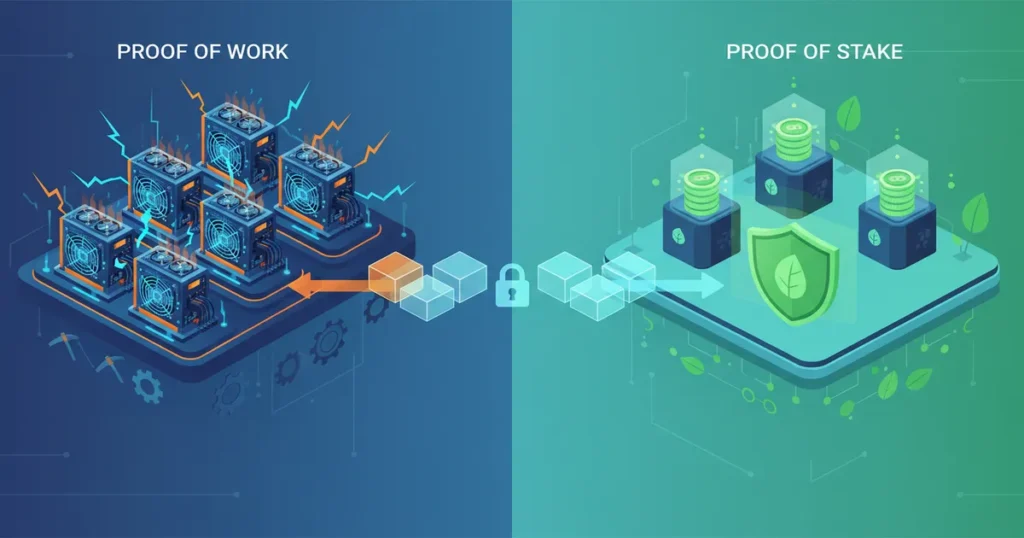
Proof of work consensus is the original blockchain validation method. Here’s how it works: thousands of miners around the world race to solve a complex mathematical puzzle using raw computing power. The first miner to crack it gets to add the next block of transactions to the blockchain and earns a block reward in Bitcoin.
Think of it like a massive global lottery where your chances of winning scale with how much computing power you throw at the problem. More hash power equals more lottery tickets. The process of crypto mining is energy-intensive by design. That’s the security feature, not a bug.
Why Bitcoin Chose Proof of Work
Bitcoin’s creator, Satoshi Nakamoto, chose proof of work because it solves a critical problem: making it absurdly expensive to cheat. To attack the Bitcoin network, you’d need to control 51% of the global hash power. The estimated cost runs into the billions of dollars. After 15+ years, Bitcoin’s proof of work has never been successfully compromised. That track record matters.
The Bitcoin Halving event, which cuts miner block rewards in half roughly every four years, adds another layer to the economics. Each halving squeezes miner margins and historically precedes major price movements.
The Real Cost: Energy and Hardware
Here’s where proof of work gets controversial. Bitcoin consumes roughly 175 to 211 TWh of energy per year, comparable to the entire nation of Thailand. According to the Bitcoin Energy Consumption Index, each Bitcoin transaction uses around 1,444 kWh. That’s enough to power an average American home for 49 days.
Data from the U.S. Energy Information Administration crypto mining data shows that US-based mining operations account for a significant chunk of this consumption. The industry is moving toward renewables (52.4% renewable energy usage in 2025), but the raw energy demand remains a real concern.
Proof of Work at a Glance
- How it secures the network: Miners spend energy solving puzzles
- Who validates transactions: Anyone with mining hardware
- Attack cost: Billions of dollars in hardware and electricity
- Used by: Bitcoin, Litecoin, Dogecoin
- Trade-off: Maximum security at high energy cost
How Proof of Stake Actually Works
Validators vs Miners: A Different Kind of Competition
Proof of stake flips the script entirely. Instead of burning electricity to compete, validators lock up (or “stake”) their own crypto as collateral. The network selects validators pseudo-randomly to propose and verify the next block, weighted by how much they’ve staked.
On Ethereum, you need 32 ETH to become a solo validator. As Fidelity’s Learning Center puts it: “Proof of stake requires an often enormous initial investment. You must purchase enough of the native token of that cryptocurrency to qualify to be a validator.” That barrier to entry is meaningful. Crypto staking has become one of the most popular ways to earn passive yield in the space.

How Staking Rewards Are Earned
Validators earn staking rewards for honestly processing transactions and maintaining network uptime. The annual yield varies by chain. Ethereum validators currently earn roughly 3 to 5% APR, while other proof of stake chains like Solana and Avalanche offer different rates based on their tokenomics.
I started staking ETH about six months after the Merge, once I felt confident the network was stable. The yield isn’t life-changing, but it compounds. And unlike mining, I don’t have a garage full of hardware generating heat and noise.
Slashing: The PoS Penalty System
What keeps validators honest? Slashing. If a validator acts maliciously (like trying to approve fraudulent transactions) or goes offline for extended periods, the network confiscates a portion of their staked tokens. It’s financial punishment that makes cheating expensive. Instead of wasting energy on a failed attack like in proof of work, you lose actual money.
Proof of Work vs Proof of Stake: The Key Differences
Energy Consumption: No Contest
This is the most dramatic difference. Proof of stake uses roughly 99% less energy than proof of work. Ethereum’s transition from PoW to PoS cut its energy consumption by 99.988%. The network went from consuming more power than many countries to using about 0.02 TWh per year.
For context, Bitcoin still draws 211 TWh annually. Ethereum now uses 0.02 TWh. That gap is staggering.
Security: Which Is Harder to Attack?
Both consensus mechanisms make attacks expensive, but in different ways. Attacking Bitcoin requires acquiring 51% of the global hash power, which would cost billions in hardware alone (plus ongoing electricity). According to a peer-reviewed comparative analysis of blockchain consensus mechanisms, each approach carries distinct security trade-offs.
Attacking a proof of stake chain requires buying 51% of all staked tokens. On Ethereum, that’s a massive capital requirement. However, PoS introduces unique risks like long-range attacks, where early validators could theoretically mine an alternate chain history privately.
Decentralization: More Complicated Than It Looks
Neither system is perfectly decentralized. Proof of work mining has consolidated into massive mining farms and pools, mostly concentrated in a handful of countries. Proof of stake faces its own centralization pressure through large staking pools and institutional validators that accumulate outsized influence.
I’ve watched this play out in real time. The promise of decentralization sounds clean in theory. In practice, both models drift toward concentration of power. It’s something I factor into every investment thesis.
Scalability and Transaction Speed
Proof of stake chains generally process transactions faster and at lower cost. Bitcoin handles about 7 transactions per second. Ethereum post-Merge handles more, and PoS chains like Solana push thousands of TPS. Layer 2 solutions build on top of PoS chains to scale even further, enabling the DeFi ecosystem, liquidity pools, and smart contracts to operate at speeds that users actually expect.
The Ethereum Merge: The Biggest PoW-to-PoS Experiment in History
In September 2022, Ethereum completed “The Merge,” switching its consensus mechanism from proof of work to proof of stake. It was the most-watched event in crypto infrastructure history. And honestly, I was nervous. I had significant ETH exposure, and a botched transition could have been catastrophic.
It worked. The result was a 99.988% reduction in energy use and a 99.992% drop in carbon emissions.
“The Merge lowered the world’s energy consumption by 0.2% — one of the single biggest decarbonization events ever.” — Vitalik Buterin, Ethereum Co-founder
The Merge proved that a major blockchain could switch consensus mechanisms without breaking security or losing users. Ethereum now consumes just 0.02 TWh per year. It validated proof of stake as a viable model at massive scale.
Which One Should You Care About as a Crypto Investor?
This is where most articles stop at the technical stuff and leave you hanging. But the consensus mechanism directly affects your portfolio. Here’s how I think about it:
Investor Implications
- Proof of work (Bitcoin): Fixed supply, deflationary pressure from halvings, “digital gold” narrative, settlement-layer security. No staking yield.
- Proof of stake (Ethereum, Solana, Cardano): Staking rewards create yield, variable inflation rates tied to tokenomics, programmable for DeFi applications.
- Portfolio consideration: Consensus mechanism affects token emission schedules, inflation, and income potential.
My approach? I hold Bitcoin as my base layer. It’s the asset I don’t touch. It’s proof of work, battle-tested, and I treat it like digital savings. Then I allocate to PoS chains where I can stake and earn yield while participating in ecosystems I believe in. Understanding market cap differences between PoW and PoS chains helps me size those positions appropriately.
Neither consensus mechanism is objectively “better.” They serve different purposes. Asking which is superior is like asking whether a vault or a checking account is better. It depends on what you need.
The Bottom Line
The proof of work vs proof of stake debate comes down to trade-offs. Proof of work offers proven, battle-tested security at a steep energy cost. Proof of stake delivers efficiency, scalability, and staking yield while introducing different risk vectors.
| Feature | Proof of Work | Proof of Stake |
|---|---|---|
| Energy Use | Very High (~211 TWh/yr for BTC) | Very Low (~0.02 TWh/yr for ETH) |
| Security Model | Hash power (energy cost) | Staked capital (financial cost) |
| Passive Income | Mining rewards (requires hardware) | Staking rewards (requires tokens) |
| Speed (TPS) | ~7 TPS (Bitcoin) | Higher (varies by chain) |
| Track Record | 15+ years (Bitcoin) | 3+ years at scale (Ethereum) |
| Top Chains | Bitcoin, Litecoin, Dogecoin | Ethereum, Solana, Cardano, Avalanche |
The crypto world isn’t choosing one over the other. Both coexist, and both will likely continue to evolve. Hybrid models are already emerging in 2025, aiming to combine the security of proof of work with the efficiency of proof of stake.
If you want to go deeper, I’d start with my full guide on blockchain technology for the big picture, then dive into proof of stake or crypto mining depending on which side of the debate interests you most. And if you’re ready to put your crypto to work, my guide on crypto staking walks through everything you need to get started earning yield on your holdings.