Hetzner Review 2025: Is the Best-Value Linux VPS Worth the Hype?
Honest Hetzner review 2025: pricing, performance benchmarks, pros & cons, and who it's really for. A Linux sysadmin's take after years of real-world use.

In this article
If you’ve spent any time in Linux forums, self-hosting communities, or sysadmin circles, you’ve heard the name. This Hetzner review 2025 is my honest breakdown after years of running everything from hobby projects to production workloads on their infrastructure. Hetzner is a virtual private server provider that the open-source crowd can’t stop talking about. But is the hype justified? Let me walk you through what I’ve actually experienced.
I still remember the first time I spun up a Hetzner cloud server. I’d been limping along on a shared hosting plan for a personal project, SSHing in through tmux sessions that felt sluggish and cramped. When that Hetzner VPS came online and I ran my first benchmarks, my jaw literally dropped. The performance gap was enormous. That moment turned me into a believer, and I haven’t looked back since.
This review is written for people like me: Linux sysadmins, developers, self-hosters, and anyone who’s comfortable with a terminal. If that sounds like you, keep reading. There’s a lot to unpack here, including a major pricing change coming in 2026 that you need to know about.
Who Is Hetzner (And Why the Linux Community Is Obsessed With It)
Hetzner is a German hosting company founded in 1997. They own and operate their own data centers across Europe and beyond, which gives them a level of cost control that most cloud providers can only dream about. They’re not a reseller. They’re not slapping a fancy dashboard on top of someone else’s hardware. They build the racks, run the cables, and keep the lights on themselves.
Why does the Linux community love them? Three words: raw power, low price. While AWS and Google Cloud charge premium rates for managed services you may never use, Hetzner gives you bare metal performance at a fraction of the cost. You get root access, a clean minimal OS image, and the freedom to build whatever you want on top.
For the FOSS crowd, there’s another angle. Hetzner is a German company subject to GDPR and European privacy law. That matters if you care about where your data lives and who can access it. We’ll dig deeper into that later, because it’s one of Hetzner’s most underrated advantages.
Hetzner Plans and Pricing: What You Actually Get
Let’s talk numbers. Hetzner’s pricing is where most people’s eyes go wide. And honestly, the value is still hard to beat even with changes on the horizon.
Cloud VPS (CX, CPX, and CAX Series)
Hetzner organizes their cloud servers into three main tiers:
- Shared Cost Optimised (CX): Starting at just €3.49/month for 2 vCPUs, 4 GB RAM, and 40 GB NVMe storage. Perfect for dev environments, personal projects, and lightweight services.
- Shared Regular Performance (CPX): More consistent CPU allocation with AMD EPYC-Genoa processors. Great for production workloads that need reliable throughput.
- ARM-based (CAX): Ampere Altra ARM servers starting at €3.79/month. Excellent price-to-performance if your software supports ARM64.
Every plan includes 20 TB of included traffic at European locations. Compare that to DigitalOcean or Vultr, which typically include 2-4 TB at similar price points. That bandwidth difference alone can save you serious money if you’re running anything with meaningful traffic.
Dedicated Servers and Auction Servers
This is where Hetzner gets really interesting. Their dedicated server auction (through the Hetzner Robot marketplace) offers refurbished enterprise hardware at steep discounts. I’ve seen quad-core Xeon boxes with 64 GB RAM and dual NVMe drives go for under €40/month. For homelab use or production workloads that need raw horsepower, it’s ridiculous value.
How Hetzner Compares to DigitalOcean and Vultr on Price
At the 4 vCPU / 8 GB RAM tier, Hetzner typically costs 30-50% less than equivalent plans on DigitalOcean or Vultr. And that’s before you factor in the bandwidth advantage. If you need to add swap space to squeeze more out of a smaller plan, you can start even cheaper.
⚠️ Heads Up: Price Increase Coming April 2026
Hetzner announced a 30-37% price increase across several plan tiers, effective April 2026. The reason? Rising DRAM and NAND costs driven by AI infrastructure demand. Even after the hike, Hetzner will likely remain cheaper than DigitalOcean and Vultr for equivalent specs. But it’s worth knowing before you commit to a long-term setup. Check Hetzner Cloud official pricing for the latest numbers.

Performance: What I Actually Measured
Reviews that don’t include real benchmarks aren’t reviews. They’re marketing. Here’s what I’ve seen running production and lab workloads on Hetzner over the past year.
CPU: AMD EPYC-Genoa and Ampere Altra Performance
The Regular Performance tier runs on AMD EPYC-Genoa processors, which are fast, efficient, and consistent. I’ve run compilation jobs, database queries, and containerized applications without hitting the kind of noisy-neighbor throttling you sometimes see on budget shared hosts. The ARM-based CAX servers on Ampere Altra chips are equally impressive for workloads that support ARM64.
Disk: NVMe RAID-10 I/O Speeds
All Hetzner cloud servers use NVMe storage in RAID-10. In practice, I’ve measured sequential read speeds well above 1 GB/s and random IOPS that make database-heavy workloads feel snappy. If you’re running PostgreSQL, MySQL, or container workloads with persistent volumes, you’ll appreciate the I/O throughput.
Network: 10 Gbit Bandwidth and Latency
Hetzner data centers are connected with 10 Gbit networking. European latency is excellent, typically under 20ms between major EU cities. US latency from Ashburn or Hillsboro is workable for most applications, but if your entire audience is US-based and latency-sensitive, you might want a US-native provider as a complement.
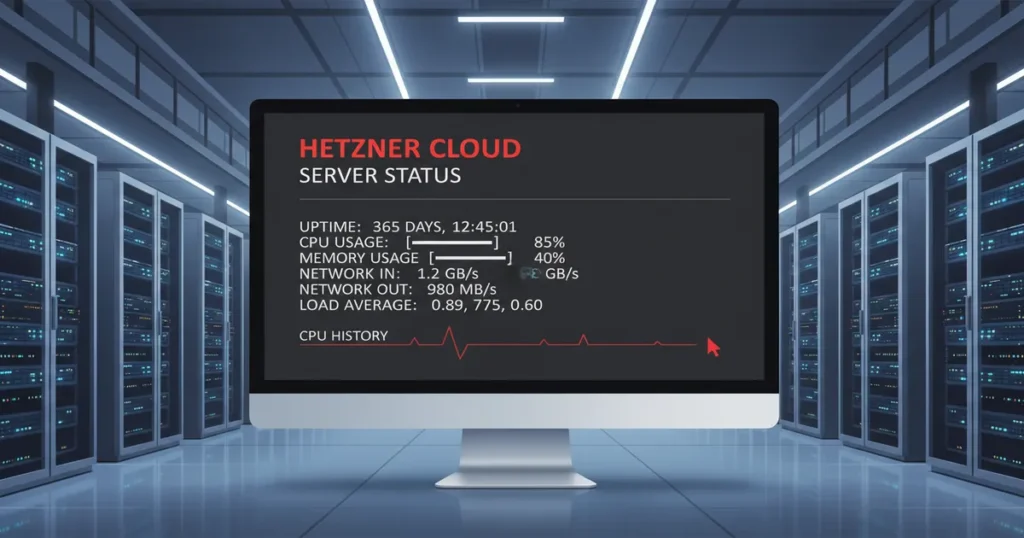
Uptime? Independent monitors have recorded 99.96-99.99% uptime across Hetzner’s fleet over 12-month periods. That’s top-tier reliability for any price bracket.
“Hetzner Cloud offers a level of power, control, and value that is exceptionally hard to beat in 2025.”
— HostingExplainer editorial review
Hetzner Features That Matter for Linux Admins
Raw specs are one thing. What actually matters is whether the platform fits into your workflow. Here’s what I use and what I think is worth highlighting.
Data Center Locations
Hetzner currently operates in six locations: Falkenstein and Nuremberg (Germany), Helsinki (Finland), Ashburn (Virginia, US), Hillsboro (Oregon, US), and Singapore. The European presence is strong. The US and Asia locations are newer but growing. Pick the one closest to your users.
Load Balancers and Private Networking
Hetzner’s load balancers handle TCP, HTTP, and HTTPS traffic with TLS termination and HTTP/2 support. They’re fairly priced and straightforward to configure. Private networking between servers in the same project is free, which is essential if you’re running multi-node setups. Once your servers are live, you’ll want to manage services with systemctl and keep everything running smoothly.
Block Storage and Snapshots
You can attach block storage volumes to any cloud server. This is great for databases, media files, or any stateful workload that might outgrow the built-in disk. Snapshots let you capture your server’s state before risky changes. I always recommend pairing this with a proper backup strategy. If you haven’t already, learn how to set up automatic backups in Linux and use rsync for file transfers to an offsite location.
One gap worth noting: Hetzner does not offer managed object storage like DigitalOcean Spaces. If you need S3-compatible storage, you’ll want to pair Hetzner with Backblaze B2 or run MinIO yourself. For volume management on the server side, understanding LVM for storage management is extremely useful.
Kubernetes and Docker Support
Hetzner doesn’t offer a managed Kubernetes product like DigitalOcean or GKE. But the community has built a solid cloud-controller-manager that integrates with Hetzner’s API for node provisioning, load balancer creation, and networking. If you’re running Docker on Linux, Hetzner’s performance and pricing make it an excellent host for containerized workloads.
You also get full root access, a clean REST API, and the hcloud CLI tool. For infrastructure-as-code workflows, Hetzner integrates well with Terraform and Ansible. If you want to set up Nginx on Linux as a reverse proxy in front of your containers, it’s a straightforward process on a Hetzner VPS.
Privacy, Security, and GDPR: Why This Matters to Me
This is where I get a little passionate, and I won’t apologize for it. As someone who cares deeply about software freedom and digital privacy, Hetzner’s legal jurisdiction is a genuine selling point.
Hetzner is a German company. That means they’re subject to GDPR (General Data Protection Regulation) and German federal data protection law. They are not subject to the US CLOUD Act, National Security Letters, or FISA court orders. Your data on a Hetzner server in Germany or Finland stays under European legal protection.
“Hetzner is subject to German privacy law and GDPR — not US surveillance laws, not the CLOUD Act, not National Security Letters.”
— State of Surveillance Privacy Guide
Their data centers are ISO 27001 certified with redundant power, cooling, and physical security. For hardening the server itself, I’d recommend you configure UFW firewall and set up fail2ban immediately after provisioning. And of course, the very first thing you should do on any new VPS is generate an SSH key and disable password authentication.
Hetzner Support: What to Actually Expect
I’ll be straight with you. Hetzner’s support model is built for people who can help themselves. If you’re used to 24/7 live chat with hand-holding, this isn’t your provider.
Support is ticket-based primarily. Phone support is available during business hours, but there’s no live chat. When you do reach the support team, they’re competent and usually fast. I’ve had billing issues resolved in under an hour and technical questions answered with genuine expertise.
The real gem is the Hetzner Community tutorials. Seriously, these are excellent. The community-written guides often rival or exceed official documentation from other providers. For self-sufficient Linux admins who know how to read logs and troubleshoot, you’ll rarely need to file a ticket anyway.
💡 Honest Take
If you need a provider that will walk you through basic server setup, Hetzner is not the right fit. But if you’re comfortable with SSH and a terminal, you’ll find the documentation and community resources more than sufficient.
Who Hetzner Is For (And Who Should Look Elsewhere)
Not every hosting provider is right for every person. Here’s my honest breakdown.
Hetzner Is Ideal For:
- Linux developers and sysadmins who want raw performance at rock-bottom prices
- Self-hosters and homelab enthusiasts running Proxmox, Docker, or personal cloud setups
- Privacy-conscious users who want GDPR-compliant European hosting
- European-focused projects that benefit from low-latency EU data centers
- Budget-conscious teams building production infrastructure without VC-funded cloud bills
Hetzner Is Not Ideal For:
- Complete beginners who need managed hosting with a GUI-first approach
- Windows Server users — Hetzner is a Linux-first platform
- US-only, latency-sensitive apps where every millisecond counts for domestic users
- Teams wanting extensive managed services like managed Kubernetes, managed databases, or an app platform
If you need an affordable US-based alternative, check out my RackNerd review for a budget option that serves a different niche. Hetzner and RackNerd actually complement each other well in a multi-provider strategy.
Final Verdict: My Honest Take After Years Running Hetzner Servers
After running Hetzner servers for years across personal projects, homelab experiments, and production workloads, my verdict is simple: if you’re a Linux person, Hetzner is probably the best value on the market right now.
📊 Quick Rating Summary
- Performance: Excellent — AMD EPYC and Ampere Altra deliver at every price tier
- Value: Excellent — still the price-performance leader even with the 2026 hike
- Support: Adequate — great if you’re self-sufficient, limited if you’re not
- Ease of Use: Intermediate — built for people who know their way around a terminal
The price-performance ratio remains best-in-class. Even after the April 2026 increase, Hetzner will still undercut most competitors while delivering superior hardware. My Proxmox cluster, several Docker hosts, and a handful of production projects all live on Hetzner. I trust it with my work, and I wouldn’t recommend it if I didn’t.
The best part? There’s no minimum commitment. You can spin up a cloud server for a few euros, test it for a week, and tear it down if it’s not for you. For most Linux admins, I think you’ll stick around.
If you’re ready to get started, check out our guides on how to generate an SSH key for secure access, configure UFW firewall for basic hardening, and set up Nginx on Linux to get your first web server running. Your Hetzner journey starts with a terminal and a good SSH key.