Centralized vs Decentralized Crypto Exchanges: Which One Should You Actually Use?
CEX vs DEX comparison: Learn the critical differences in security, fees, and control. I'll show you when to use each type of exchange based on your needs.

In this article
If you’ve spent any time in crypto, you’ve probably heard the debate: centralized vs decentralized crypto exchanges. Which one is safer? Which one is cheaper? Which one should you actually trust with your money?
I’ve traded on both for years. I’ve watched a centralized exchange freeze withdrawals while I sat there refreshing the page at 2 AM. I’ve also fat-fingered a DEX swap and lost money to slippage because I didn’t check the pool depth. Both sides have burned me. Both sides have made me money.
Here’s what I’ve learned: the answer isn’t one or the other. It’s knowing when to use each. Let me walk you through the real differences so you can make that call for yourself.
What Are Centralized Exchanges (CEXs)?
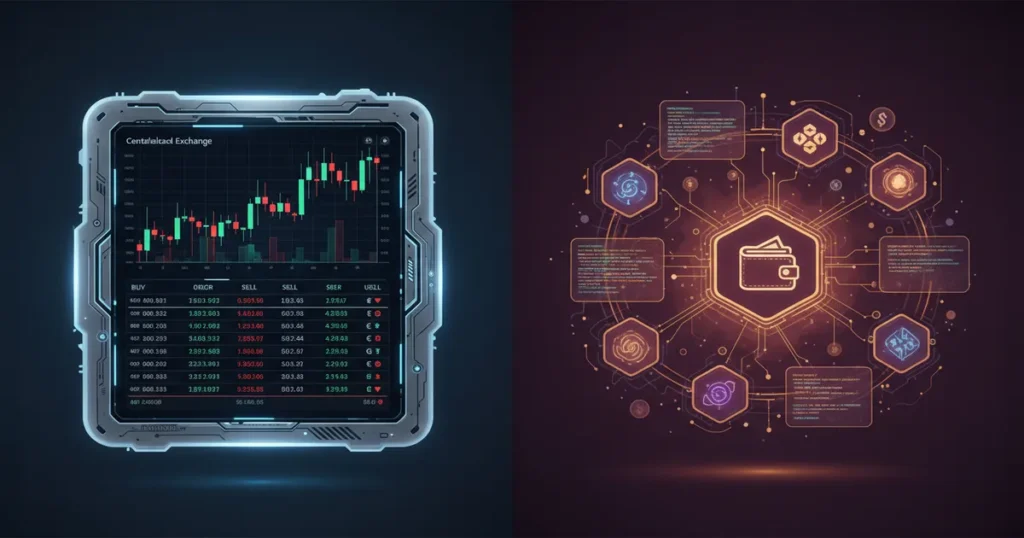
A centralized exchange works like a traditional brokerage. You create an account, deposit your money, and the exchange handles everything behind the scenes. Think of it as handing your cash to a middleman who promises to keep it safe and execute your trades.
CEXs dominate the market right now. They handle roughly 87.4% of all crypto trading volume, and for good reason. They’re familiar, fast, and easy to use.
How CEXs Work: The Traditional Model
When you buy Bitcoin on a centralized exchange, you’re not directly interacting with a blockchain. The exchange matches your buy order with someone else’s sell order using an internal order book. Your crypto sits in the exchange’s wallet, not yours.
This is the critical thing most beginners miss: you don’t actually control your crypto on a CEX. The exchange holds your private keys. If you’re new to this concept, I’d recommend understanding crypto wallets before going further.
CEXs also require identity verification. About 92% of centralized exchanges now require KYC (Know Your Customer) compliance. You’ll need to upload an ID, verify your address, and sometimes even do a video call before you can trade.
Popular CEX Examples (Binance, Coinbase, Kraken)
The big three you’ll hear about most often are Binance (largest by volume globally), Coinbase (most popular in the US), and Kraken (known for solid security). Each has different fee structures, supported coins, and regional availability. If you’re shopping around, I put together a breakdown of the best cryptocurrency exchanges for 2025 that covers the specifics.
What Are Decentralized Exchanges (DEXs)?
A decentralized exchange cuts out the middleman entirely. Instead of trusting a company to hold your funds and match your trades, you trade directly from your own wallet using smart contracts.
No account. No KYC. No one standing between you and your money.
DEX trading volume has been growing fast. It jumped from roughly 10% of spot trading volume in 2024 to nearly 20% by Q3 2025. That’s a significant shift, and it tells you something about where the market is heading.

How DEXs Work: Smart Contract Trading
Instead of order books, most DEXs use something called an Automated Market Maker (AMM). Liquidity providers deposit pairs of tokens into pools, and the smart contract algorithmically determines the price based on the ratio of tokens in the pool. For a deeper dive, check out how liquidity pools work.
According to Uniswap’s official DEX documentation, this model eliminates the need for a centralized party to facilitate trades. Your wallet connects directly to the smart contract, the swap executes on-chain, and the tokens land in your wallet. No custodian ever touches your funds.
Popular DEX Examples (Uniswap, PancakeSwap, dYdX)
Uniswap is the flagship on Ethereum. PancakeSwap runs on BNB Chain with lower fees. dYdX caters to derivatives traders who want decentralized perpetual contracts. Each serves a different niche, but they all share that core principle: you keep your keys.
Security: The $2.2 Billion Question
Security is the most important factor when comparing centralized vs decentralized crypto exchanges. In 2024, over $2.2 billion was stolen across crypto hacks and exploits. And 2025 is tracking even worse, potentially reaching $4 billion. Security isn’t a theoretical concern. It’s the thing that can wipe you out overnight.
CEX Security Risks (Hacks, Bankruptcies, Account Takeovers)
Centralized exchanges are massive honeypots. They hold billions of dollars in a single place, making them prime targets for hackers. CEX account takeover attacks surged 808% year-over-year in 2023. That’s not a typo.
But hacks aren’t even the biggest risk. Insolvency is. When an exchange goes down, your funds go with it.
DEX Security Risks (Smart Contract Exploits, Front-Running)
DEXs have their own problems. A systematic review of 220 major exchange incidents found that smart contract exploits across DEXs resulted in $1.939 billion in losses across 56 incidents. Bugs in code can be just as devastating as a corrupt CEO.
Then there’s MEV (Maximal Extractable Value). Bots can front-run your trades on DEXs, sandwiching your transaction to extract value. It’s like someone cutting in line at the checkout and making you pay more for the same item.
The FTX Lesson: What Happens When CEXs Fail
I remember exactly where I was when FTX halted withdrawals. I was sitting at my desk, coffee going cold, watching my timeline explode. I didn’t have funds on FTX personally, but I had friends who did. Smart people. People who’d done their due diligence, or thought they had.
FTX collapsed and trapped billions in user funds during bankruptcy proceedings. It was the clearest possible lesson: if you don’t hold the keys, you don’t own the crypto. That event alone pushed me to move the majority of my long-term holdings into self-custody. If you’re thinking about doing the same, start with best cold wallets for long-term storage.
Quick Security Takeaway
- CEX risk: Single point of failure. Hacks, insolvency, and account takeovers.
- DEX risk: Smart contract bugs, front-running, and user error (no customer support).
- Best practice: Never leave more on any exchange than you’re actively trading.
Fees and Costs: The Real Price of Trading
Fees matter more than most people think, and the cost structure is another key difference between centralized vs decentralized crypto exchanges. They quietly eat into your returns, especially if you’re an active trader. Let me break down what you’re actually paying on each type.
CEX Trading Fees Breakdown
Most major CEXs charge a maker/taker fee model. Binance sits around 0.10% per trade. Coinbase charges significantly more for retail users, sometimes 1-2% depending on the transaction method. Kraken falls somewhere in between.
The upside? These fees are predictable. You know exactly what you’re paying before you execute.
DEX Fees and Gas Costs
DEX fees vary wildly. Uniswap pools typically charge 0.05% to 1% depending on the pool tier. PancakeSwap ranges from 0.01% to 1% but runs on BNB Chain, where crypto gas fees are a fraction of Ethereum’s.
And that’s the kicker. On Ethereum-based DEXs, gas fees can absolutely destroy small trades. I once paid $47 in gas to swap $200 worth of tokens. That’s a 23.5% fee. Painful lesson.
Hidden Costs You’re Not Seeing
On CEXs, watch for withdrawal fees and spread markups. On DEXs, watch for slippage issues, especially on large trades or thin pools. Price impact on a $50K swap through a small liquidity pool can cost you hundreds.
Layer 2 scaling solutions are helping reduce DEX costs significantly. If gas fees are your main concern, trading on L2 networks like Arbitrum or Optimism brings fees down to pennies.
Liquidity and Trading Experience
Liquidity determines how easily you can buy and sell without moving the price. And right now, CEXs and DEXs aren’t even close.
Why CEXs Dominate Liquidity
The top 15 centralized exchanges processed $18.8 trillion in trading volume during 2024. That massive liquidity means tight spreads, instant fills, and minimal price impact on most trades. You can place a $100K market order on Binance and barely move the price.
CEXs also offer advanced order types: limit orders, stop-losses, OCO orders, and sophisticated charting tools. For active traders, this is hard to beat.
DEX Liquidity Pools Explained
The top 10 DEXs handled about $1.76 trillion in 2024. That’s growing, but it’s still roughly one-tenth of CEX volume. The practical impact? Larger trades on DEXs often suffer from slippage because the liquidity pools aren’t deep enough.
For mainstream pairs like ETH/USDC, DEX liquidity is usually fine. But for smaller altcoins or larger positions, you’ll feel the difference. Understanding how crypto trading platforms differ at a fundamental level helps explain why this gap exists.
Privacy and Control: KYC vs Anonymity
This is a philosophical divide as much as a practical one. How much of your identity are you willing to hand over to trade?
CEX Compliance Requirements
92% of centralized exchanges now require KYC verification. You’re handing over your government ID, proof of address, and sometimes biometric data. In return, you get regulatory protections, insurance on some platforms, and the ability to convert directly between crypto and fiat currency.
For many people, this is a fair trade. For others, it defeats the entire purpose of cryptocurrency.
DEX Privacy Benefits (and Risks)
DEXs let you trade with just a wallet address. No name, no ID, no data collection. Connect your wallet, make your swap, disconnect. That’s it.
But here’s what’s changing: regulatory pressure is increasing. Global policy is pushing major DEX protocols to integrate KYC layers or implement regional access controls. The anonymous DEX experience may not last forever.
And there’s a practical downside to anonymity: no customer support. If you send tokens to the wrong address or approve a malicious contract, nobody is coming to help. Make sure you understand protecting your seed phrase before you start using DEXs.
When to Use a CEX vs When to Use a DEX
This is the section I wish someone had written for me back when I was starting out. There’s a time and place for each, and getting this right saves you money, stress, and security headaches.
Best Use Cases for Centralized Exchanges
- Buying crypto with fiat: CEXs are still the easiest way to convert dollars to crypto. About 67% of top CEXs offer fiat trading pairs.
- Active trading: If you’re day trading or using leverage, CEX order books and tools are superior.
- Beginners: The user experience is simpler. If you’re just learning how to buy your first cryptocurrency, start here.
- Derivatives: Futures, options, and margin trading are almost exclusively CEX territory.
Best Use Cases for Decentralized Exchanges
- Long-term holding: If you’re buying and holding, there’s no reason to leave funds on a CEX. Swap and store in your own wallet.
- DeFi strategies: Yield farming, liquidity provision, and other DeFi plays require DEX access.
- Privacy: When you don’t want to hand over personal data for every transaction.
- Early altcoin access: New tokens often launch on DEXs before getting listed on major CEXs.
The Hybrid Approach I Actually Use
Here’s my honest setup. I use a CEX for fiat on-ramps and active trading positions. When I’m done trading, I move profits to a DEX for any DeFi strategies I’m running. And my long-term holds? Those go straight to cold storage.
I think of it like this: the CEX is my trading desk, the DEX is my workshop, and my cold wallet is the vault. Each serves a purpose. None of them gets all my money.
Before you decide your own split, I’d suggest using a solid research framework for evaluating exchanges to vet any platform you’re considering.
The Biggest Mistakes I See People Make
After years in this space and hundreds of conversations with other traders, these are the errors I see over and over again.
Common Mistakes to Avoid
- Leaving large amounts on CEXs long-term. Your exchange is not a savings account. If FTX taught us anything, it’s that even “reputable” platforms can fail overnight.
- Using DEXs without understanding smart contract risks. Approving unlimited token spending on a sketchy contract can drain your wallet. Always review what you’re signing.
- Ignoring tax implications. CEXs report to tax authorities. DEXs mostly don’t. But that doesn’t mean your DEX trades aren’t taxable. They absolutely are.
- Getting wrecked by gas fees on small DEX trades. If you’re swapping $50 on Ethereum mainnet, the gas might cost more than the trade. Use L2s or cheaper chains instead.
- Chasing every new DEX or token launch. I lost money early on aping into brand new DEX pools without checking the contract. Do your homework. Always.
That last one stings because I lived it. Back in 2021, I was riding the DeFi wave and threw money into a liquidity pool on a DEX I’d barely researched. The smart contract had an exploit, and the pool was drained within hours. It wasn’t a lot of money, but it was enough to teach me that “decentralized” doesn’t mean “safe.” I journal every mistake like that now. It keeps me honest.
Final Verdict: Which Exchange Type Wins?
Neither. And that’s actually the healthiest answer for the market.
“In 2026, the market’s healthiest outcome is coexistence. CEXs continue to be the backbone for liquidity, fiat integration, and institutional flows. DEXs’ development continues to be the innovation engine.”
That quote pretty much sums it up. Centralized vs decentralized crypto exchanges isn’t a winner-take-all competition. It’s a spectrum, and smart users position themselves across it.
If you’re a beginner, start with a regulated centralized exchange. Learn the basics. Get comfortable. Then, as your knowledge grows, explore DEXs for the added control and DeFi opportunities they provide. Understanding stablecoins and crypto whale trading patterns will help you navigate both environments more effectively.
My personal split right now is roughly 20% on CEXs for active trading, 15% on DEXs for DeFi, and 65% in cold storage. That ratio shifts depending on market conditions, but the principle stays the same: never put all your eggs in one basket, especially a basket someone else is holding.
The crypto exchange landscape is evolving fast. The more you understand both sides, the better positioned you are to protect your assets and grow your portfolio. If you’re just getting started on this journey, check out our guide on how to buy your first cryptocurrency or explore the best cryptocurrency exchanges for 2025 to find the right platform for your needs.