What is Smart Money Concept Trading (And Why Retail Traders Are Finally Learning It)
Smart Money Concept (SMC) trading teaches you to think like institutions, not retail traders. Learn liquidity sweeps, order blocks, and FVGs that move markets.

In this article
If you’ve ever watched a trade move against you the second you hit “buy,” you’re not imagining things. Smart money concept trading is a framework that explains exactly why this happens. It teaches you to read the market the way institutions do, not the way retail traders have been taught.
I spent my first two years stacking RSI signals and chasing breakouts. Then I lost $8,000 in a single week when every “breakout” I entered reversed within minutes. That’s when I finally asked the right question: who was on the other side of my trades? The answer changed everything.
Here’s what smart money concepts actually are, how to use them, and whether they’re worth your time.
What Is Smart Money Concept (SMC) in Trading?
Smart Money Concept trading is a framework for understanding how institutional investors move markets. Instead of relying on lagging indicators like RSI or MACD, SMC focuses on market structure, liquidity, and order flow.
The “smart money” refers to banks, hedge funds, and market makers with enough capital to actually move prices. These players don’t trade based on indicators. They trade based on where the liquidity sits.
Traditional technical analysis tells you what happened. Smart money concepts help you understand why it happened and what’s likely next.
Quick Answer: What Is Smart Money Concept Trading?
SMC is a trading method where you study how institutions create and use liquidity to fill large orders. Instead of chasing price, you learn to anticipate where institutions will push price next by reading market structure, order blocks, and fair value gaps.
When I stopped trading against institutions and started following their footprints, my whole approach shifted. I went from guessing to reading the market with a framework that actually made sense.
The Core Principles of Smart Money Concepts
SMC trading rests on four pillars. Each one builds on the last. Master them in order, and they start working together like a checklist before every trade.
Market Structure (The Foundation)
Market structure is the backbone of every SMC setup. It comes down to identifying trends through higher highs and higher lows (bullish) or lower highs and lower lows (bearish).
Two key signals matter here:
- Break of Structure (BoS): Price continues the existing trend by breaking a recent high or low. This confirms the trend is still alive.
- Change of Character (CHoCH): Price breaks structure in the opposite direction. This signals a potential reversal.
If you can identify these two patterns on a clean chart, you’re already ahead of most retail traders who are buried under five indicators. Understanding support and resistance levels is a natural starting point for grasping market structure.

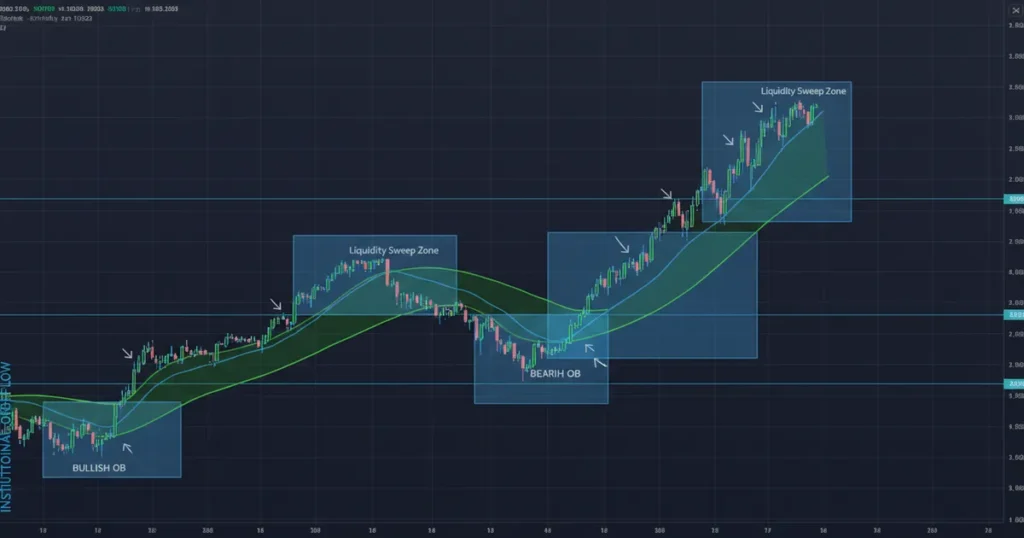
Liquidity Sweeps (The Manipulation Move)
This is where it gets interesting. Institutions need liquidity to fill their massive orders. They can’t just buy 50,000 contracts without moving the price against themselves. So they engineer liquidity.
How? By pushing price into zones where retail stop losses are clustered. That means sweeping above obvious highs (buy-side liquidity) or below obvious lows (sell-side liquidity).
Here’s the pattern:
- Price approaches a well-known level where stops are sitting
- Price breaks through, triggering those stops
- Institutions absorb the liquidity from those triggered orders
- Price reverses sharply in the opposite direction
That $8,000 I lost? Every single trade was a textbook liquidity sweep. I was trading breakouts right into institutional traps. Once I learned to spot these sweeps, I stopped being the exit liquidity.
Order Blocks (Institutional Footprints)
An order block is the last opposing candle before an explosive price move. Think of it as a footprint left by institutional traders.
For a bullish order block, look for the last bearish candle before a strong rally. For a bearish order block, find the last bullish candle before a sharp drop. These zones represent areas where institutions left unfinished business, and price often returns to them.
When combined with trading volume analysis, order blocks become even more reliable. High volume at an order block tells you institutions were actively filling positions there.
Fair Value Gaps (Price Inefficiencies)
A Fair Value Gap (FVG) forms when price moves so quickly that it leaves a gap between three consecutive candles. The middle candle’s body doesn’t overlap with the wicks of the first and third candles.
Why does this matter? Because approximately 70% of fair value gaps get filled. Price tends to return to these zones before continuing its trend. That makes FVGs high-probability entry zones when combined with the right context.
The best setups happen when an order block and a fair value gap overlap. That confluence is essentially a flashing sign that says “institutional interest zone.” I look for this overlap on almost every trade now.
How Smart Money Concepts Differ From Retail Trading
Here’s the core difference: retail traders react. Smart money traders anticipate.
| Approach | Retail Trading | Smart Money Concepts |
|---|---|---|
| Entry Trigger | Indicator signals (RSI oversold, MACD cross) | Order blocks + liquidity sweeps |
| Market View | Pattern-based (head & shoulders, triangles) | Structure-based (BoS, CHoCH, liquidity) |
| Stop Placement | Below obvious support levels | Beyond liquidity sweep zones |
| Edge | Reacts to what price did | Anticipates where price is going |
| Weakness | Lagging signals, late entries | Steep learning curve, subjective |
Learning to read candlestick charts cleanly is essential for both approaches. But the SMC trader reads those candles through the lens of structure and institutional intent, not just pattern recognition.
You can also use reading order books to see where large orders are stacking in real time. This adds another layer of confirmation for SMC setups.
The ICT Connection (And the Controversy)
You can’t discuss smart money concepts without mentioning ICT (Inner Circle Trader), the online persona of Michael J. Huddleston. He popularized most of the terminology used in SMC trading today.
But here’s what the YouTube gurus won’t tell you. Critics argue that ICT largely rebranded existing concepts from Wyckoff Method, Market Profile, and market microstructure theory with flashier names. Order blocks? Similar to supply and demand zones. Liquidity sweeps? Essentially stop hunts, which traders have known about for decades.
There’s also the credibility question. ICT has no verified public trading track record. His 2016 challenge to trade $1 million publicly didn’t pan out. He’s been open about making more from mentorship subscriptions than from trading.
My honest take? The concepts themselves are valid. Understanding liquidity and institutional behavior gives you a real edge. But you don’t need a $2,000 course to learn them. The principles come from market microstructure research that’s freely available. Learn from the ideas, not the personality cult.
Does Smart Money Concept Trading Actually Work?
In my experience, yes. But with major caveats.
When I started recognizing liquidity sweeps and trading from order blocks instead of chasing breakouts, my win rate went from about 48% to 64%. That’s a meaningful jump when you’re managing risk properly with position sizing that keeps losses small.
Here’s what the data supports:
- Win rate: 60-70% is achievable when applying SMC with proper risk management
- FVG fill rate: Roughly 70% of fair value gaps eventually get filled
- Learning curve: Expect 3-6 months of dedicated study before consistent results
- Risk-reward: SMC entries often offer 1:3 or better risk-to-reward ratios
But here’s the hard truth: SMC is nearly impossible to backtest objectively. It’s visual and structural. Two experienced SMC traders might draw different order blocks on the same chart. That subjectivity is the biggest weakness of the approach, and anyone who says otherwise is selling you something.
Tools like backtesting strategies can help you validate your specific rules, but you’ll need clearly defined criteria for each concept.
How to Start Learning Smart Money Concepts
If you’re convinced SMC is worth exploring, here’s the path I’d recommend. I wish someone had laid this out for me instead of letting me waste six months bouncing between YouTube channels.
Your SMC Learning Roadmap
- Master market structure basics. Identify higher highs, lower lows, BoS, and CHoCH on a clean chart. No indicators. Just price.
- Study liquidity zones. Mark where stop losses likely cluster above swing highs and below swing lows.
- Mark order blocks and FVGs on historical charts. Go back through 100+ candles and label everything. This builds your eye.
- Practice with paper trading. Take at least 50-100 paper trades using SMC setups before risking real money.
- Start small. Once consistently profitable on paper, trade with minimal real capital and strict stop losses.
You don’t need expensive courses. Free resources on YouTube and trading communities cover everything ICT teaches. The investment is screen time, not money.
I’d also suggest studying volume profile alongside SMC. Understanding where volume concentrates at certain price levels gives you independent confirmation of where institutions are active.
Common Mistakes When Trading Smart Money Concepts
I’ve made most of these myself. Learn from my scars, not yours.
- Overcomplicating from day one. When I first discovered SMC, I tried to use order blocks, FVGs, liquidity sweeps, and multi-timeframe analysis all at once. The result? Analysis paralysis. I’d identify three conflicting signals and freeze. Start with market structure and liquidity only. Add layers gradually.
- Ignoring risk management. SMC entries give you great risk-to-reward ratios, but only if you actually use stops. Knowing about order blocks doesn’t exempt you from trading psychology pitfalls.
- Chasing every liquidity sweep. Not every wick beyond a high or low is institutional manipulation. Some are just normal price discovery. Wait for confirmation before entering.
- Ignoring higher timeframe structure. A perfect 5-minute order block means nothing if the daily chart shows you’re trading against the trend. Always check one or two timeframes above your entry.
- Expecting instant results. SMC requires pattern recognition that only develops through screen time. Give yourself at least three months of practice before judging if it works for you.
Should You Trade Using Smart Money Concepts?
SMC works best for intermediate to advanced traders who already understand basic price action and chart patterns. If you don’t know what a swing high is or how a candlestick forms, start there first.
For traders with solid foundations, SMC adds a powerful lens. It doesn’t replace everything you know. It reframes it. I still use the VWAP indicator and open interest data alongside SMC concepts. The more confluence, the better the trade.
Smart money concept trading gave me a framework for understanding why price does what it does. After years of feeling like the market was rigged against me, SMC showed me that it kind of is rigged, but now I know the rules of the game.
The catch? It demands discipline. Screen time. Honest trade journaling. None of this works without the discipline to follow your own rules. I learned that lesson the hard way, and it applies to every strategy, not just SMC.
Ready to Go Deeper?
If smart money concepts clicked for you, start building your foundation with these guides:
- Learn how to read candlestick charts for clean price action analysis
- Understand volume profile to spot where institutions are most active
- Practice risk-free with our guide to paper trading