How to Use Moving Averages in Crypto Trading (The Indicator I Ignored Until It Cost Me a 40% Rally)
Learn how to use moving averages in crypto trading with proven strategies, setup guides, and common mistakes to avoid. Master this essential indicator today.

In this article
I still remember the exact moment I realized my stubbornness cost me a 40% rally. It was spring 2021. Ethereum was sitting at $1,800, and the 50-day EMA had just flipped bullish. Every indicator screamed “buy.” But I was convinced the market was overheated. By the time I finally bought in, ETH was trading at $2,800. Learning how to use moving averages in crypto trading properly would have saved me from that painful lesson.
Moving averages are probably the most important technical indicator you’ll ever learn. They’re the foundation for countless other tools like MACD indicator. Yet most traders either ignore them completely or use them wrong.
In this guide, I’ll show you exactly how moving averages work, which settings to use, and the strategies that actually make money. More importantly, I’ll share the mistakes that cost me over $8,000 so you don’t repeat them.
What Are Moving Averages? (The Basics You Need First)
Before we dive into strategies, you need to understand what moving averages actually do. If you’re new to reading candlestick charts, start there first.
A moving average is a smoothing indicator. It calculates the average price over a specific time period. As new prices come in, old ones drop off. The average “moves” with the market.
Why does this matter? Crypto is volatile. Prices swing 5-10% in hours sometimes. Moving averages filter out that noise and reveal the actual trend underneath.
Simple Moving Average (SMA) Explained
The Simple Moving Average gives equal weight to every price in the calculation. A 50-day SMA adds up the last 50 closing prices and divides by 50. That’s it.
This makes SMAs smooth and stable. They don’t react to every little price spike. The downside? They’re slow. By the time an SMA signals a trend change, you might have missed part of the move.
Exponential Moving Average (EMA) Explained
The Exponential Moving Average gives more weight to recent prices. If Bitcoin dropped hard yesterday, the EMA reflects that faster than an SMA would.
EMAs are more responsive. In fast-moving crypto markets, that responsiveness can help you catch trends earlier. But it also makes EMAs more sensitive to fake-outs and noise.
Which One Should You Use? (SMA vs EMA for Crypto)
Here’s my rule of thumb after years of trading both:
- Use EMAs for shorter timeframes: Day trading and swing trading benefit from faster reactions. The 9 and 21 EMAs are my go-to for entries.
- Use SMAs for longer-term trends: The 200-day SMA is the gold standard for determining bull vs bear markets. Its stability matters more than speed at that scale.
A Springer study analyzing Bitcoin and Ethereum price forecasts actually found that Weighted Moving Averages showed superior forecasting accuracy compared to EMAs. But for practical trading, the EMA/SMA combo works well for most people.

Why Moving Averages Matter in Crypto Trading
Let me be direct: if you’re trading crypto without understanding moving averages, you’re flying blind.
Filtering Out Market Noise in Volatile Assets
Crypto can move 20% in a day. Bitcoin has done it. Altcoins do it weekly. Staring at raw price action during those swings will make you second-guess everything.
Moving averages cut through that chaos. They show you whether the overall trend is up, down, or sideways regardless of today’s drama.
Identifying Trend Direction Before It’s Too Late
Here’s a simple rule: price consistently above its 50-day MA = bullish trend. Price consistently below = bearish trend. That’s 80% of what you need to know.
When I missed that ETH rally, the 50-day EMA was right there showing me the trend had flipped. I just didn’t trust it. The indicator wasn’t wrong. I was.
Dynamic Support and Resistance Levels
Unlike horizontal support and resistance levels that stay fixed, moving averages move with price. They act as dynamic zones where price often bounces or breaks through.
The 200-day MA is especially powerful. It acts like a magnet for price. Major institutional traders watch it. When Bitcoin approaches its 200-day MA, expect a reaction.
The Most Popular Moving Averages for Crypto Trading
Not all MAs are created equal. Different periods serve different purposes.
The 20-Period Moving Average (Day Trading)
The 20-day MA is the day trader’s best friend. It reacts fast enough to catch short-term trends but smooth enough to filter minor noise.
Research from veteran trader Barry D. Moore (CFTe with 25 years experience) shows the 20 SMA or EMA on a daily chart achieves about a 23% win rate with proper risk management across 43,770 trades tested. That sounds low, but with good risk-reward ratios, it’s profitable.
The 50-Day Moving Average (Swing Trading)
If you’re into swing trading strategy, the 50-day MA is your baseline. It’s widely watched by institutional traders and often acts as a key decision point.
I personally use the 50-day EMA for entries and the 50-day SMA for trend confirmation. The slight difference between them can help time entries better.
The 200-Day Moving Average (The Market’s Line in the Sand)
This is the big one. The 200-day MA separates bull markets from bear markets in most traders’ minds.
When Bitcoin crossed above its 200-day MA in early 2023, that was the signal that the bear market was likely over. Traders who recognized that setup caught the entire run from $20k to $70k+.
Short-Term Setups: 7, 21, and 25-Day MAs
For faster trading, these shorter periods work well together:
- 7-day EMA: Acts as immediate support in strong uptrends
- 21-day EMA: The pullback zone – price often bounces here
- 25-day SMA: Resistance level in downtrends, support flip in uptrends
I use the 7/21 combo on 4-hour charts for altcoin trades. It’s responsive enough for crypto’s volatility without generating too many false signals.
How to Set Up Moving Averages on Your Charts
Let me walk you through the setup on TradingView, the platform most traders use.
Quick Setup Guide:
- Open your chart (Bitcoin, Ethereum, whatever you’re trading)
- Click “Indicators” at the top menu
- Search for “Moving Average” or “EMA”
- Click to add it to your chart
- Click the settings gear icon on the indicator
- Set your preferred period (20, 50, 200, etc.)
- Choose your color for easy identification
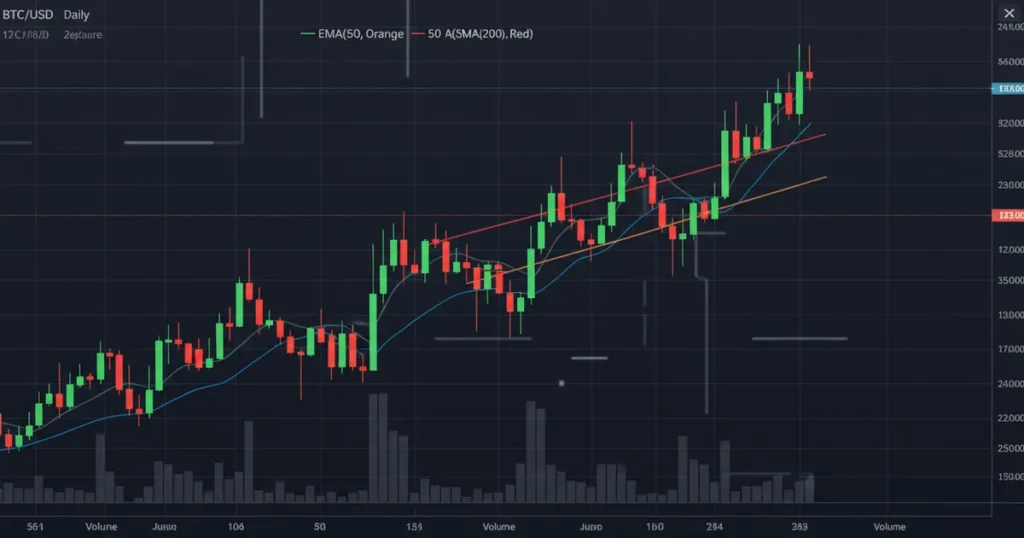
My recommended starter setup:
- 20 EMA (blue): Short-term trend and entries
- 50 EMA (orange): Medium-term trend
- 200 SMA (red): Long-term trend and major support/resistance
Color coding matters more than you think. During fast moves, you need to instantly know which line is which. I learned this the hard way during a volatile Bitcoin dump when I confused my 50 and 200 MAs and entered a position at the worst possible moment.
Pro tip: Don’t overload your chart. Three to four MAs maximum. More than that becomes visual noise that hurts more than helps.
5 Moving Average Trading Strategies That Actually Work
Now the practical stuff. These are strategies I use regularly.
Strategy #1: The Golden Cross and Death Cross
You’ve probably heard these terms. The Golden Cross happens when the 50-day MA crosses above the 200-day MA. It signals a potential new bull trend.
The Death Cross is the opposite 50-day crosses below 200-day. It warns that bears are taking control.
Important Warning:
Don’t just buy the instant a Golden Cross forms. Wait for confirmation. I want to see price hold above both MAs for at least 3 days with decent volume before entering. The cross itself is the alert, not the trigger.
Strategy #2: Moving Average Crossover (Fast vs Slow)
This uses two MAs of different periods. When the faster one crosses above the slower one, that’s a bullish signal. When it crosses below, bearish.
Popular combinations:
- 9 EMA / 21 EMA: Day trading setups
- 20 EMA / 50 EMA: Swing trading entries
- 50 SMA / 200 SMA: Position trading (Golden/Death Cross)
Strategy #3: The Moving Average Bounce Strategy
In a strong uptrend, price often pulls back to a key MA before bouncing higher. This pullback is your buying opportunity.
What I look for:
- Clear uptrend (price above 50-day MA)
- Price pulls back to touch the 50-day MA
- Volume decreases on the pullback (healthy correction)
- Bounce candle with increasing volume
The key is confirmation. Don’t buy the touch. Buy the bounce. And make sure volume supports the move.
Strategy #4: Multiple MA Alignment for Trend Confirmation
When price is above the 20 MA, which is above the 50 MA, which is above the 200 MA all aligned upward that’s a strong trend. These are the highest-probability trades.
I only take aggressive positions when I have full alignment. Partial alignment means smaller position sizes and tighter stops.
Strategy #5: Using MAs as Dynamic Stop Loss Levels
Instead of fixed dollar stops, trail your stop loss just below the MA that matches your timeframe.
For swing trades, I trail my stop below the 20 EMA. If price closes below it convincingly, I exit. This lets winners run while protecting profits. For more on this approach, check out my guide on setting stop losses.
Common Moving Average Mistakes (That Cost Me $8,000)
I need to be honest here. These mistakes aren’t theoretical. I made every single one of them.
Mistake #1: Trading Every Crossover Signal (The Whipsaw Trap)
Summer 2020. Bitcoin was stuck between $9,000 and $10,000 for months. Every time I saw a 9/21 EMA crossover, I jumped in. Long. Short. Long again.
The result? Death by a thousand cuts. That ranging market whipsawed me back and forth until I’d lost $8,000 chasing signals that went nowhere.
“Moving averages are best used as a context tool to understand market trends and cycles.” Garrett, SMB Training technical expert
The lesson burned into my brain: MA crossovers only work in trending markets. In sideways chop, they’ll destroy you.
Mistake #2: Ignoring Market Context and Volume
A crossover with no volume is meaningless. I’ve seen beautiful Golden Crosses fail immediately because there was no buying pressure behind them.
Now I require volume confirmation. The crossover candle should have at least 1.5x average volume, ideally 2x. Low volume crossovers get ignored.
Mistake #3: Using MAs in Sideways/Choppy Markets
This connects to mistake #1. MAs are trend-following tools. They need a trend to follow.
When Bitcoin is consolidating in a tight range, put the MA strategies aside. Use RSI indicator for overbought/oversold instead. Or just wait for a breakout.
Mistake #4: Not Combining with Other Indicators
Moving averages alone give you an incomplete picture. I always combine them with:
- RSI: Confirms momentum direction
- Volume: Validates the strength of moves
- Support/Resistance: Confluence zones are highest probability
When a 50 EMA bounce aligns with a horizontal support level AND RSI is oversold that’s a setup I’ll size into with confidence. Single-indicator trades are gambling.
Mistake #5: Forgetting That MAs Are Lagging Indicators
This is crucial. Moving averages confirm trends after they start. They don’t predict the future.
By the time a Golden Cross forms, the trend has already begun. You’re not catching the bottom. You’re confirming the move is real. That’s valuable, but it’s not magic.
Research shows EMAs are more sensitive to noise than SMAs. A temporary price spike can trigger false signals that SMAs would ignore. Keep that in mind when choosing your tools.
How to Combine Moving Averages with Other Indicators
Here’s how I build confirmation into my setups:
Powerful Combinations:
- MA + RSI: Price above 50 EMA AND RSI above 50 = bullish confirmation
- MA + Volume: Crossover with 2x average volume = reliable signal
- MA + Support/Resistance: MA bounce at horizontal support = highest probability
- MA + MACD: MACD crosses bullish while price breaks above 50 EMA = strong entry
The MACD indicator literally uses moving averages in its calculation. When MACD and your chart MAs agree, pay attention.
I also recommend learning Bollinger Bands which use MAs as their centerline. They add volatility context that plain MAs don’t provide.
Rule of thumb: Never use more than 2-3 indicators total. Analysis paralysis is real. Pick your favorite combination and master it.
Advanced Moving Average Techniques
Once you’ve got the basics down, these techniques take it further.
Using Multiple Timeframe Analysis
Check the daily chart’s 200 MA to understand the overall trend. Then drop to the 4-hour chart and use the 20 EMA for entry timing.
This top-down approach keeps you aligned with the bigger picture while finding precise entries on smaller timeframes.
Adjusting MA Periods for Different Crypto Volatility
Bitcoin moves differently than small-cap altcoins. Standard 50/200 settings work well for BTC because it’s relatively stable (for crypto).
For volatile altcoins, I adjust periods upward about 50%. Instead of 20/50, I might use 30/75. This filters out more noise without sacrificing responsiveness.
According to research on technical trading rules in cryptocurrency markets, a 20-day MA strategy on 11 cryptos generated 8.76% annual excess return. But results varied by asset. Adjust your settings based on what you’re trading.
The 3-EMA Strategy for Scalpers
Use 5, 12, and 26 EMAs together. Trade only when all three align in the same direction and price respects them as support or resistance.
This setup is aggressive. Only use it in strong trends with clear directional bias. In choppy markets, it’ll chew you up.
Risk Management When Trading with Moving Averages
No strategy matters if you blow up your account first. I’m serious about risk management after learning the hard way.
Core rules I follow:
- Position sizing: Risk only 1-2% of capital per trade, regardless of how confident the MA signal looks. Learn more about position sizing in crypto.
- Stop loss placement: Set stops 2-3% below the MA you’re using for the signal. If I’m buying a 50 EMA bounce, my stop goes below that 50 EMA.
- MA breakdown = exit: If price closes below your key MA with volume, don’t hope. Cut the position. Hope isn’t a strategy.
- Distance from MA = risk: Buying when price is extended far above the 50 EMA increases risk. Wait for a pullback closer to the MA for better entries.
For deeper position sizing principles, that link breaks down the math behind proper sizing.
Good trading psychology matters here too. It takes discipline to cut a position that’s not working, especially when you were confident in the setup. But MAs fail sometimes. Accept it and move on.
Real-World Example: Trading Bitcoin with the 50/200 MA Strategy
Let me walk you through an actual trade setup.
Case Study: Bitcoin Golden Cross October 25, 2023
Setup: The 50-day SMA crossed above the 200-day SMA around $34,000. Classic Golden Cross.
Entry: Waited for 3-day confirmation above both MAs. Entered at $34,500.
Stop Loss: Placed at $32,000 (below the 200-day MA support).
Result: Bitcoin rallied to $44,000 by December. That’s a 27% gain in two months.
Final Exit: Held through volatility. When the 50-day crossed back below the 200-day in April 2024, exited at $63,000.
Risk-Reward: Risked $2,500 to make $28,500. That’s over 11:1 R:R.
The lessons from this trade:
- Patience on entry: Waiting for confirmation avoided potential fakeouts
- Strict stops: The 200-day MA provided a logical invalidation point
- Let it run: Trailing with the MAs instead of taking quick profits captured the full move
According to academic research on adjustable-band moving average algorithms, both standard and adjustable MA strategies tend to outperform simple buy-and-hold over time. This Bitcoin trade was a perfect example.
FAQs About Moving Averages in Crypto Trading
Which moving average is best for crypto day trading?
The 9 EMA and 21 EMA combination on 15-minute to 1-hour charts works well for most day traders. They’re responsive enough to catch intraday moves without generating excessive false signals.
Should I use SMA or EMA for Bitcoin?
Use EMA for entries and exits because it reacts faster. Use SMA for the 200-day trend context because it’s less prone to noise. I use both together.
How many moving averages should I use?
Maximum three. More than that creates confusion and visual clutter. The popular combo is 20/50/200. Master that before adding complexity.
Do moving averages work in bear markets?
Yes, but inverted. In bear markets, trade bounces to MAs as resistance for short entries. Or use MA breaks above key levels as signals that the trend might be changing. The same principles apply they just point the other direction.
What’s the best MA crossover strategy?
The 50/200 Golden Cross for position trading and the 9/21 EMA for day trading. But only in trending markets with volume confirmation. In sideways chop, skip crossover signals entirely.
Final Thoughts: Moving Averages Are Tools, Not Magic
Every professional trader uses moving averages. They’re foundational. But they’re not a crystal ball.
Start simple. Add the 50-day and 200-day MAs to your Bitcoin chart. Watch how price interacts with them. Notice the bounces. Notice the breakouts. Get a feel for how they work before adding more complexity.
Combine them with volume, support/resistance, and market context. That’s where the real edge comes from not from the MAs alone.
Paper trade your strategy for at least 20 trades before risking real money. MAs work best in trending markets and fail in chop. Learning to identify which environment you’re in is half the battle.
That ETH rally I missed in 2021? It cost me 40% gains I’ll never get back. But the lesson forced me to finally learn this indicator properly. Since then, moving averages have been central to my trading. They’ve made me far more than they ever cost me once I stopped ignoring them.
Open TradingView, add these MAs to Bitcoin, and watch for the next crossover with volume confirmation. That’s your homework.
When you’re ready to put these strategies into action, you’ll need a solid platform. Check out my guide to the best crypto exchanges for recommendations on where to trade.