What is Crypto Position Trading (And Why It Finally Made Me Patient)
Position trading in crypto means holding for weeks or months to capture major trends. Learn how this patient strategy differs from day trading and swing trading.

In this article
I spent nearly two years glued to 5-minute charts, chasing every wick and fakeout like my life depended on it. My sleep suffered. My relationships suffered. And my P&L? Let’s just say the fees alone could have funded a nice vacation. Then I discovered crypto position trading, and everything changed. Not overnight, but slowly, like learning to breathe again after holding your breath for way too long.
Position trading is the strategy that finally taught me patience isn’t passive. It’s a deliberate edge. If you’re exhausted from staring at screens all day, or if you’ve ever been stopped out of a trade only to watch it rally 40% without you, this guide is for you.
What is Position Trading in Crypto
Crypto position trading means holding a trade for weeks, months, or sometimes even years. You’re not trying to catch every bounce. You’re identifying major trends and riding them until the thesis breaks or the target gets hit.
Think of it like surfing. Day trading is splashing around in the shallows, trying to catch every ripple. Position trading is sitting out past the break, waiting for the big wave. You’ll miss a lot of small ones. But when the right set comes, you ride it all the way in.
The Time Horizon That Changes Everything
The defining feature of position trading is the timeframe. You’re looking at weekly and monthly charts, not the 1-minute candle that just printed red. This longer horizon filters out noise. It lets you see the actual trend beneath all the chaos.
I remember the first time I zoomed out from a 15-minute chart to a weekly chart on ETH. The pattern that looked like random noise up close was actually a clean uptrend with higher highs and higher lows. I felt like I’d been reading a book with my face pressed against the page, and someone finally told me to sit back.
Position traders rely heavily on moving averages like the 50-day and 200-day MA to confirm whether a trend is intact. When the 50 crosses above the 200 (the golden cross), that’s a signal position traders love. When it crosses below (the death cross), it’s time to get cautious.
How Position Trading Differs from Day Trading and Swing Trading
The differences go beyond just “how long you hold.” Each style demands a completely different mindset, skill set, and lifestyle commitment.
| Factor | Day Trading | Swing Trading | Position Trading |
|---|---|---|---|
| Holding Period | Minutes to hours | Days to weeks | Weeks to months |
| Charts Used | 1-min to 15-min | 1-hour to daily | Daily to monthly |
| Time Commitment | 40+ hours/week | 10-20 hours/week | 2-5 hours/week |
| Primary Analysis | Technical | Technical + some fundamental | Fundamental + macro |
| Stress Level | Very high | Moderate | Low to moderate |
For a deeper dive into how these approaches compare, check out this position trading vs swing trading comparison that breaks down ten key differences.
Why I Finally Switched to Position Trading (After Burning Out on Scalping)
I’ll be honest with you. I didn’t choose position trading because I read some article about it. I ended up here because the scalping strategy I was running nearly broke me.
Back in 2022, I was taking 15-20 trades a day. Alarm at 4 AM for the Asian session. Coffee by 4:15. Charts by 4:20. I was making money, but the fees were eating half my gains. Worse, I was making decisions at 2 AM that I’d never make at 2 PM. The exhaustion was compounding, and my edge was eroding.
The turning point came during a particularly brutal week where I got stopped out of a long ETH position three times in two days, each time with a tight stop. Then I watched ETH rally 38% over the next six weeks. I had the right thesis. I just couldn’t hold through the noise.

That’s when it clicked: I wasn’t wrong about the market. I was wrong about the timeframe. My trading psychology was shot, and I needed a strategy that worked with my temperament, not against it.
My first real position trade was a 6-week ETH hold through some gut-wrenching 15% drawdowns. But the thesis held. The fundamentals held. And when I finally exited near my target, the profit was larger than my best month of scalping. With about 1/100th of the stress.
How Position Trading Actually Works
Position trading isn’t just “buy and hope.” It’s a structured approach with clear entries, defined risk, and planned exits. Here’s how I break it down.
Identifying Long-Term Trends Worth Riding
Everything starts with the trend. Position traders live and die by one question: Is this asset in a sustained uptrend or downtrend?
I use weekly charts as my primary timeframe. If the 50-day moving average is above the 200-day MA, and price is making higher highs, I’m interested. I also look for fundamental catalysts that could sustain a multi-month move:
- Bitcoin halving cycles: Historically trigger 12-18 month bull markets
- Major protocol upgrades: Like Ethereum’s transition to proof-of-stake
- Institutional adoption signals: ETF approvals, corporate treasury allocations
- Macro conditions: Interest rate cycles, liquidity expansion
Understanding market cycles is critical here. Position trading during a confirmed uptrend is playing the game on easy mode. Trying to position trade during a bear market? That’s a recipe for slow bleeding.
Entry Strategy for Position Traders
I don’t chase pumps. My entries come from a combination of technical and fundamental signals. I’m looking for confluence between support and resistance levels, moving average bounces, and MACD indicator momentum confirmation.
My Position Entry Checklist
- Weekly trend is up (price above 50-day MA)
- Fundamental catalyst identified (halving, upgrade, adoption)
- Price is near support, not chasing a breakout
- MACD showing momentum shift or continuation
- Risk/reward ratio is at least 3:1
For more specific entry and exit signals for trend traders, I recommend studying how different indicators confirm each other before committing capital.
Setting Stop Losses You Can Actually Live With
This is where most new position traders mess up. They bring their day trading stops (2-3% below entry) into a position trade, and they get shaken out immediately.
Position trades need wider stops. I typically place mine 10-20% below my entry, depending on the asset’s normal volatility. Yes, that means accepting a larger dollar loss if the stop hits. But that’s why setting stop losses correctly goes hand-in-hand with position sizing. Smaller position, wider stop, same dollar risk.
Exit Strategy: When to Take Profits
I use a layered approach to taking profits. Instead of trying to sell the exact top (spoiler: you won’t), I scale out in chunks:
- 25% at first target (usually a key resistance level)
- 25% at second target (next major resistance or round number)
- Trail the remaining 50% with a moving average stop (close below the 50-day MA)
This way, I lock in guaranteed profit while keeping exposure to further upside. The trailing portion catches those multi-month parabolic moves that make position trading so rewarding.
Position Trading vs Swing Trading vs Day Trading: What’s Right for You?
There’s no objectively “best” strategy. The right one depends on your lifestyle, personality, and capital situation.
- Choose position trading if: You have a full-time job, prefer lower stress, and can tolerate seeing unrealized losses for weeks
- Choose swing trading if: You have 10-20 hours per week, enjoy technical analysis, and want more frequent trades
- Choose day trading if: You can commit full-time, handle high stress, and have strong emotional control
Here’s something most guides won’t tell you: you can combine strategies. I run a core position portfolio (the bulk of my capital) while occasionally taking swing trades with a smaller allocation. The position trades are my foundation. The swing trades are my bonus rounds.
The Best Cryptos for Position Trading
Not every crypto is suitable for a multi-month hold. Some tokens can lose 90% in a week due to low liquidity or rug pulls. Position trading demands assets you can trust to still exist when you check back in three months.
Why Market Cap Matters for Position Traders
I stick to the top 20-30 cryptocurrencies by market cap for my position trades. Bitcoin and Ethereum are always my core holdings. They have the deepest liquidity, the most institutional interest, and the longest track records.
For smaller allocations, I’ll look at established layer-1s and DeFi protocols with real revenue and active development. But I research fundamentals hard: team background, tokenomics, on-chain adoption metrics, and competitive positioning.
Liquidity is Your Friend Over Months
Liquidity matters more over longer timeframes than most people realize. If you’re holding a micro-cap token for three months and it drops 40%, can you actually exit? With thin order books, your market sell could push the price down another 10-15% on slippage alone.
I learned this the hard way on a mid-cap DeFi token back in 2023. Great thesis. The protocol was growing. But when sentiment turned, there was nobody on the other side of my trade. I took a 35% loss that should have been 20% because I couldn’t get out cleanly.
Risk Management for Position Traders (The Mistakes I Made)
If there’s one section of this article I want you to read twice, it’s this one. Good risk management is the only thing that separates traders who survive from those who blow up.
Position Sizing When You’re Holding for Months
The golden rule: never risk more than 1-2% of your total portfolio on a single position trade. As the risk management strategies guide from Changelly puts it: “Professional traders adhere to a strict rule: in a single trade, you should risk an amount that does not exceed 1% (maximum 2%) of your total trading capital.”
Quick Position Sizing Example
Portfolio: $10,000
Max risk per trade: 2% = $200
Stop loss: 15% below entry
Position size: $200 ÷ 0.15 = $1,333
This means you’d buy $1,333 worth of the asset, with a stop loss that risks only $200 if triggered.
I like to think about portfolio allocation in tiers: 60% in BTC/ETH core positions, 30% in large-cap altcoins, and 10% for higher-conviction speculative plays. This structure keeps the foundation solid even when individual positions go sideways.
The Stop Loss Mistake That Cost Me $7,500
This one still stings. Early in my position trading journey, I set a 5% stop loss on a BTC position during what I correctly identified as a bull market breakout. Normal Tuesday volatility shook me out. I re-entered higher, got stopped again, re-entered again. Three stop-outs in a row, plus fees, cost me $7,500.
BTC then rallied 40% over the next two months. I was right on the thesis. I was just using day-trading stop levels on a position trade. The lesson: your stop loss needs to match your timeframe. Wider timeframe, wider stop, smaller position.
Common Position Trading Mistakes to Avoid
After three years of position trading, I’ve made most of these mistakes myself. Save yourself the tuition:
- Overtrading: If you have 15 open positions, you’re not position trading. You’re running a poorly diversified fund. Stick to 3-5 positions max.
- Checking charts hourly: This defeats the entire purpose. Hourly chart-checking triggers emotional decisions. I check weekly. Sometimes less.
- Ignoring fundamental changes: A protocol hack, a regulatory crackdown, a team departure. These are valid reasons to exit early, even if your technical levels haven’t broken.
- Holding through trend reversals: Denial is expensive. If the 50-day MA crosses below the 200-day and your candlestick chart patterns are screaming reversal, listen. You can always re-enter.
- Using leverage: Position trading and leverage don’t mix. A 15% drawdown on a 5x leveraged position wipes you out. Spot only for position trades.
Position Trading Success Rate: What the Research Says
Let’s talk numbers. A study applying the Turtle Trading System to cryptocurrency markets found an average profitability of 52.75% across 41 trades. That might not sound exciting, but combined with proper position sizing where winners are significantly larger than losers, it’s a profitable strategy over time.
“Position trading allows you to capitalise on broader market trends without the need for constant management. While they may not yield quick profits like day trading, they offer a more balanced approach that focuses on sustainable growth over time.”
— CMC Markets
A comprehensive survey on cryptocurrency trading published in Financial Innovation also found that simple buy-and-hold strategies often outperform complex active trading approaches. Position trading sits in the sweet spot: active enough to manage risk, passive enough to capture major moves.
My Position Trading Strategy in 2025
I’ve refined my approach through years of trial and error (heavy on the error at first). Here’s what actually works for me now.
The Setup I Actually Use
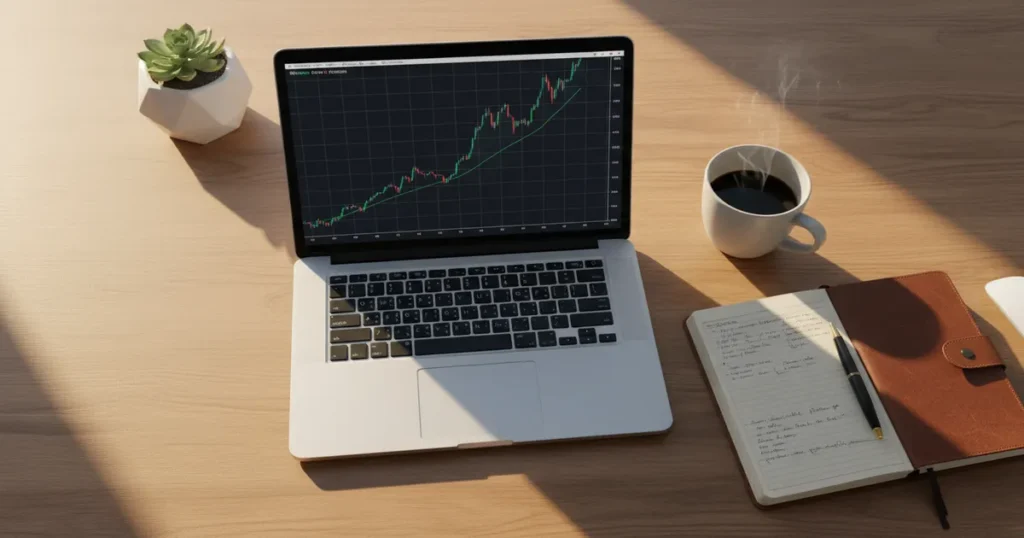
Every Sunday morning, I sit down with coffee and do my weekly review. Not during the week. Sunday. That’s it. I look at:
- Weekly charts for my open positions (trend still intact?)
- Key moving averages on assets I’m watching
- On-chain metrics (active addresses, exchange flows, whale movements)
- Macro calendar for the coming week (Fed meetings, CPI data, major unlocks)
If nothing has changed, I do nothing. Most Sundays, the answer is “stay the course.” And that’s fine. The discipline of doing nothing when nothing needs doing is half the battle in position trading.
How I Track Macro Trends
I combine dollar cost averaging with strategic position entries. My DCA runs automatically. But when I see a significant macro catalyst aligning with a technical setup, I’ll add a lump-sum position on top of my DCA base.
For tools, I use TradingView for charts, Glassnode for on-chain data, and a simple spreadsheet to track my positions and journal my reasoning. Nothing fancy. The simpler the system, the more likely you are to actually follow it.
Is Position Trading Right for You?
Before you jump in, ask yourself these questions honestly:
Position Trading Self-Assessment
- Do you have a day job? Position trading is ideal for people who can’t watch charts during market hours.
- Can you handle seeing -20% unrealized losses? Because it will happen. Multiple times.
- Are you patient? Some positions take months to play out. Can you wait?
- Do you have enough capital to not panic? If a 15% drawdown makes you lose sleep, your position is too large.
The time commitment is genuinely minimal: 2-5 hours per week versus 40+ hours for day trading. But the emotional commitment is real. You need the discipline to stick with your thesis through volatility, and the wisdom to know when the thesis has actually changed versus when you’re just scared.
For navigating the emotional side of trading, I’d strongly recommend reading up on trading psychology. It’s the skill that makes every other skill work.
Final Thoughts: Patience as a Trading Edge
Position trading taught me something I couldn’t learn from scalping a thousand trades: the market rewards patience more than speed. Being right on the big moves matters more than being right on twenty small ones.
I started this journey exhausted, over-leveraged, and making emotional decisions at 3 AM. Position trading didn’t just fix my P&L. It fixed my relationship with the market. I sleep through the night now. I enjoy weekends without checking Binance every twenty minutes. And somehow, my returns are better than they ever were when I was grinding 16-hour days.
Start small. Track everything. Journal your reasoning so you can learn from both wins and losses. And remember the paradox that took me years to accept: in trading, doing less often makes you more.
If you’re ready to get serious about protecting your capital while you hold, start with our guide on risk management. And if you’re still figuring out which trading style fits your life, compare the differences between swing trading and position trading, or explore bear market strategies for when the trend turns against you.