What is Crypto Grid Trading (And Why It Finally Made Me Consistent Profits)
Learn what crypto grid trading is and how automated grid bots can generate consistent profits in sideways markets. Real performance data, setup guide, and mistakes to avoid.

In this article
My Grid Trading Wake-Up Call: When Manual Trading Finally Broke Me
I remember the exact night crypto grid trading saved my trading career. It was 2:47 AM, and I was staring at a BTC chart with bloodshot eyes, waiting for a breakout that never came. I’d been glued to screens for 14 hours, had two losing trades, and my coffee had gone cold three times. Sound familiar?
After years of manual trading that left me emotionally wrecked and physically exhausted, I stumbled across grid trading in a Discord server. Some quiet trader kept posting consistent small gains while the rest of us were riding emotional rollercoasters. My first thought? “This is too boring to work.” My second thought, three months later? “Why didn’t I find this sooner?”
Grid trading isn’t glamorous. It won’t make you rich overnight. But it did something no other strategy managed for me: it made my trading psychology irrelevant. And for someone who blew up an account because of emotional decisions, that was everything.
What is Grid Trading in Crypto?
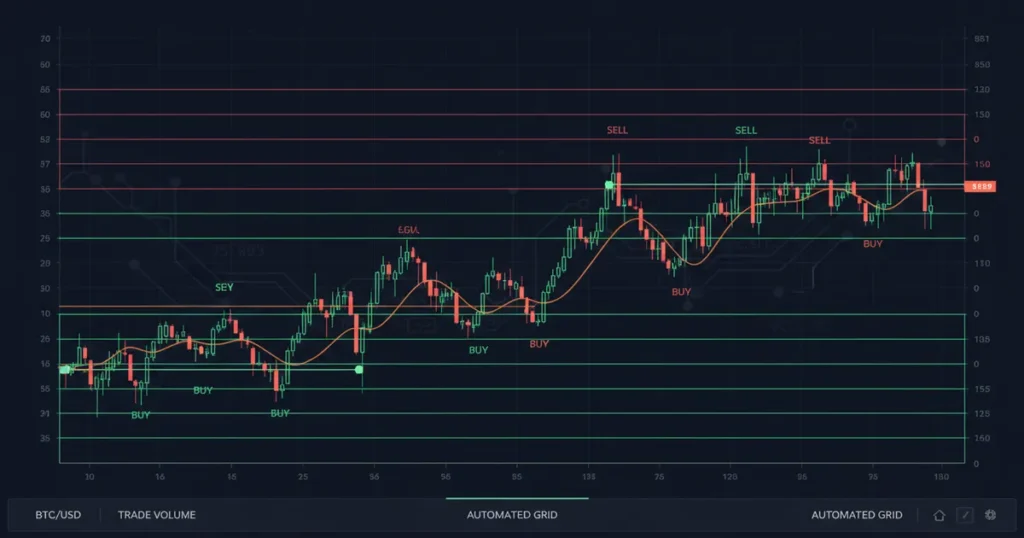
Grid trading is an automated strategy that places a series of buy and sell orders at preset price intervals, creating a “grid” of orders above and below the current price. As the market bounces within a range, the bot automatically buys low and sells high on each swing, capturing small profits with every completed cycle.
Think of it as a form of algorithmic trading designed specifically for sideways markets. Instead of predicting direction, you’re profiting from crypto market volatility itself.
The Fishing Net Analogy
Imagine casting a fishing net across a river. You don’t need to know exactly where the fish will swim. You just need them to move through your net. Grid trading works the same way. Your buy and sell orders are the net, and price movements are the fish. The more the price bounces around, the more “fish” you catch.
Grid Trading vs Traditional Trading
Traditional trading demands you predict where price is going. Grid trading only needs price to move. That’s a fundamentally different game. You’re not betting on direction. You’re betting on volatility. And in crypto, volatility is the one thing you can almost always count on.
This is exactly why I recommend grid trading alongside other approaches like swing trading and dollar cost averaging. Each works in different market conditions.
How Grid Trading Bots Actually Work (The Technical Breakdown)
Let’s get under the hood. Understanding the mechanics will help you set up a bot that actually makes money rather than one that bleeds fees.
Setting Your Price Range
You define the upper and lower boundaries where you expect price to trade. For BTC, this might be $90,000 to $105,000 during a consolidation phase. Set it too narrow and price breaks out constantly. Too wide and your capital is spread thin. I aim for 1.5 to 2 times the recent trading range.
Grid Levels and Spacing
Within your range, the bot places evenly spaced orders. More grids mean more trades but smaller profits per trade. Fewer grids mean bigger profits per trade but fewer opportunities.
Beginner Grid Settings (BTC/USDT)
- Grid levels: 15-25 grids
- Spacing: 0.3% to 0.5% between levels
- Price range: 10-30% of current price
- Pair: BTC/USDT or ETH/USDT for best liquidity
Arithmetic vs Geometric Grids
Arithmetic grids use equal dollar spacing (every $500, for example). Geometric grids use equal percentage spacing (every 1%). For crypto, geometric grids almost always perform better because price moves in percentages, not fixed dollars. A $500 move means something very different at $20,000 versus $100,000.

The Buy-Sell Cycle Explained
Here’s the actual loop. The bot places buy orders below the current price and sell orders above it. When price dips and fills a buy order, the bot immediately places a sell order one grid level higher. When price rises and fills that sell, the bot places a new buy order below. Each completed buy-sell cycle captures a small profit. This runs 24/7 without you touching anything.
When Grid Trading Works Best (And When It Fails Hard)
Perfect Market Conditions for Grid Bots
Grid trading thrives in ranging markets with decent volatility. Think Bitcoin consolidating between $90K and $100K for weeks. The price bouncing between support and resistance is pure fuel for grid bots. Bitcoin’s massive daily volume (over $35 billion) and 12-18% monthly volatility make it ideal.
When Grid Trading Becomes a Nightmare
Here’s what most “grid trading is amazing!” articles won’t tell you. During strong trends, grid bots get destroyed. In a sustained downtrend, your bot keeps buying as price falls, accumulating losses. In a strong uptrend, it sells too early, and you watch gains you should’ve captured disappear.
I learned this during a sudden crash in 2022. My grid bot happily bought every dip while the floor kept falling. That experience taught me to always pair grid trading with an understanding of market cycles and bear market strategies.
Real Grid Trading Performance: The Numbers Don’t Lie
Case Study: 180% APR During Bitcoin Consolidation
A 180% APR case study documented a grid bot running while Bitcoin stayed flat between $90K and $100K. The bot captured hundreds of small price swings that a buy-and-hold strategy would have returned basically zero on. A separate 3Commas study across 100 verified users showed an 18.7% average annualized return over 12 months.
“Grid trading is more about money and risk management than trading.” — Forex Factory community consensus
My Personal Grid Trading Results
My first grid bot was a BTC/USDT setup on Binance with 20 grid levels across a 15% range. In two weeks of sideways action, it returned about 3.2%. Not life-changing, right? But here’s what mattered: I slept through the night for the first time in months. No 3 AM chart checks. No emotional panic sells. The consistency was more valuable than any single big win. I know how to take profits manually, but having a bot do it removed the one variable I couldn’t control: myself.
Setting Up Your First Grid Trading Bot (Step-by-Step)
Choosing Your Platform
You need a platform with built-in grid bots or a third-party service. Here are your best options among the best cryptocurrency trading bots:
- Pionex: 16 free built-in bots, lowest fees at 0.05%
- Binance: Free grid bot, massive liquidity, ideal for BTC/ETH pairs
- Bybit: Free built-in grid bot with solid interface
- 3Commas: More advanced features, starts at $20/month
If you’re just getting started, check our guide to the best crypto exchanges to pick the right platform for your needs.
Recommended Grid Parameters for Beginners
Start simple. Pick BTC/USDT as your crypto trading pair. Use 15-25 grid levels with 0.3-0.5% spacing. Set your range at about 1.5 times the recent trading range. Run it for at least two weeks before tweaking anything.
Capital Allocation Strategy
This is where most beginners go wrong. Start with 5-10% of your portfolio. Never exceed 20% in grid strategies. Each grid level should hold about 3-7% of your total grid allocation. If you’re starting with small capital, grid trading actually works well because the bot does the heavy lifting while you learn.
Grid Trading vs Other Crypto Strategies
| Strategy | Best Market | Time Needed | Stress Level |
|---|---|---|---|
| Grid Trading | Sideways/ranging | Low (automated) | Low |
| DCA | Any (long-term) | Minimal | Very low |
| Swing Trading | Trending | Moderate | Moderate |
| Scalping | Volatile | Very high | Very high |
| HODLing | Bull market | None | Low |
The smart play? Combine strategies. Run grid bots during consolidation, switch to swing trading during trends, and maintain a DCA base layer for long-term accumulation. That’s portfolio rebalancing in action.
7 Grid Trading Mistakes That Cost Me Real Money
Every single one of these cost me actual dollars. Learn from my pain so your wallet doesn’t have to.
-
Running Grids During Strong Trends
I left a grid bot running into a 30% Bitcoin rally in early 2024. The bot sold at every level while price kept climbing. I captured pennies while missing thousands. Now I check market cycles before deploying any grid.
-
Setting Price Range Too Narrow
My first few grids broke out within days. A 5% range on BTC is basically useless. Go wider than you think you need.
-
Too Many Grids (Death by Fees)
100 grid levels sounds great until fees eat 80% of your profits. Keep spacing above 0.3% to stay profitable after trading costs.
-
No Stop-Loss
This is the one that almost wrecked me. Running a grid bot without a stop-loss below your range is like driving without brakes. Learn about setting stop losses before you deploy any bot.
-
Using Leverage with Grid Bots
Leverage trading amplifies everything, including grid trading losses. I tried 3x leverage on a grid once. The liquidation happened faster than I could react.
-
Ignoring Market Regime Changes
Markets shift from ranging to trending. Your grid bot doesn’t know the difference. Check conditions weekly.
-
Over-Allocating to Grid Strategies
I once put 40% of my portfolio into grid bots. When the market trended down, I lost way more than necessary. Now I follow strict position sizing rules: 5-10% to start, 20% maximum.
If you recognize yourself in any of these, you’re not alone. These are all common trading mistakes that nearly every grid trader makes at some point.
Grid Trading Risk Management: What Actually Matters
Proper risk management strategies will determine whether grid trading builds your account or drains it. Here’s what I’ve learned matters most:
Grid Trading Risk Checklist
- Position size: Start with 5-10% of portfolio, never exceed 20%
- Stop-loss: Always set one below your lowest grid level
- Leverage: Avoid it entirely with grid bots
- Pair selection: Stick to high-liquidity trading pairs (BTC, ETH)
- Fee check: Grid spacing must exceed 2x your trading fees
- Weekly review: Monitor for market regime changes
- Exit plan: Know your shutdown conditions before starting
Is Grid Trading Right For You? The Honest Assessment
Grid trading works best for traders who can recognize ranging markets, resist the urge to intervene with their bots, and treat it as one tool in a larger strategy. It’s not for anyone chasing overnight riches or addicted to the adrenaline of manual trading.
The time commitment is genuinely low. After initial setup, you’re looking at a weekly check-in. The risk is moderate with proper management. And the psychological relief of automated, emotion-free trading? For someone like me who fought trading psychology demons for years, that’s priceless.
Grid trading didn’t make me a millionaire. But it made me a consistent, disciplined trader who actually sleeps at night. Sometimes the boring strategy is the one that keeps you in the game long enough to win.
What to Read Next
If grid trading sounds like a fit for your style, dig deeper into these resources to build a complete strategy. Start with our guide to the best cryptocurrency trading bots to compare platforms. Then review risk management strategies to protect your capital. And if you’re still building your foundation, starting with small capital will show you exactly how to begin without risking more than you can afford.