What is a Bull Market (And Why I Stopped Chasing the Top)
Learn what defines a bull market, how to identify one, and the mistakes that cost me thousands. Bull market psychology, strategies, and warning signs explained.

In this article
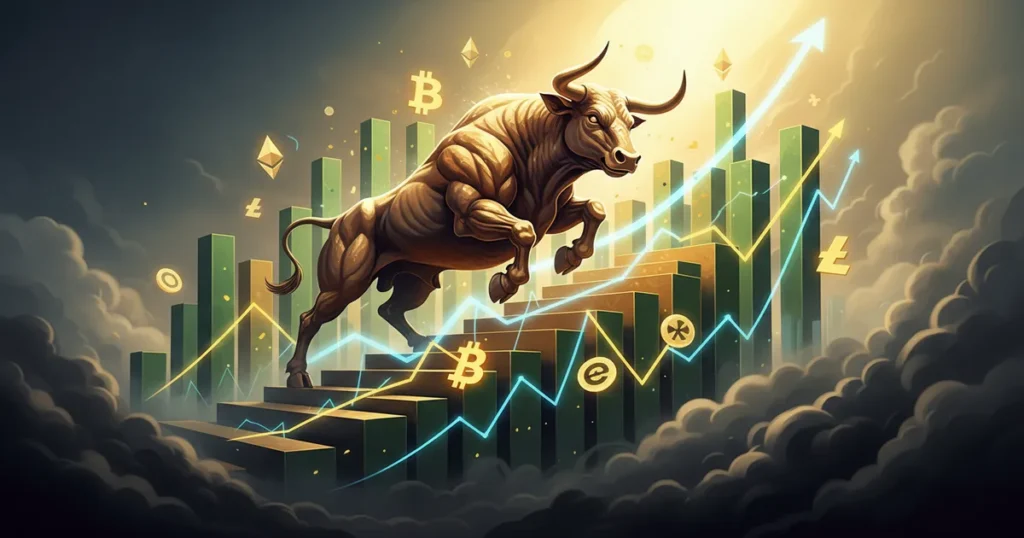
A bull market is when prices surge, confidence explodes, and everyone thinks they’re a genius. I know the feeling. In November 2021, I was up 340% on my crypto portfolio and genuinely believed I’d cracked some code. Three months later, I’d given back most of those gains because I never sold a single coin.
That’s the dirty secret about bull markets. Making money is easy. Keeping it? That’s where most of us fail. Understanding crypto market cycles saved me from making the same mistake twice.
In this article, I’ll explain what defines a bull market, how to spot one forming, and the specific mistakes that cost me thousands. More importantly, I’ll share what I do differently now.
What is a Bull Market? The Technical Definition
According to the SEC’s official bull market definition, a bull market occurs when a broad market index rises 20% or more over at least two months. Simple enough, right?
But here’s what took me years to understand: not every price spike is a bull market. Sometimes it’s just a dead cat bounce. Sometimes it’s a bear market rally that sucker-punches you right when you go all in.
The 20% Rule That Defines Bull Markets
The 20% threshold isn’t arbitrary. It separates meaningful uptrends from noise. In crypto, we see 20% moves in a week sometimes. That’s not a bull market. A true bull run needs:
- Sustained momentum: Prices hold gains and build on them over months
- Broad participation: Multiple assets rising together, not just Bitcoin
- Fundamental support: Real adoption, institutional buying, or improving macro conditions
Bull Markets vs. Market Corrections
A 10-15% pullback during a bull market is called a correction. It’s healthy. It shakes out weak hands. The problem? In real-time, corrections feel exactly like the start of a crash. I’ve panic sold during corrections more times than I care to admit.
5 Characteristics of Bull Markets (That Fool Everyone)
Every bull market I’ve lived through shares these five traits. Recognizing them is one thing. Not getting swept up in the euphoria is another.
- Rising prices setting new all-time highs repeatedly: Each dip gets bought. Each resistance becomes support.
- High investor confidence and buying activity: Trading volume explodes. New accounts open daily.
- Strong economic indicators: GDP growth, low unemployment, corporate earnings beating expectations.
- Favorable borrowing conditions: Low interest rates make leverage cheap and accessible.
- Increased IPO and token launch activity: In crypto, this means ICO booms, meme coin seasons, and every influencer launching a token.
In late 2021, I watched all five characteristics light up like a Christmas tree. The market was screaming that we were in peak euphoria. I convinced myself it was “different this time.” It wasn’t.
Historical Bull Markets: What Past Cycles Teach Us
Study enough market history and patterns emerge. According to historical crypto bull run analysis, every cycle follows a similar emotional arc: disbelief, hope, optimism, euphoria, then panic.
The 2017 Crypto Bull Run: ICO Mania
Bitcoin climbed from $1,000 to nearly $20,000. A 1,900% gain in twelve months. The driver? ICO mania. Everyone was launching tokens. Whitepapers promised the moon. Most projects went to zero within two years.
I wasn’t trading yet in 2017, but I watched from the sidelines. When the crash came, I thought crypto was dead. That turned out to be the buying opportunity of a lifetime.

The 2020-2021 Bull Run: Institutional Adoption
This one I lived. Bitcoin bull run history will remember 2021 as the year institutions showed up. MicroStrategy. Tesla. PayPal. Bitcoin went from $8,000 to $69,000.
I remember the exact moment I should have sold. November 10, 2021. Bitcoin hit $69,000 and I texted my sister that I was up six figures on paper. She asked if I was going to sell. I laughed and said we were going to $100K.
We didn’t.
Traditional Market Bull Runs
The S&P 500 has been in a secular bull market since the Global Financial Crisis recovery. Investors who stayed invested from 1980 to 2025 earned roughly 12% annually. Those who sold after downturns averaged 10%. That 2% difference? It’s the gap between $6.1 million and $3.6 million on $5K annual contributions.
The Psychology of Bull Markets: Why Smart People Make Dumb Decisions
Understanding trading psychology is the only thing that’s ever made me a better trader. Technical analysis helps. Fundamentals help. But psychology is everything.
FOMO: The Fear of Missing Out
Warren Buffett said it best: “Once a bull market gets underway, and once you reach the point where everybody has made money no matter what system they followed, a crowd is attracted into the game that is responding not to interest rates and profits but simply to the fact that it seems a mistake to be out of stocks.”
That crowd? In 2021, it was my friends quitting jobs to day trade crypto. My coworkers asking about Dogecoin. Random people at AA meetings wanting “hot tips.”
When everyone is making money, the fear of missing out overwhelms rational analysis.
The “Everyone’s a Genius” Effect
Another Buffett gem from Warren Buffett’s bull market warnings: “In a bull market, one must avoid the error of the preening duck that quacks boastfully after a torrential rainstorm, thinking that its paddling skills have caused it to rise in the world.”
I was that duck. My 340% gains had nothing to do with skill. I just happened to buy Bitcoin before a massive run. But I convinced myself I was special. I started taking bigger positions. Using more leverage. Ignoring my own risk rules.
The market taught me humility the hard way.
How to Identify a Bull Market (Before It’s Too Late)
These indicators help me recognize bull market phases in real-time:
- Rising price trends across multiple assets: Not just Bitcoin, but Ethereum, altcoins, and even stocks moving together
- Bitcoin Fear and Greed Index above 70: Persistent extreme greed readings signal bull conditions
- Bitcoin dominance patterns: Early bull markets see Bitcoin lead, then money rotates to altcoins during altcoin season
- Mainstream media coverage: When CNBC talks crypto daily, we’re well into the cycle
- On-chain metrics: Exchange outflows, whale accumulation, and declining exchange reserves
The tricky part isn’t identifying a bull market. It’s knowing when we’re early versus late in the cycle.
Smart Bull Market Strategies (That Actually Work)
After losing money in 2022, I rebuilt my approach from scratch. These strategies aren’t sexy. They won’t make you rich overnight. But they actually work.
Dollar Cost Averaging: The Boring Strategy That Wins
Dollar cost averaging removes the stress of timing the market. Buy the same amount weekly or monthly regardless of price. In a bull market, you’ll buy some at lower prices and some at higher prices. Over time, it smooths out.
I DCA’d $200 weekly throughout 2023 when everyone said crypto was dead. That boring discipline is paying off now.
Taking Profits: The Hardest Trade You’ll Ever Make
Here’s what I wish someone had drilled into my head in 2021: how to take profits systematically is the most important skill you’ll ever develop.
My current system:
Profit-Taking Ladder:
- Sell 10% of position at 2x initial investment
- Sell 25% at 3x
- Sell 50% at 5x
- Let remaining position ride with house money
It feels terrible selling when prices keep rising. But recouping your initial investment early means you’re playing with house money. That changes everything psychologically.
Position Sizing and Portfolio Rebalancing
Bull markets create concentration risk. That 5% altcoin position becomes 25% of your portfolio if it 5x’s. Regular portfolio rebalancing locks in gains and prevents one position from sinking your entire account.
7 Bull Market Mistakes That Cost Me Thousands
These aren’t theoretical warnings. Every one of these common trading mistakes came directly from my trading journal.
- Overconfidence from early gains: I mistook luck for skill and sized up too aggressively
- Overtrading to catch every move: Transaction costs and taxes ate into my profits
- Excessive leverage: Statistics show 71% of retail CFD traders lose money. Leverage trading amplifies losses as much as gains
- Ignoring fundamentals: I bought tokens based on Twitter hype, not actual utility
- Lack of diversification: I went all-in on one narrative that didn’t play out
- Abandoning risk management: I stopped using stop losses when “everything only goes up”
- Refusing to take profits: I held waiting for “the top” that never came
My $18,000 Lesson: In November 2021, I used 10x leverage on a Bitcoin position near the top. I was so confident we were going to $100K that I ignored every warning sign. When the crash started, my position got liquidated within 48 hours. $18,000 gone in two days. That single trade wiped out months of gains.
During volatile periods, crypto sees $180 million in daily liquidations. In November 2025 alone, a single liquidation cascade exceeded $1.1 billion. Leverage kills.
When Bull Markets End: Warning Signs I Wish I’d Seen
Leon Cooperman recently warned: “We are in the late innings of a bull market where bubbles can form and risks rise.” Recognizing these signs early can save your portfolio.
Distribution Phase Indicators
- Declining volume on rallies: Prices rise but fewer people are buying
- Smart money selling: Whale wallets reducing positions while retail buys
- Bearish divergences: Price makes new highs but momentum indicators don’t
Euphoria Warning Signs
- Extreme greed readings for weeks: Fear and Greed Index stuck above 80
- Peak mainstream coverage: Magazine covers asking “Is It Too Late to Buy?”
- The barber indicator: When your Uber driver asks about crypto, the top is near
- Parabolic price action: Vertical price moves disconnected from any fundamental news
In November 2021, I saw every single one of these signs. I told myself they didn’t apply because “institutions changed everything.” They didn’t.
Bull Markets vs. Bear Markets: Understanding the Full Cycle
Bull and bear markets are part of natural crypto market cycles. Neither lasts forever. Average bull markets run 2-3 years. Bear markets typically last 9-18 months.
Understanding this helps emotionally. Bull markets don’t mean prices only go up. Bear markets don’t mean crypto is dead. Having bear market strategies ready before the crash is essential.
The best traders I know prepare for bear markets during bulls. They take profits. They build cash positions. They don’t get caught off guard.
Final Thoughts: Surviving Bull Markets Means Preparing for Bear Markets
There’s a saying: “Bull markets are where money is made. Bear markets are where wealth is built.” I didn’t understand that in 2021. I do now.
Good risk management strategies aren’t optional. They’re the only thing separating traders who survive multiple cycles from those who blow up and quit.
Here’s what I do differently now compared to 2021:
- I take profits at predetermined levels, no matter how bullish I feel
- I never use more than 2x leverage (and usually none)
- I rebalance monthly to prevent concentration risk
- I ignore the FOMO and stick to my plan
You don’t have to make my mistakes. The information is all here. Whether you act on it is up to you.
Want to dive deeper into market psychology and strategy? Explore our guides on trading psychology, taking profits strategically, and understanding market cycles. The more you learn now, the better prepared you’ll be when the next bull run tests your discipline.