What is APY vs APR in Crypto (And Why I Stopped Trusting the Bigger Number)
APY vs APR in crypto explained: Learn the critical difference between these yield metrics, why APY is always higher, and how to avoid misleading returns.

In this article
If you’ve ever staked a token or browsed a lending platform, you’ve seen two numbers fighting for your attention: APY and APR. Understanding APY vs APR in crypto is the difference between knowing your real returns and getting blindsided by misleading math. I learned this the hard way back in 2021 when I chased a juicy yield number without understanding what it actually meant. Spoiler: it cost me more than a few sleepless nights.
In this guide, I’ll break down exactly what each metric means, when to use which one, and how to spot the red flags that separate real yield from marketing tricks. Whether you’re exploring DeFi yield farming or just parking some coins in a staking pool, this is the foundation you need before putting money to work.
What is APR in Crypto
APR stands for Annual Percentage Rate. It’s the simplest way to express interest. No compounding, no reinvestment, no tricks. Just a flat rate applied over one year.
Simple Interest Explained
Think of APR like a straightforward handshake deal. If someone offers you 10% APR on $1,000, you’ll earn exactly $100 over the year. That’s it. The interest doesn’t earn interest on itself. It just sits there, accumulating at a steady pace.
The formula is dead simple: Interest = Principal x Rate x Time. No exponents, no compounding periods. What you see is what you get.
When Platforms Use APR
You’ll typically see APR when platforms quote borrowing costs. Aave, one of the biggest lending protocols, displays APR for both supply and borrow sides. This makes sense because APR gives you the clearest picture of your cost without any compounding assumptions baked in.
If you’re comparing rates across different crypto lending platforms, APR is the more honest starting point. It strips away variables and shows you the base rate.
What is APY in Crypto
APY stands for Annual Percentage Yield. Unlike APR, it factors in compound interest, which is the effect of earning returns on your returns.
Compound Interest Explained
If you want a deeper dive, I wrote a full breakdown on how compound interest works. But here’s the short version: instead of your interest just sitting idle, it gets added back to your principal. Then the next round of interest is calculated on that bigger number.
The formula looks like this: APY = (1 + r/n)^n – 1, where r is the nominal interest rate and n is the number of compounding periods per year. More compounding periods means a higher APY.
When Platforms Use APY
You’ll see APY when platforms advertise earning opportunities. Lido shows APY for ETH staking because rewards automatically compound through their stETH rebasing mechanism. Binance Earn displays APY for savings products. It’s the number that makes yields look more attractive, and platforms know it.
This is where most people researching APY vs APR in crypto start to see the disconnect. The same underlying rate looks bigger when expressed as APY.

The Key Difference Between APY and APR
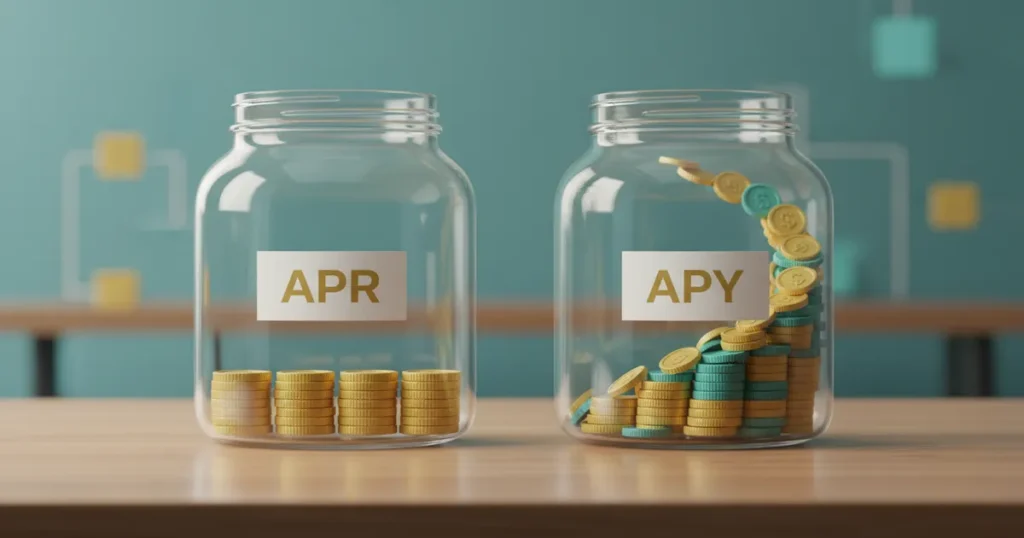
Here’s the one-liner: APY includes compounding. APR does not.
That single difference means APY will always be equal to or higher than APR for the same nominal rate. The gap between them grows wider as compounding frequency increases.
Quick Comparison
- APR: Flat annual rate, no compounding
- APY: Annual rate including compound interest
- APR is used for: Borrowing costs, base rates
- APY is used for: Staking rewards, lending yields, savings
- Which is higher: APY is always equal to or greater than APR
I remember early in my crypto journey, I’d see 12% on one platform and 10% on another. I assumed the 12% was better. Turns out, the 12% was APY with daily compounding, and the 10% was APR. When I did the math, the real difference was barely 0.5%. That lesson taught me to always check which metric I’m looking at before comparing platforms.
APY vs APR: Real Example Calculation
Let’s make this concrete with actual numbers.
The Math Behind the Numbers
Say you deposit $1,000 at a 10% rate. Here’s what happens depending on which metric you’re using:
- 10% APR (no compounding): After one year, you have $1,100. Simple.
- 10% APR with daily compounding (expressed as APY): After one year, you have approximately $1,105.16. That’s an APY of about 10.51%.
The extra $5.16 comes entirely from earning interest on your interest. On $1,000, that seems small. But on $100,000 over five years? It adds up fast.
Compounding Frequency Impact
The frequency of compounding changes everything. Here’s what a 10% APR looks like as APY at different compounding intervals:
| Compounding | APY | Earnings on $1,000 |
|---|---|---|
| Yearly | 10.00% | $100.00 |
| Monthly | 10.47% | $104.71 |
| Weekly | 10.51% | $105.06 |
| Daily | 10.52% | $105.16 |
Notice how the jump from yearly to monthly compounding is significant, but daily barely edges out weekly. There are diminishing returns at higher frequencies.
When to Pay Attention to APR vs APY
Context determines which number matters more to you.
For Borrowers: Focus on APR
When you’re taking a crypto loan, APR tells you the true cost of borrowing. This is the number you want as low as possible. Some platforms will show a “variable APR” that fluctuates based on supply and demand. Keep an eye on it.
For Lenders and Stakers: Focus on APY
When you’re earning yield through crypto staking or lending, APY is your real return metric, but only if compounding is automatic. Some platforms require you to manually claim and restake rewards. In that case, the advertised APY is aspirational, not guaranteed.
This distinction matters a lot in DeFi. If you’re providing liquidity to liquidity pools, check whether rewards auto-compound or if you need to do it yourself (and pay gas fees each time).
Why APY is Always Higher Than APR
It comes down to one word: compounding.
With APR, your interest stays flat. With APY, each compounding period adds earned interest to your principal, and then interest is calculated on that larger amount. Over time, this creates exponential growth rather than linear growth.
Platforms love advertising APY for earning products because the number is always bigger. It’s not dishonest, but it can be misleading if you don’t understand what’s behind it. A 12% APY sounds incredible until you realize the underlying APR is closer to 11.3%.
Common Mistakes When Comparing APY and APR
The High APY Trap
This is the one that got me. Back in DeFi summer, I found a yield farm advertising 400% APY on a token I’d never heard of. The math looked incredible on paper. I tossed in a few thousand dollars thinking I’d found free money.
Two weeks later, the token had dumped 60% in value. My “400% APY” didn’t matter because the asset itself was worth a fraction of what I paid. The yield was real in token terms but meaningless in dollar terms. That was an expensive lesson in understanding that APY vs APR crypto metrics mean nothing if the underlying asset collapses.
Not Checking Compounding Frequency
Another common mistake: assuming all compounding is automatic. Some platforms advertise APY but don’t auto-compound. You have to manually claim rewards and restake them. If you don’t, your actual returns are closer to the APR.
Always read the fine print. Ask: “Does this platform auto-compound, or do I need to do it myself?”
How to Calculate Your Real Returns
Using the APY Formula
To convert APR to APY yourself, use this formula:
Where n = number of compounding periods per year
For example, 10% APR with daily compounding: APY = (1 + 0.10/365)^365 – 1 = 10.52%
But here’s the part most guides skip: your real return in crypto isn’t just the APY. You need to factor in token price changes. If you earn 15% APY but the token drops 20%, you’re still down 5% in dollar terms. Real returns = APY minus price depreciation minus fees.
Online Calculators
If math isn’t your thing, use an APY calculator to plug in your numbers. These tools let you input the rate, compounding frequency, and investment amount to see projected returns.
Just remember: calculators show projections, not promises. Rates change, tokens move, and nothing in crypto is static.
Which Number Should You Trust
Honestly? Neither one on its own.
Both APY and APR are projections, not guarantees. They assume rates stay constant, which rarely happens in crypto. The real question isn’t “What’s the APY?” It’s “Where does the yield come from?”
Sustainable yields typically fall in the 2-20% range. They come from real economic activity: trading fees, borrowing interest, or protocol revenue. If you see a rate above 50%, be skeptical. If it’s above 100%, be very skeptical. Before chasing any yield, take time to research crypto projects thoroughly.
“High APYs often indicate higher risk including smart contract risk, impermanent loss, de-peg risk, and short-lived incentives.” — Bitpanda Academy
Red Flags: When APY Numbers Are Misleading
Unsustainable Yield Red Flags
After years in this space, I’ve developed a mental checklist for spotting trouble. Watch for these warning signs:
- Triple-digit APY from unknown protocols: If it sounds too good, it usually is
- Rates that swing wildly week to week: Instability signals unsustainable tokenomics
- No clear explanation of yield source: If they can’t tell you where the money comes from, run
- Token emissions disguised as yield: You’re just getting paid in newly minted (inflationary) tokens
- Low liquidity with high APY: You might earn big numbers but can’t exit without massive slippage
Smart Contract and Platform Risks
Even with reasonable APY numbers, there are risks beyond the rate itself. Smart contract bugs can drain funds. Validator slashing can eat into staking returns. And impermanent loss can quietly erode your capital in liquidity pools.
The risks associated with staking go far beyond just the APY number on the screen. Always consider the full picture before committing capital.
My Rule of Thumb
Before I put money into any yield opportunity, I ask three questions: Where does the yield come from? What happens if the token drops 50%? And can I get my money out quickly if things go wrong? If I can’t answer all three confidently, I move on.
The Bottom Line on APY vs APR in Crypto
Understanding APY vs APR in crypto isn’t just about knowing formulas. It’s about developing the judgment to see through flashy numbers and evaluate what your money is actually doing.
APR shows you the base rate. APY shows you the rate with compounding. Neither tells you whether an investment is safe, sustainable, or right for your risk tolerance. That part requires digging deeper into the protocol, the team, and the economics behind the yield.
I’ve been burned by high numbers. I’ve also earned steady, reliable yields by keeping expectations realistic and doing my homework. The difference wasn’t intelligence. It was patience and a willingness to ask uncomfortable questions before clicking “deposit.”
If you’re still building your foundation, check out our guides on crypto staking fundamentals and strategies for earning yield during bear markets. The more you understand, the harder it is for a flashy APY to fool you.