How to Use Ichimoku Cloud in Crypto Trading (The Indicator I Ignored Until It Saved My Portfolio)
Learn how to use Ichimoku Cloud for crypto trading. Master Tenkan-sen, Kijun-sen, and cloud signals with TradingView setup, strategies, and common mistakes to avoid.

In this article
I’ll be honest: the first time I saw an Ichimoku Cloud on a chart, I closed the tab. Five colored lines, a shaded blob, and what looked like spaghetti thrown at a screen. Learning how to use Ichimoku Cloud in crypto trading was the last thing on my priority list. I already had my MACD indicator and my RSI indicator. Why complicate things?
Then came the Bitcoin consolidation phase of early 2023. My usual setups kept whipsawing me. False breakouts everywhere. A friend in my Discord group told me to overlay the Ichimoku and just watch. No trades, just watch. After two weeks, I saw something that changed how I read charts forever: the cloud was projecting support levels that were holding almost perfectly while my other indicators were flashing contradictory signals.
That’s when I stopped ignoring this indicator and started studying it seriously. If you’re comfortable reading candlestick charts and want a tool that shows trend direction, momentum, and future support/resistance in a single view, this guide is for you.
What Is the Ichimoku Cloud? (And Why It’s More Than Just Pretty Lines)
The Ichimoku Cloud (formally called Ichimoku Kinkō Hyō) is a comprehensive technical indicator that combines five different calculations into one visual overlay. Unlike most indicators that tell you one thing, the Ichimoku tells you several things at once: where the trend is heading, how strong it is, and where price might find support or resistance in the future.
The 30-Year Development Story
A Japanese journalist named Goichi Hosoda started developing this system in the late 1930s. He didn’t just whip it up over a weekend. He spent over 30 years perfecting it with a team of students who did manual backtesting, originally on rice markets. He finally published it in the late 1960s. That level of dedication always impressed me. When I get impatient about spending a week backtesting a strategy, I remind myself this guy spent three decades on one indicator.
Why Ichimoku Works in Crypto Markets
Here’s what makes it special for crypto: the Ichimoku Cloud is one of the only indicators that projects support and resistance levels into the future. Most indicators are lagging. They tell you what already happened. The cloud component actually plots 26 periods ahead, giving you a roadmap of where price might react before it gets there.
That forward-looking quality is gold in crypto’s 24/7 markets, where things move fast and you need every edge you can get.
The Five Components of Ichimoku Cloud Explained
This is where most tutorials lose people. They dump five Japanese terms and a wall of formulas. I’m going to keep it simple. Think of the Ichimoku as a team of five players, each with a specific job. According to Corporate Finance Institute’s Ichimoku definition, these five components together form one of the most complete single-indicator systems available.
Tenkan-sen (Conversion Line): Your Short-Term Compass
The Tenkan-sen calculates the average of the highest high and lowest low over the last 9 periods. Think of it like a fast moving average. It reacts quickly to price changes and shows short-term momentum. When it’s rising, short-term momentum is bullish. When it’s falling, momentum is bearish.
Kijun-sen (Base Line): The Medium-Term Trend
Same calculation as the Tenkan-sen, but over 26 periods. It moves slower and represents the medium-term trend. I think of it as the “reality check” line. When price pulls back to the Kijun-sen in an uptrend and bounces, that’s often a great entry point.
Senkou Span A and B: The Cloud Itself
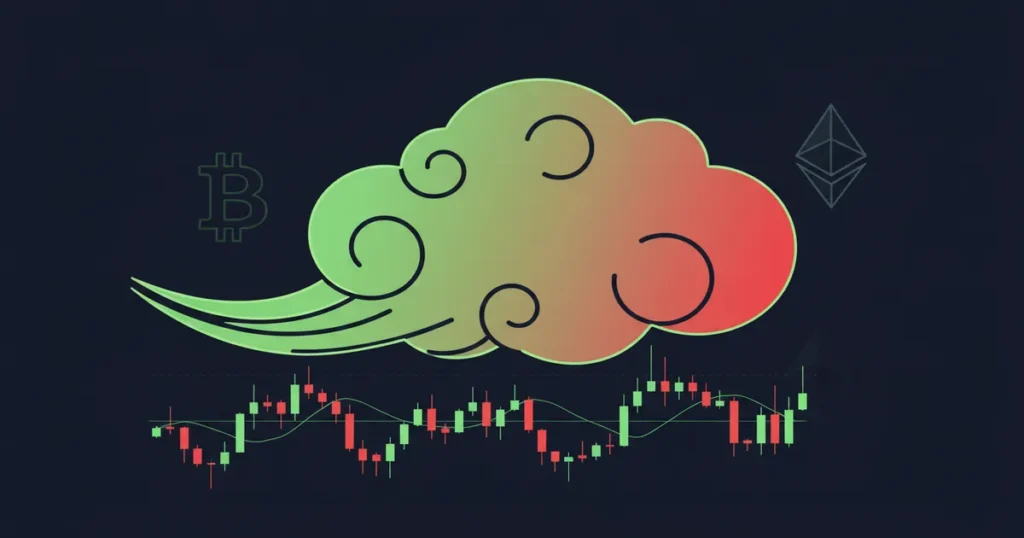
This is the signature feature. Senkou Span A is the average of the Tenkan-sen and Kijun-sen, plotted 26 periods forward. Senkou Span B is the average of the 52-period high/low, also plotted 26 periods forward. The space between these two lines creates the “cloud” (or kumo).
Quick Reference: Cloud Color Signals
- Green cloud (Span A above Span B): Bullish conditions ahead
- Red cloud (Span B above Span A): Bearish conditions ahead
- Thick cloud: Strong support or resistance zone
- Thin cloud: Weak zone, easier for price to break through
Chikou Span (Lagging Line): The Confirmation Filter
The Chikou Span plots the current closing price 26 periods back on the chart. Most tutorials gloss over this line, and I did too for months. That was a mistake. The Chikou Span confirms momentum by comparing current price to where price was 26 periods ago. If it’s above past price action, bullish momentum is confirmed. If it’s tangled in past candles, the signal is weak.

How to Set Up Ichimoku Cloud on TradingView
Setting up the Ichimoku on TradingView takes about 30 seconds:
- Open any crypto chart on TradingView
- Click the Indicators button (top toolbar)
- Search for “Ichimoku Cloud” and select the built-in version
- The default settings (9-26-52) will load automatically
- Customize colors if needed (I use green for bullish cloud, red for bearish)
For additional customization options, check out TradingView’s Ichimoku Cloud scripts for community-built variations.
Best Timeframes for Crypto
Stick with the 4-hour and daily charts when you’re starting out. I’ve tried using the Ichimoku on 1-minute and 5-minute charts and it’s pure chaos. The noise overwhelms the signals. The 4H chart gives you enough data for the calculations to be meaningful while still being actionable for swing trading.
Reading Ichimoku Cloud Signals: The Basics
Now that you have the indicator on your chart, here’s how to actually read it. This is where the Ichimoku goes from “confusing spaghetti” to “my favorite crypto trading tool.”
Price Position Relative to Cloud
The simplest signal is where price sits relative to the cloud:
- Price above cloud: Bullish trend. Look for long entries.
- Price below cloud: Bearish trend. Look for shorts or stay out.
- Price inside cloud: Indecision zone. This is a no-trade zone for me.
The TK Cross (Tenkan-Kijun Crossover)
When the faster Tenkan-sen crosses above the slower Kijun-sen, that’s a bullish TK cross. When it crosses below, bearish. But here’s the critical detail most beginners miss: the location of the cross matters enormously.
- TK cross above the cloud: Strong buy signal
- TK cross below the cloud: Strong sell signal
- TK cross inside the cloud: Weak signal. I skip these entirely.
Cloud Breakouts and Bounces
When price breaks through the cloud with conviction (and with trading volume to back it up), that’s a high-probability signal. The cloud acts as dynamic support and resistance levels, so breaking through it means something significant has shifted. If you’re new to trading breakouts, the cloud gives you a clear line in the sand.
The Chikou Span Confirmation
Before taking any trade, I check whether the Chikou Span is clear of past price action. If the lagging line is stuck in previous candles, I wait. This single habit has saved me from more bad trades than I can count.
Advanced Ichimoku Trading Strategies for Crypto
Once you’re comfortable reading the basic signals, here are three strategies I rotate between depending on market conditions.
The Cloud Bounce Strategy (Trending Markets)
In a clear uptrend, price will often pull back to the top edge of the cloud and bounce. This is the Ichimoku equivalent of “buying the dip” but with a defined level.
I used this setup on ETH when it pulled back to the cloud edge around $1,850 in mid-2023. The cloud was thick (strong support), the Chikou Span was clear, and volume was drying up on the pullback. I entered there with a stop just below the cloud and rode it to $2,100. Clean trade, defined risk.
The Cloud Breakout Strategy (Range Breaks)
When price has been consolidating inside or near the cloud, a decisive breakout with strong volume profile analysis can signal the start of a new trend. Wait for the candle to close above or below the cloud, not just wick through it. Wicks lie.
The Triple Confirmation Setup
This is my highest-conviction setup. All three conditions must align:
- Price is above (or below) the cloud
- TK cross confirms direction
- Chikou Span is clear of past price action
When all three line up, you have trend, momentum, and confirmation working together. These trades don’t come often, but when they do, I size up (within my 2% risk rule, always).
Common Mistakes That Kill Your Ichimoku Trades
I’ve made every one of these mistakes. Hopefully sharing them saves you some money.
Mistake #1: Trading Inside the Cloud
The cloud is an indecision zone. Taking signals here produces the highest false signal rate. I lost $3,200 in August 2022 taking TK crosses inside the cloud during Bitcoin’s sideways chop. The signals looked valid in isolation but the cloud was telling me to sit on my hands.
Mistake #2: Ignoring the Chikou Span
It’s tempting to skip this “extra” step. Don’t. The Chikou Span is your confirmation filter. Skipping it is like ignoring your rearview mirror while driving.
Mistake #3: Using Wrong Timeframes
The 1-minute Ichimoku chart is noise. The 4-hour and daily charts give the calculations enough data to be meaningful. As noted by Fidelity’s technical analysis research, the indicator works best in trending conditions on higher timeframes.
Mistake #4: Not Recognizing Sideways Markets
When the cloud is flat (Senkou Span A and B running parallel), the market is ranging. The Ichimoku was designed for trends. Don’t force it in flat conditions.
Mistake #5: Overleveraging on “Perfect” Signals
No signal is perfect. I keep risk below 2% per trade and always use a stop loss. I’ve written about setting stop losses in detail. Place yours at the cloud edge, and respect it.
Should You Adjust Ichimoku Settings for Crypto?
The default 9-26-52 settings were designed around the Japanese trading week (9 days = 1.5 weeks, 26 days = 1 month, 52 days = 2 months). Since crypto trades 24/7, some traders adjust to 10-30-60 or even 20-60-120.
My take: master the default settings first. Most professional traders still use 9-26-52 even in crypto. The settings have decades of proven reliability behind them. Once you’re consistently profitable with the defaults, then experiment. And always backtest changes before using them with real money.
Combining Ichimoku with Other Indicators
The Ichimoku is comprehensive, but I still pair it with a couple of tools for extra confirmation. The goal isn’t to overload your chart. It’s to find confluence, where multiple signals point the same direction.
My daily setup is simple: Ichimoku Cloud plus volume plus horizontal support/resistance levels. That’s it. Some traders add the RSI indicator to filter overbought and oversold extremes, which works well. Others use VWAP for institutional price context or Bollinger Bands for volatility readings.
“The Ichimoku Cloud stands out as one of the few indicators that delivers a holistic, forward-looking view of the crypto market by combining trend direction, momentum, and projected support and resistance.” — OSL Digital Securities Academy
The key rule: use additional indicators for confirmation, not replacement. If you need five indicators to agree before you take a trade, you’ll never trade. If you want to see where the Ichimoku fits among other tools, check out our guide to the best technical indicators.
When Ichimoku Fails (And What to Do About It)
No indicator works all the time. Pretending otherwise would be dishonest, and I’d rather lose a reader than give bad advice.
The Ichimoku struggles most in choppy, sideways markets. When the cloud is flat and thin, signals whipsaw constantly. Crypto manipulation (especially on lower-cap altcoins) can trigger false breakouts that look convincing on the Ichimoku but are just whale games.
My personal rule: if the cloud has been flat for three or more days, I stop looking for Ichimoku setups on that asset and move to other opportunities. I use that downtime to work on trading psychology and chart pattern recognition instead.
The solution is patience. Wait for clear trends. Use higher timeframes. Add volume confirmation. And always remember that the best trade is sometimes no trade at all.
Putting It All Together
The Ichimoku Cloud looked like chaos to me at first. Now it’s the first thing I turn on when I open a chart. It took me about three weeks of daily practice to feel comfortable reading all five components together, and about two months before I trusted it enough to base trades on it.
Start with the daily chart. Learn to identify whether price is above, below, or inside the cloud. Then add TK crosses. Then the Chikou Span. Build your understanding layer by layer instead of trying to absorb everything at once.
If you’re building a broader technical analysis toolkit, I’d suggest reading our guides on moving averages and support and resistance levels as foundations. The Ichimoku builds on both of those concepts, and understanding them first will make the cloud click faster.
The market rewards patience and preparation. This indicator, built over 30 years by a man who understood that deeply, might just become your most valuable trading tool too.