What Is Render Network (RENDER): The AI Crypto Powering Decentralized GPU Computing
Render Network (RENDER) is the AI crypto connecting GPU owners with creators. Learn how it works, its tokenomics, and whether RENDER is worth investing in.

In this article
If you’ve spent any time tracking the AI boom, you’ve probably noticed one thing: everyone needs GPUs and nobody has enough. So what is Render Network crypto, and why does it keep showing up in conversations about AI and blockchain?
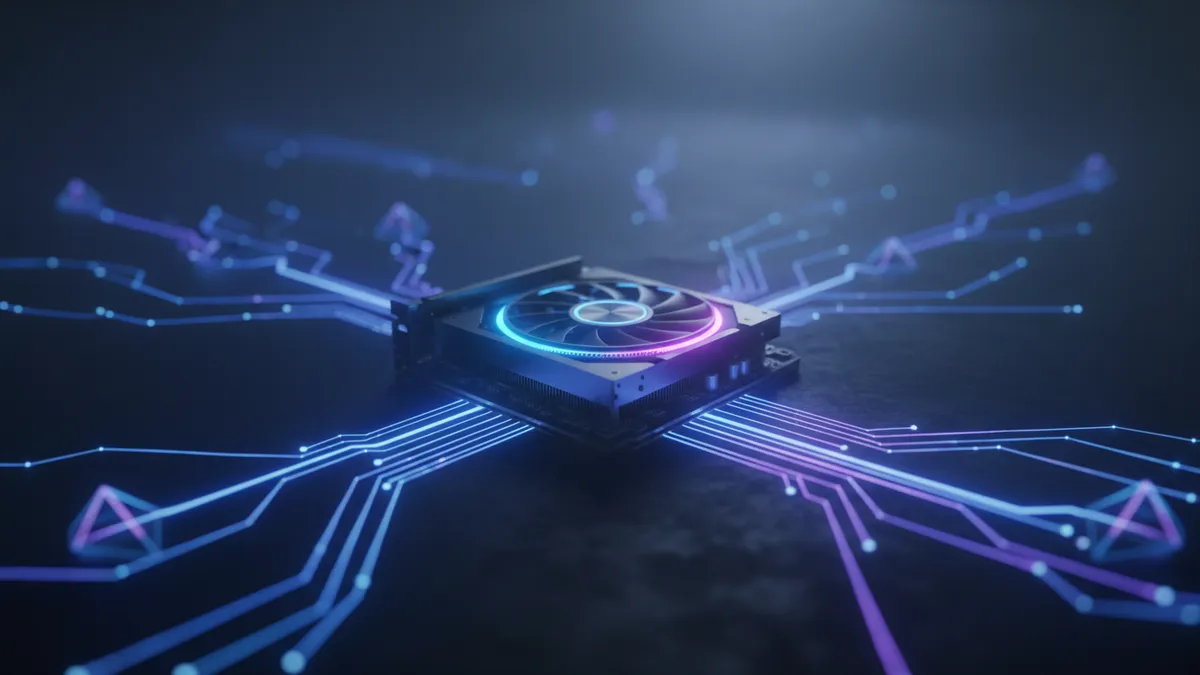
Render Network is a decentralized marketplace that connects GPU owners with creators and developers who need computing power. It sits at the intersection of decentralized finance principles and real physical infrastructure. And it’s one of the few crypto projects where “real-world usage” isn’t just marketing fluff.
I remember the 2021 GPU crunch vividly. I was trying to help a friend price out a modest mining rig, and every NVIDIA card was either backordered or scalped beyond reason. Standing in a Micro Center parking lot, watching people line up at 6am for a $700 card marked up to $1,500, it hit me: millions of powerful GPUs sit idle in gaming rigs and workstations worldwide. A project that could connect that idle supply to genuine demand would have something truly valuable. That’s exactly the problem Render Network’s official site describes solving.
Let me break down how it works, what makes its tokenomics unique, and whether RENDER deserves a spot on your watchlist.
What Is Render Network?
Render Network is a decentralized GPU marketplace built by OTOY Inc., the company founded by Jules Urbach. OTOY has been in the rendering business since 2009 with its Octane Render software, which is an industry standard for 3D artists and visual effects studios.
The network launched publicly in April 2020 and is classified as a DePIN project (Decentralized Physical Infrastructure Network). Think of DePIN as physical infrastructure tokenization applied to computing hardware. Instead of building massive centralized data centers, you tap into GPU power that already exists around the world.
Today, Render is the 3rd-largest DePIN by market cap. The entire DePIN sector grew 265% to over $19 billion in 2025, and Render sits right at the center of two mega-trends: AI compute demand and decentralized infrastructure.
How Render Network Works
The system has two sides: people who need graphics processing units (GPUs) and people who have them sitting idle. Here’s how each side operates.
Creators: Who Needs the GPU Power
Creators are the demand side. These include 3D artists, animation studios, AI developers, and anyone who needs serious computing power for rendering or inference tasks. They submit jobs to the network and pay in RENDER tokens.
Here’s what makes it practical: jobs are priced in fiat terms, then converted to RENDER at payment time. Creators don’t have to worry about crypto price swings when budgeting a project. That’s a small but critical design choice that removes one of the biggest friction points for real business adoption.
Node Operators: Who Supplies It
Node operators are the supply side. If you own a powerful GPU sitting idle, you can connect it to Render Network, complete jobs, and earn RENDER tokens. It’s a way to monetize hardware that would otherwise collect dust.

Operators must begin by staking RENDER tokens to participate. This acts as a quality guarantee. Over 60,000 GPUs are now integrated into the network through governance proposal RNP-023. The result? Computing costs that run 60-80% cheaper than AWS or Google Cloud on-demand pricing.
The Job Flow: From Submission to Completion
When a creator submits a job, the network matches it with available GPU nodes. The work is processed, then verified on-chain using a proof-of-render system before payment is released. No centralized middleman required.
Quick Summary: How a Render Job Works
- Creator submits a rendering or AI compute job
- Network matches the job to available GPU nodes
- Node operator’s GPU processes the work
- Proof-of-render verification confirms completion on-chain
- RENDER is burned from the creator’s payment, and fresh RENDER is minted for the operator
The RENDER Token and Burn-Mint Equilibrium (BME)
This is where the tokenomics get interesting. Most utility tokens just float around with no built-in demand sink. RENDER uses a model called Burn-Mint Equilibrium (BME), and after years of analyzing token designs, I think this is one of the more elegant ones out there.
How BME Keeps Supply in Check
Here’s the core mechanic: when creators pay for jobs, RENDER tokens are burned (permanently destroyed). When node operators complete those jobs, fresh RENDER is minted as their reward.
This creates a deflationary loop when network usage increases. More jobs equal more burns. If demand for GPU compute keeps growing (and with the AI wave, that’s a reasonable bet), the burn rate should outpace the mint rate over time.
You can verify all of this yourself through on-chain analysis. Every burn and mint event is publicly recorded on the blockchain.
Token Burns Are Accelerating
According to official RENDER token metrics, 2025 token burns are up 278.9% year-over-year. Between January and September 2025, 530,171 RENDER were burned compared to just 139,924 in the same period of 2024. That’s not a marginal increase. That’s a signal.
Current supply numbers at a glance:
- Circulating supply: ~518.7 million RENDER
- Max supply: ~644.2 million RENDER
- Market cap: ~$983 million (ranked #60)
- Fully diluted valuation (FDV): ~$1.22 billion
- Price: ~$1.86-$1.90 as of April 2026
RNDR to RENDER: Why Render Migrated to Solana
Render Network didn’t start on Solana. The original RNDR token launched as an ERC-20 on Ethereum. It worked, but Ethereum’s gas fees and throughput limitations made it expensive and slow for a network coordinating thousands of GPU jobs daily.
In April 2023, the community voted to migrate to the Solana blockchain. The migration completed in late 2023, with RNDR holders swapping 1:1 for the new RENDER token (an SPL token on Solana).
Why Solana? Three reasons:
- Speed: Solana’s throughput enables real-time job coordination
- Cost: Transaction fees are fractions of a penny versus dollars on Ethereum
- Integrations: The move opened doors to AI compute subnets and third-party clients like io.net, Nosana, FEDML, and Beam
If you still hold old RNDR on Ethereum, you’ll need a compatible crypto wallet to complete the swap to the new RENDER token.
Render Network in the Real World
This is where Render separates itself from the pack. This isn’t a whitepaper project hoping for future adoption. It’s processing real workloads right now.
Creative and 3D Rendering: Where It Started
To date, the network has rendered over 71.27 million frames. Monthly processing now averages about 1.5 million frames and is growing 28.8% month-over-month.
Real-world creative clients and projects include:
- Las Vegas Sphere: Immersive visual displays
- Super Bowl concerts: Live visual effects
- NASA: Scientific visualizations
- Generative artists: High-fidelity art workflows
These aren’t hypothetical partnerships. These are rendered frames that have been displayed to millions of people. When I saw the Sphere footage for the first time, I immediately pulled up Render’s on-chain metrics to see if the job volume matched the hype. It did.
AI Compute: The Bigger Opportunity
Render’s expansion into AI is where the growth story gets compelling. The Dispersed subnet now offers 600+ open-weight AI models for decentralized inference at roughly $0.69 per GPU hour. That’s a fraction of what centralized cloud providers charge.
At RenderCon 2026, the team previewed native neural denoising and AI-accelerated rendering planned for H2 2026. This could dramatically reduce render times while opening entirely new use cases. The earning model here differs from something like liquid staking because node operators provide active compute work rather than passive capital.
“Distributed GPUs can (and will) power AI and rendering without the need for massive centralized datacenters. A global pool of compute unlocks lower cost, lower latency, and massive scale.” — Jules Urbach, Founder, Render Network / OTOY
Render vs. Competitors: Akash, io.net, and Centralized Cloud
Render doesn’t operate in a vacuum. Here’s how it stacks up against the main alternatives:
| Project | Focus | Key Differentiator |
|---|---|---|
| Render Network | High-fidelity rendering + AI media | OTOY/Octane heritage, creative industry moat |
| Akash Network | General-purpose cloud compute | Reverse auction pricing model |
| io.net | ML training clusters | GPU aggregation for machine learning |
| AWS / Google Cloud | Everything | Scale and reliability, but 60-80% more expensive |
Render’s competitive edge is its creative industry roots. OTOY and Octane Render give it a built-in user base that competitors can’t easily replicate. The network also generates approximately $38 million in monthly on-chain revenue, making it one of the highest-revenue DePIN projects in the entire sector.
Should You Consider Adding RENDER to Your Portfolio?
I’ve learned the hard way that the most exciting narratives can be the most dangerous positions if you don’t size them right. I blew up my first trading account chasing a “can’t lose” thesis, and I’m never making that mistake again. Here’s my honest assessment of RENDER:
The Bull Case
- AI compute demand is exploding and shows no sign of slowing
- The decentralized GPU narrative is a multi-year trend
- Real revenue is growing, not speculative hype
- BME tokenomics benefit directly from network growth
- DePIN tokens like RENDER often move strongly during altcoin season
The Bear Case
- RENDER is down 80%+ from its all-time high
- Macro crypto headwinds persist
- Centralized cloud giants (AWS, Google, Microsoft) aren’t standing still
- Competition from other DePIN projects is intensifying
If this catches your interest, take the time to properly research a crypto project before investing. RENDER is a high-beta altcoin, which means it can swing 20%+ in a week without blinking. Your position sizing matters more than your entry price.
I’d slot RENDER into the speculative conviction tier of a crypto portfolio allocation strategy. Small enough that a worst-case drawdown won’t wreck you, but large enough that it matters if the thesis plays out. RENDER is available on major crypto exchanges including Coinbase and Binance.
This is not financial advice. Always do your own research.
The Bottom Line
Render Network is one of the few crypto projects with demonstrable real-world usage and growing revenue. Its BME tokenomics are designed to reward the network’s own growth. Whether you’re a creator looking for affordable GPU power, a hardware owner wanting to earn yield, or an investor tracking the AI-crypto convergence, RENDER has carved out a unique and defensible niche.
In a space absolutely packed with vaporware and empty promises, Render has built actual infrastructure that people pay real money to use. That alone puts it in rare company.
Want to keep building your crypto knowledge? Explore our deep dives on how Solana works, understanding tokenomics, and how to evaluate any crypto project before putting money on the line.