What Is Solana Crypto: The High-Speed Blockchain Taking On Ethereum
What is Solana crypto? Discover how this Layer 1 blockchain uses Proof of History to hit 65,000 TPS, why SOL is top-5 crypto, and what the risks really are.


In this article
If you’ve spent any time in crypto, you’ve heard the name. But what is Solana crypto, really? Beyond the hype, beyond the meme coins, beyond the Twitter debates? Solana is a Layer 1 blockchain technology built for speed, low fees, and high throughput. It’s one of the most ambitious projects in crypto, and whether you love it or side-eye it, ignoring it isn’t an option anymore.
I remember the exact moment Solana clicked for me. It was Consensus Austin in 2022. I’d just paid $47 in Ethereum gas fees to move $200 worth of tokens. Forty-seven dollars. On a $200 transfer. A developer at a side event pulled out his phone, showed me a Solana transaction, and the fee was a fraction of a penny. I was skeptical. But I couldn’t unsee the difference, especially when I watched the Ethereum network choke that same evening while Solana hummed along.
That moment changed how I evaluated blockchains. Let me walk you through everything you need to know about Solana, how it works, and whether SOL deserves a spot in your portfolio.
What Is Solana? The 30-Second Version
Solana is a Layer 1 blockchain designed to process thousands of transactions per second at near-zero cost. Founded by Anatoly Yakovenko, a former Qualcomm engineer, and co-founded by Raj Gokal, the network launched its mainnet beta in March 2020 through the Solana Foundation.
Here’s the elevator pitch: Solana does what Ethereum does, but faster and cheaper. Whether that trade-off is worth it depends on what you value. We’ll get to the trade-offs shortly.
SOL is Solana’s native token. You use it to pay transaction fees, stake for rewards, and participate in governance. As of March 2026, SOL sits around $85-90 with a market cap near $49 billion, making it a top-5 to top-7 cryptocurrency globally.
How Does Solana Work? Proof of History Explained Simply
This is where Solana gets interesting. Most blockchains waste enormous time on one simple problem: agreeing on when things happened. Solana’s innovation is a mechanism called Proof of History that solves this elegantly.
What Is Proof of History (PoH)?
Think of Proof of History as a cryptographic clock. Before validators even process transactions, PoH timestamps them in order. This means validators don’t need to communicate with each other to agree on which transaction came first.
On Ethereum, validators must reach consensus on transaction ordering before processing. That coordination takes time. Solana skips that step entirely. PoH creates a verifiable sequence of events that everyone can check independently.
It’s like the difference between a group of people shouting over each other to decide who arrived at a restaurant first versus everyone pulling a numbered ticket from a machine. The ticket machine is faster. That’s PoH.
Proof of Stake: Solana’s Security Layer
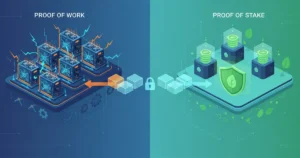
While PoH handles ordering, Proof of Stake provides the economic security. Validators lock up SOL as collateral. If they act dishonestly, they lose their stake. This is the same fundamental model used by Ethereum since its Merge in 2022.
If you’re curious about how different consensus mechanisms compare, I wrote a deeper dive on Proof of Work vs Proof of Stake that covers the key differences.

Parallel Processing: Why Solana Is So Fast
Here’s the real speed secret. Solana uses a runtime called Sealevel that allows thousands of smart contracts to execute simultaneously. Ethereum’s virtual machine processes transactions one at a time, like a single checkout lane at the grocery store. Solana opens every lane at once.
Solana Speed: The Numbers
- Theoretical throughput: 65,000 transactions per second (TPS)
- Real-world performance: 3,000-5,000 TPS consistently
- Ethereum base layer: 15-30 TPS
- Firedancer (new validator client): Hit 600,000 TPS in testing
That last bullet is a big deal. Firedancer, built by Jump Crypto in C/C++, went live in December 2025 with 207 validators. It’s designed to eliminate single points of failure and push Solana toward 1 million TPS at full network migration. This is the kind of infrastructure upgrade that doesn’t make headlines but fundamentally changes what the network can handle.
The SOL Token: What It Does and How Supply Works
Understanding SOL’s tokenomics matters if you’re thinking about investing. Here’s the breakdown.
SOL Tokenomics at a Glance
- Transaction fees: Typically $0.00025 or less per transaction
- Circulating supply: ~570 million SOL
- Market cap: ~$49 billion (March 2026)
- All-time high: ~$294 in January 2025
- Current price: ~$85-90 (down 70%+ from ATH)
- Inflation schedule: Built-in reduction over time, similar to a halving mechanism
You can check live SOL price and market data for the most current numbers. In crypto, things move fast.
How to Stake SOL
Staking SOL is one of the most accessible staking experiences in crypto. The minimum stake is just 0.01 SOL. You can delegate to a validator through wallets like Phantom and earn inflation rewards without running any infrastructure yourself.
I started staking SOL with a small position back in 2023. Nothing life-changing, but the low minimum made it easy to test the waters without risking much. That’s something I always tell newer investors: you don’t need thousands of dollars to start learning by doing.
What Can You Actually Do on Solana? The Ecosystem Explained
Speed means nothing if nobody builds on it. Here’s what the Solana ecosystem actually looks like today.
DeFi on Solana
Solana has become a serious player in decentralized finance (DeFi). The major protocols include:
- Jupiter: The dominant DEX aggregator, routing trades across multiple decentralized exchanges for the best price
- Raydium: An automated market maker (AMM) that uses liquidity pools to enable fast swaps
- Marinade Finance: A liquid staking protocol for SOL
- Jito: MEV-protected staking that helps validators extract value more fairly
NFTs and Meme Coins
Let’s talk about the elephant in the room. Meme coins have been enormous on Solana. The Pump.fun platform turned Solana into the go-to chain for meme token launches. According to Messari’s State of Solana Q4 2025 report, meme coins accounted for 62% of Solana’s DeFi revenue in Q2 2025, totaling $1.6 billion.
Is that sustainable? Probably not in that form. But Solana co-founder Anatoly Yakovenko had an interesting take on it:
“Blessed are the meme coin traders, for those who can overcome their spam will inherit the metaverse.”
— Anatoly Yakovenko, Solana Co-Founder
He’s not wrong. That insane volume stress-tested the network in ways years of normal usage never could. The outages it caused (more on that below) ultimately forced improvements that made Solana more resilient.
On the NFT side, Magic Eden remains the dominant marketplace. The Solana NFT scene is smaller than Ethereum’s but active, with lower minting and trading costs attracting creators who don’t want to spend $50 just to list something.
Real-World Payments on Solana
Here’s something most explainers skip. Western Union is launching its USDPT stablecoin on Solana in 2026. This isn’t some small DeFi experiment. Western Union handles roughly $150 billion in annual remittance volume. That’s real-world money flowing through Solana infrastructure.
Solana Pay also enables point-of-sale crypto payments, and Phantom, the most popular crypto wallet on Solana, makes staking, swapping, and NFT management accessible to everyday users.
Solana vs. Ethereum: How Do They Stack Up?
This is the comparison everyone wants. So let’s lay it out honestly.
| Feature | Solana | Ethereum |
|---|---|---|
| Speed (TPS) | 3,000-5,000 real-world | 15-30 base layer |
| Transaction Fees | Fractions of a penny | $1-$100+ during congestion |
| Validators | ~1,900 | 700,000+ |
| Smart Contract Language | Rust | Solidity |
| ETF Status | Bitwise BSOL, Fidelity FSOL (late 2025) | Established spot ETFs |
Ethereum has the larger developer ecosystem and significantly more decentralization. Solana has raw speed and near-zero fees. Ethereum addresses its speed limitations through Layer 2 solutions like Arbitrum and Optimism, which can push throughput much higher while inheriting Ethereum’s security.
Here’s something I tell people all the time: this isn’t a zero-sum game. Both are legitimate Layer 1 blockchains with different trade-offs. Thinking you have to pick one is like saying you can only own stocks or bonds. Morgan Stanley filing for spot SOL ETFs in January 2026 signals that institutions see room for both.
Solana’s Biggest Risks and Criticisms
I’d be doing you a disservice if I didn’t cover the risks plainly. I’ve seen too many people get burned because someone sold them only the upside.
Network Outages: Solana’s Achilles Heel
Solana experienced multiple network outages in 2021 and 2022. Some were partial slowdowns. Some were full stalls where the network stopped producing blocks entirely. The primary culprits? Spam bots and the meme coin craze flooding the network with more transactions than it could handle.
The network has improved significantly since then. Firedancer’s architecture is specifically designed to eliminate single points of failure. But the history is real, and anyone telling you Solana has “fixed” all its reliability issues is overselling it. It’s better. It’s not bulletproof.
Centralization Concerns
This is the trade-off that keeps me cautious. Solana runs on roughly 1,900 validators. Ethereum has over 700,000. Fewer validators means faster consensus but also means the network is more concentrated. If a handful of large validators coordinated (or went offline), the impact would be larger than on Ethereum.
Additionally, Solana Labs and the Solana Foundation hold significant early token allocations. This is common for VC-backed chains, and it’s not a red flag by itself. But it’s a trade-off you should understand before putting money in.
Should You Invest in SOL? A Balanced Take
Let me be clear: this is not investment advice. But I’ll tell you how I think about it, because I think the framework matters more than any specific call.
The Bull Case for SOL
- Down 70%+ from its all-time high, with institutional inflows increasing (ETFs, Morgan Stanley filings)
- Firedancer upgrade positions Solana for massive throughput improvements
- Western Union’s USDPT stablecoin launch brings real-world transaction volume
- Strong developer activity and genuine use cases beyond speculation
The Bear Case for SOL
- Centralization risk remains real compared to Ethereum
- History of network outages, even if improving
- Meme coin revenue (62% of DeFi revenue) raises sustainability questions
- Competing with Ethereum’s massive first-mover advantage and L2 ecosystem
If I’m building a position, I’m thinking about position sizing first. Don’t go all-in on any single altcoin. I’ve blown up an account before by overconcentrating in assets I was emotionally attached to. It’s not fun. SOL could 3x from here or drop another 50%, and you need to be okay with either scenario.
For most people, dollar-cost averaging into SOL over time is a smarter approach than trying to time the bottom. Set a plan, stick to it, and don’t let a green candle convince you to YOLO your savings.
Frequently Asked Questions
Is Solana faster than Ethereum?
Yes. Solana processes 3,000-5,000 TPS in real-world conditions compared to Ethereum’s 15-30 TPS on its base layer. However, Ethereum’s Layer 2 solutions push its effective throughput much higher when you include rollups like Arbitrum and Optimism.
Is SOL a good long-term investment?
SOL has strong fundamentals, including institutional ETF inflows, real-world adoption through Western Union’s stablecoin, and the Firedancer upgrade. However, centralization risk and network outage history are real concerns. Always practice proper position sizing and never invest more than you can afford to lose.
How much does a Solana transaction cost?
A typical Solana transaction costs about $0.00025 or less. That’s a fraction of a penny. Compare that to Ethereum, where fees can spike to $50-100 or more during periods of high network congestion.
The Bottom Line on Solana
Solana is one of the most technically ambitious blockchains in the space. It’s fast, cheap, and attracting serious institutional attention. It’s also less decentralized than Ethereum, has a messy outage history, and leans heavily on meme coin activity for revenue. Both things are true.
I’ve watched this space long enough to know that the best investments are the ones where you understand both the upside and the risk before you put money down. Solana isn’t a guaranteed moonshot, and it’s not a scam. It’s a technology with real trade-offs that you should evaluate with clear eyes.
If you’re newer to crypto and building your foundation, start with understanding blockchain technology and how Ethereum works. If you’re deeper in and evaluating your portfolio allocation, take a hard look at Solana’s fundamentals, set your risk parameters, and make a plan you can stick to regardless of what the market does tomorrow.
That’s how you survive in this space. Trust me, I learned the hard way.