What is FDV in Crypto (And Why I Passed on a “10x Gem” That Crashed 80%)
Learn what FDV (fully diluted valuation) means in crypto, how to calculate it, and why high FDV tokens crash. Real examples from someone who learned the hard way.

In this article
If you’ve ever looked at a new altcoin and thought “wow, the market cap is only $50 million, this could 100x” — stop right there. You might be looking at the wrong number. Understanding what is FDV in crypto saved me from one of the biggest traps in this market. It’s also why I passed on a “guaranteed 10x gem” that a friend was raving about in 2024. That token crashed 80% within six months.
FDV, or fully diluted valuation, is one of the most important metrics in crypto that most beginners never check. And honestly? I didn’t either for my first two years of trading. That ignorance cost me real money. Let me break down exactly what FDV means, why it matters, and how to use it before you buy anything.
What is FDV (Fully Diluted Valuation)
The Simple Definition
FDV stands for fully diluted valuation. It tells you what a cryptocurrency’s total market value would be if every single token that will ever exist was already in circulation at today’s price.
Think of it like this. A company plans to print 1 billion shares, but only 100 million are trading right now. The stock price is $10. The crypto market cap based on circulating supply is $1 billion. But the FDV? That’s $10 billion — because all 1 billion shares at $10 each equals $10 billion.
That gap is where people get wrecked.
How FDV is Calculated
FDV Formula
FDV = Current Token Price × Total (Maximum) Supply
Example: Token price is $2.00, max supply is 500 million tokens
FDV = $2.00 × 500,000,000 = $1 billion
The key word here is total supply. This includes every token that’s locked, vesting, reserved for the team, allocated to VCs, and set aside for future emissions. All of it. That’s what makes FDV so revealing — it shows you the full picture that market cap alone hides.
FDV vs Market Cap: Understanding the Gap
What Market Cap Actually Tells You
Market cap only counts tokens that are actually circulating right now. It’s the price multiplied by the circulating supply. For established coins like Bitcoin, this number is pretty close to the FDV because roughly 95% of all Bitcoin that will ever exist is already mined.
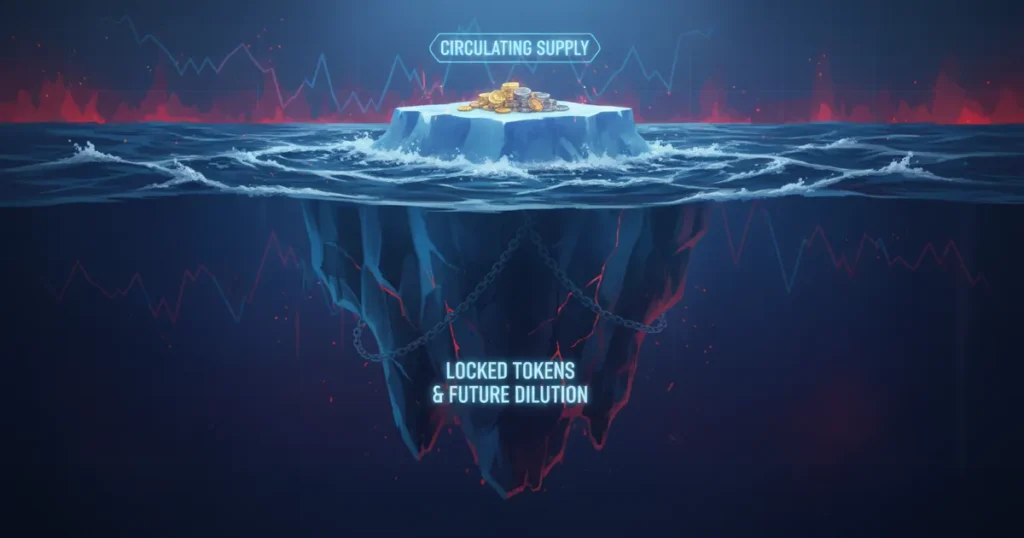
But for newer altcoins? The story is completely different. Many tokens launched in 2024 and 2025 had only 10-15% of their total supply circulating at launch. The rest was locked up for teams, venture capital investors, and future rewards.
Why the Gap Between FDV and Market Cap Matters
I remember scrolling through new listings on CoinGecko in early 2024. One token had a market cap of $200 million. Looked cheap. Then I checked the FDV: $4 billion. That’s a 20x ratio. It meant 95% of the token supply was still locked and waiting to flood the market.

A large gap between FDV and market cap tells you one thing: massive amounts of tokens are coming. When those tokens unlock and hit the open market, they create selling pressure. More supply with the same demand equals lower prices. It’s basic tokenomics.
Real Example: Bitcoin vs New Altcoin
Let’s compare two scenarios to make this concrete:
| Metric | Bitcoin (BTC) | Typical 2024 Altcoin |
|---|---|---|
| Circulating Supply | ~95% of max | ~12% of max |
| FDV / Market Cap Ratio | ~1.05x | ~8-10x |
| Dilution Risk | Minimal | Severe |
| Future Unlock Pressure | Slow, predictable mining | Massive scheduled dumps |
Even stablecoins have FDV equal to market cap since their supply matches demand by design. When you see that kind of alignment, there’s no hidden dilution waiting to crush your position.
Why High FDV is a Red Flag (My $8,000 Lesson)
The Low Float, High FDV Trap
Here’s the story I promised. In mid-2024, a buddy from my old trading Discord pinged me about a Layer 2 token. “It’s only at $300 million market cap. Solana was at $60 billion. Easy 10x minimum.” He’d already put in $15,000.
I almost followed him in. The chart looked great — steady climb, growing volume, big-name VC backers listed on the website. But something nagged at me. I pulled up the tokenomics page.
Only 8% of the total supply was circulating. The FDV was over $3.5 billion. For a chain with barely any apps built on it yet.
I passed. He didn’t. By December 2024, that token was down 80% from where he bought. The unlock schedule had started, and crypto whales — mostly early VCs — were dumping millions of tokens every week.
My friend lost about $12,000. I dodged it because of one metric: FDV.
Token Unlock Schedules Explained
Token unlocks are scheduled events where locked tokens become available to sell. Most crypto projects structure their supply like this:
- Team allocation (15-25%): Locked for 1-2 years, then vests monthly over 2-3 years
- VC/investor allocation (20-30%): Shorter lock, aggressive vesting once unlocked
- Ecosystem/community rewards (30-40%): Released gradually for staking, liquidity mining
- Initial circulating (10-15%): What’s actually tradeable at launch
When those locked tokens unlock, the holders often sell. VCs especially — they bought at seed prices (sometimes 90% cheaper than you). Their entire business model is to sell into retail liquidity. It’s not illegal. It’s not even unethical, technically. But if you’re buying without checking the unlock schedule, you’re volunteering to be their exit liquidity.
That’s why learning to spot crypto rug pulls includes understanding scheduled dilution. Not every high-FDV token is a scam, but the mechanics work similarly.
How VCs and Insiders Exit on Retail
Here’s what kills me about this cycle. Projects raise money from VCs at $50 million FDV. Then they launch publicly at $5 billion FDV. The VC is already sitting on a 100x paper gain before a single retail investor buys a token.
When the crypto FOMO kicks in and retail piles into these “cheap” tokens based on market cap alone, they’re buying the top of a structure designed to dilute them. It’s the trading psychology trap of artificial scarcity — low float makes the price easy to pump, which attracts more buyers, which gives insiders better exit prices.
How to Check FDV Before Buying
Using CoinGecko and CoinMarketCap
Checking FDV takes about 10 seconds. On CoinGecko, search for any token and look at the stats section on the token’s page. You’ll see “Fully Diluted Valuation” listed right alongside market cap.
CoinMarketCap shows the same data on every coin profile page. Both platforms pull this information automatically from on-chain data, so you don’t need to calculate anything yourself.
Calculating FDV Manually
If you want to double-check (and I always recommend it), here’s how:
- Find the token’s total or maximum supply in the project whitepaper or documentation
- Look up the current token price on any exchange or data aggregator
- Multiply: Price × Max Supply = FDV
That’s it. Three steps. I do this for every token I consider buying. It takes 30 seconds and has saved me thousands.
What FDV/Market Cap Ratio to Avoid
FDV Risk Levels
- Near 1x: Safe — most supply is already circulating (like Bitcoin)
- 2-5x: Manageable — some dilution ahead, but reasonable if fundamentals are strong
- 5-10x: Danger zone — significant unlock pressure coming
- 10x+: Extreme risk — you’re likely buying someone else’s exit
Any token where less than 20% of supply is circulating deserves extra scrutiny. That’s not a rule to never buy — it’s a rule to always investigate deeper. Check the unlock schedule. Check who holds the locked tokens. Check when the next big unlock hits.
Real-World FDV Case Studies (2024-2025)
The Starknet (STRK) Example
Starknet became the textbook case for what happens when FDV meets reality. STRK launched with a massive fully diluted valuation relative to its circulating supply. The community quickly noticed the aggressive unlock schedule and backlash followed. As tokens unlocked and hit the market, price action confirmed what the FDV had been screaming all along.
“FDV matters in crypto investing because it should immediately cause you concern when it is significantly higher, sometimes 10, 50, or even 100 times higher than the current Market Cap.” — CoinSwitch Research Team
The 2024-2025 Altcoin Massacre
This wasn’t just one project. According to Binance’s research report on low float and high FDV, the problem was systemic. Across Layer 2, GameFi, and narrative-driven sectors, tokens launched with tiny circulating supplies and bloated FDVs. CoinGecko’s own research found that 1 in 5 top cryptocurrency projects were low float with massive future unlock schedules.
Many of these tokens collapsed 70-90% as unlocks kicked in during 2024 and into 2025. Investors who relied on market cap rank alone got demolished. If you were using bear market strategies during this period, understanding FDV was the single biggest edge you could have.
Hyperliquid (HYPE) and the Reality Check
Take Hyperliquid as a current example. As of early 2026, HYPE was trading around $27 with a max supply of 1 billion tokens. The gap between market cap and FDV showed that a large majority of tokens hadn’t been issued yet. Does that mean HYPE is a bad investment? Not necessarily — but it means you need to understand what happens when those tokens enter circulation.
This is where knowing the difference between crypto forks and scheduled unlocks matters. Both change supply dynamics, but unlocks are predictable. You can plan around them if you’re paying attention.
How to Use FDV in Your Investment Decisions
FDV Red Flags to Watch For
After years of tracking this, here are the warning signs I never ignore:
- FDV is 10x+ market cap: Most of the supply is locked. You’re buying artificial scarcity.
- Less than 20% circulating supply: Massive dilution risk ahead.
- Large unlock event within 3-6 months: Price almost always drops before or during major unlocks.
- VC-heavy allocation with short vesting: Early investors will sell as soon as they can.
- No real usage to absorb new supply: If the protocol has low TVL and few users, there’s nobody to buy what insiders sell.
Before buying any token, I now check unlock schedules on Tokenomist. It shows you exactly when tokens unlock and how much is coming. Think of it as your early warning system.
When High FDV Doesn’t Matter
I want to be fair here. High FDV isn’t always a dealbreaker. Bitcoin’s FDV is slightly above its market cap, and nobody worries because the remaining supply is released through slow, predictable mining. Ethereum’s emission rate is also well-understood and relatively slow.
The key question is: how fast is the locked supply entering the market, and is there enough organic demand to absorb it?
If a protocol has genuine adoption, growing revenue, and high Total Value Locked (TVL), it can potentially absorb gradual dilution. The problem is when projects have billion-dollar FDVs with nothing but a whitepaper and some Twitter hype.
Combining FDV with Other Metrics
FDV alone doesn’t tell the whole story. I use it as part of a broader checklist when I research crypto projects before investing:
- FDV/Market Cap ratio — dilution risk assessment
- TVL and active users — is there real demand for the token?
- Revenue or fees generated — can the protocol sustain itself?
- Unlock schedule — when is supply hitting the market?
- Team and VC allocation % — who controls the locked supply?
No single metric tells you everything. But FDV is the one I check first because it reveals whether the “cheap” price you’re seeing is real or manufactured.
Frequently Asked Questions
Is a high FDV always bad?
No. High FDV matters most when combined with low circulating supply and weak fundamentals. Bitcoin has a high FDV, but 95% of supply is already circulating. The danger is when FDV is 10x+ the market cap with aggressive unlock schedules ahead.
Where can I check a token’s FDV?
CoinGecko and CoinMarketCap both show FDV on every token’s profile page. For unlock schedules, use Tokenomist. Always cross-reference with the project’s official tokenomics documentation.
What’s the difference between FDV and market cap?
Market cap uses circulating supply (tokens available now). FDV uses total supply (all tokens that will ever exist). The bigger the gap between them, the more dilution risk you face as locked tokens enter circulation.
Should I avoid all low float tokens?
Not necessarily. Some low float tokens perform well if the project has strong fundamentals, real adoption, and a reasonable unlock schedule. The key is understanding the risk and taking profits in crypto before major unlock events hit.
The Bottom Line
FDV is the metric that separates informed crypto investors from exit liquidity. It takes 10 seconds to check and it has saved me from more bad trades than any other single data point. Every time I see a “low market cap gem” being shilled in a Discord or on Twitter, the first thing I do is pull up the FDV. Nine times out of ten, the picture looks very different from what’s being advertised.
If you’re building a serious approach to crypto investing, start with the fundamentals. Learn how tokenomics works, understand what market cap really means, and always — always — check the FDV before you buy.
Your future self will thank you. Mine certainly does.