What is Crypto Mark Price (And Why It Saved Me From Unfair Liquidation)
Mark price in crypto prevents manipulation and unfair liquidations. Learn how it is calculated, why exchanges use it, and how it protects your derivatives positions.

In this article
I still remember the night I almost got liquidated on a Bybit BTC perpetual position. The chart showed a price I was comfortable with, but my unrealized PnL told a different story. That was my first real lesson in crypto mark price, and understanding it saved me from losing over $4,000. If you trade crypto perpetual futures or any leveraged derivative, mark price is one of the most important concepts you’ll ever learn.
Let me break down exactly what it is, how it works, and why it matters for your money.
What is Mark Price in Crypto Trading
Mark price is a fair-value reference price that derivatives exchanges calculate to reflect the true value of a contract. It’s not a price someone actually traded at. Instead, it’s a calculated number that combines data from multiple sources to give the most accurate picture of what an asset is actually worth right now.
Exchanges use mark price for three critical things:
- Unrealized PnL: The profit or loss shown on your open position
- Margin requirements: How much collateral you need to keep your position open
- Liquidation triggers: The price level where the exchange force-closes your position
Here’s why this matters. When I first started trading futures, I submitted a support ticket to Bybit asking why my PnL didn’t match the chart price. Embarrassing? A little. But I learned that the number on the chart (last traded price) and the number the exchange uses to value your position (mark price) are two different things. That distinction can mean the difference between keeping your position and getting liquidated.
Why Crypto Exchanges Use Mark Price Instead of Last Price
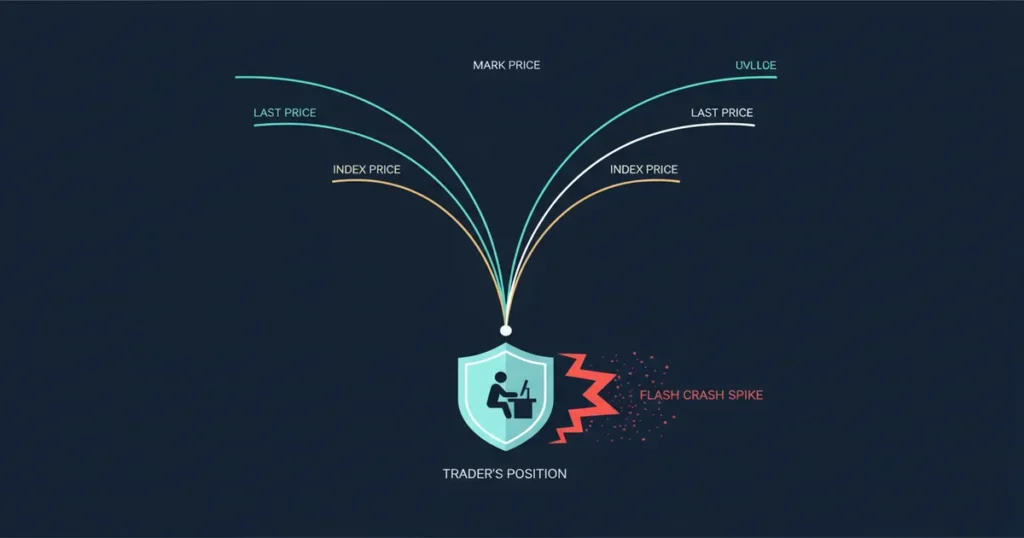
The last traded price on any single exchange can be manipulated. A whale with enough capital could dump a large market order, crash the price momentarily, trigger a wave of liquidations, then buy back cheaper. It’s happened before, and without mark price, it would happen constantly.
“Because a large trader could theoretically manipulate the price of a contract on one platform, the Last Price is not used to trigger liquidations. Instead, that is dictated by the Mark Price.” — Kraken’s official explanation of mark price
Mark price solves this by pulling data from multiple exchanges and smoothing out temporary spikes. So even if Bitcoin’s last price on one exchange flash-crashes by 8%, your liquidation won’t trigger if the broader market hasn’t actually moved.
I watched this happen in real time once. I was holding a 5x long BTC position during a volatile Sunday night session. The last price on the exchange I was using dropped hard on a thin order book, but mark price barely moved because the spot market across Coinbase, Kraken, and Binance held steady. My position survived. Without mark price, I would have lost around $4,200 that night. That experience permanently changed how I think about leverage trading.
How Mark Price is Calculated (Simple Explanation)
The formula looks intimidating at first, but the logic is straightforward. Mark price typically takes the median of three values, which filters out any single outlier. Let me walk through the components.
What is Index Price
Index price is the weighted average of an asset’s spot price across multiple major crypto exchanges like Coinbase, Kraken, Bitfinex, and Gate.io. Think of it as a “consensus price” that no single exchange can manipulate alone.
The Role of Funding Rate and Basis
Perpetual futures don’t expire, so they use funding rates to keep the contract price tethered to the spot price. Mark price factors this in. It also accounts for the basis, which is the gap between the futures price and spot price, smoothed over a moving average.

On Binance, the formula works like this:
Mark Price = Median of:
- Price 1: Index Price × (1 + Last Funding Rate × Time Factor)
- Price 2: Index Price + Moving Average of 2.5-Minute Basis
- Price 3: Current Contract Price
Bybit’s perpetual contract mark price formula follows a similar structure. Both use the median approach so that one wild value doesn’t distort the result.
Why Exchanges Use a Median Calculation
Taking the median of three prices means that even if one component spikes or crashes, the middle value wins. It’s a simple but effective way to resist manipulation. Once I understood this, I stopped panicking during drawdowns. If two out of three components say “the real price hasn’t moved much,” your position is safe regardless of what one rogue data point shows.
Mark Price vs Last Price vs Index Price (The Differences That Matter)
These three prices often move together, but they can diverge significantly during high volatility. Here’s the quick breakdown:
| Price Type | What It Is | Used For |
|---|---|---|
| Last Price | Most recent executed trade on that specific exchange | Chart display, limit orders, trade history |
| Index Price | Aggregated spot price from multiple exchanges | Mark price calculation, fair value reference |
| Mark Price | Smoothed fair value combining index, funding, and basis | Liquidation triggers, unrealized PnL, margin calls |
My personal trading rule: before I even think about liquidation risk, I check the mark price. Not the chart price, not the last trade. The mark price is what actually determines whether your position lives or dies. Everything else is noise when slippage and volatility hit the order book.
Real-World Example: The October 2025 Liquidation Cascade
If you want proof that mark price matters, look at what happened on October 10-11, 2025. In roughly 24 hours, $19 billion in crypto derivatives were liquidated, affecting approximately 1.6 million traders globally. It was the largest single-day deleveraging event in crypto history.
During that chaos, a major price oracle reportedly published a Bitcoin price nearly 10% away from the real market mid. This faulty data triggered excessive collateral calls for on-chain positions. According to the CoinGlass 2025 derivatives market report, total forced liquidations for the year hit $150 billion.
Here’s the thing: it could have been even worse. The mark price systems on centralized exchanges like Binance and Bybit filtered out that faulty oracle data because their multi-source median calculations caught the outlier. Traders on those platforms were partially shielded. The ones using protocols that relied on a single oracle feed? They weren’t so lucky.
I was watching the CoinMarketCap’s liquidations dashboard that night, refreshing it every few minutes while my trading psychology was being tested hard. The experience reinforced something I already knew: mark price isn’t some abstract concept. It’s the guardrail between your capital and a blown account.
How Mark Price Affects Your Trading (Practical Implications)
Unrealized PnL Calculation
The profit or loss number displayed on your open position uses mark price, not the last traded price. This means your PnL can look different from what the chart suggests. Don’t panic when they diverge. It usually corrects itself as the funding period progresses.
Liquidation Price Protection
Your liquidation trigger is calculated from mark price. This is the most important thing I can tell you. A flash crash that drops the last price by 10% on one exchange won’t liquidate you if the mark price only moved 2%. That protection is built into the system by design. Set your stop loss orders wisely, but know that mark price has your back against manipulation.
Cross-Exchange Basis Risk
Different exchanges calculate mark price with slightly different formulas. Binance and Bybit both use median-based approaches, but the specific inputs and smoothing periods vary. This means the mark price of the same contract can differ across platforms, creating arbitrage opportunities. In September 2025, Bybit shifted from using entry price to mark price for margin calculations, which changed the game for cross-exchange traders tracking open interest across venues.
Common Mark Price Mistakes Traders Make
Mistakes to Avoid
- Assuming last price triggers liquidation. It doesn’t. Mark price does. Check your exchange’s documentation.
- Panicking when PnL diverges from the chart. Your unrealized PnL uses mark price. The chart shows last price. They’re different by design.
- Ignoring mark price in risk calculations. If you’re calculating position sizing based on chart price instead of mark price, your risk numbers are wrong.
- Thinking mark price can’t be manipulated. It’s much harder to manipulate than last price, but not impossible. If someone could influence spot prices on multiple major exchanges simultaneously, they could move the index price and therefore the mark price. It’s just extremely expensive to do.
I’ll be honest about my own mistake here. Before I understood how mark price worked, I lost about $2,800 on a trade where I set my mental stop based on the chart price. When the chart hit my level, I closed manually, thinking liquidation was imminent. Turns out, mark price was still well above my liquidation level. I sold into a temporary dip that would have recovered within minutes. Expensive lesson, but I only needed to learn it once.
How to Use Mark Price to Trade Smarter
Here’s the checklist I personally run through before entering any leveraged position. It’s saved me more money than any indicator ever has:
- Check mark price divergence. During volatile periods, compare the last price to the mark price. A large gap often signals temporary dislocation, not a real move.
- Size positions using mark price. Calculate your real liquidation distance from the mark price, not the chart price.
- Set alerts. Most exchanges let you set alerts based on mark price. Use them when it approaches your liquidation level.
- Understand the funding rate impact. High funding rates widen the gap between mark and last price. Factor this into your entries and exits.
- Cross-reference across exchanges. If mark price on Binance diverges significantly from Bybit, there might be an arbitrage opportunity, or one platform might be lagging. Trading bots can help monitor this automatically.
Frequently Asked Questions About Mark Price
Is mark price always higher or lower than last price?
No. Mark price can be above or below the last traded price depending on the funding rate and market conditions. They often trade very close together, but diverge during volatility or when funding is extreme.
Can mark price be manipulated?
It’s significantly harder to manipulate than last price because it aggregates data from multiple exchanges. However, if someone could move spot prices across several major platforms simultaneously, they could theoretically influence it. The cost and coordination required make this very rare.
Why does my PnL not match the chart price?
Your unrealized PnL is calculated using mark price, while the chart displays the last traded price. These are intentionally different. Mark price gives a fairer picture of your position’s value.
Do all exchanges use the same mark price?
No. Each exchange uses its own formula with different index sources, smoothing periods, and weight distributions. This is why the same BTC perpetual contract can have slightly different mark prices on Binance versus Bybit.
What happens if index price feeds fail?
Exchanges have failover mechanisms. If a spot exchange’s price feed goes down or publishes bad data, it’s typically excluded from the index calculation. The October 2025 event showed what happens when on-chain oracles fail, but centralized exchanges’ multi-source systems handled it better.
Protect Your Positions With Knowledge
Understanding crypto mark price isn’t optional if you’re trading derivatives. It’s the difference between getting liquidated by a flash crash and sleeping through the noise. I learned this the hard way, through support tickets, panic closes, and one very expensive $2,800 mistake. You don’t have to.
If you’re building your derivatives knowledge, start with the fundamentals. Learn how perpetual futures work, understand how liquidations happen, and get comfortable with reading funding rates. Mark price ties all of these concepts together, and knowing how it works puts you ahead of most traders in the market.
Got a leveraged position open right now? Go check your mark price. Then check your liquidation level. That five-second habit might be the most valuable thing you do today.