What Is Chainlink (LINK): The Oracle Network Every Crypto Investor Needs to Know
What is Chainlink (LINK)? Learn how this decentralized oracle network powers DeFi, secures $95B+ in value, and why LINK matters for every crypto investor.

In this article
The Oracle Problem: Why Smart Contracts Were Incomplete
If you’ve spent any time researching what is Chainlink crypto, you’ve probably seen the phrase “oracle network” thrown around without much explanation. Here’s the thing: Chainlink solves one of the biggest bottlenecks in all of blockchain technology. And once you understand the problem it fixes, you’ll never look at decentralized finance (DeFi) the same way again.
I’ll never forget the moment this clicked for me. I was digging into Aave’s lending rates back in 2022, trying to figure out how a decentralized protocol “knew” the price of ETH. It hit me: the smart contract had no idea what was happening in the real world. It was completely blind without an external data feed. That was my lightbulb moment on Chainlink, and it changed how I evaluated every DeFi project going forward.
What Is a Blockchain Oracle?
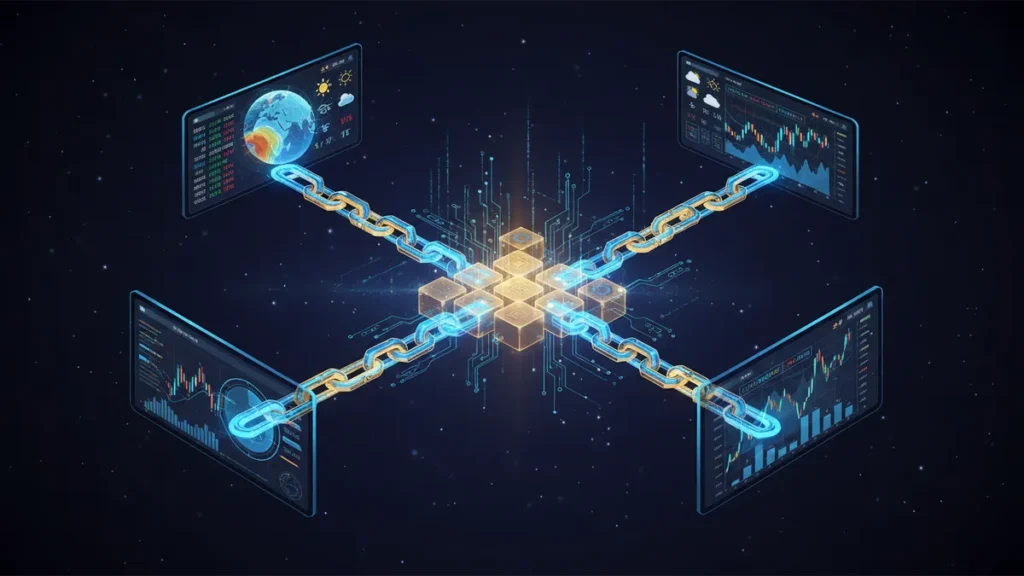
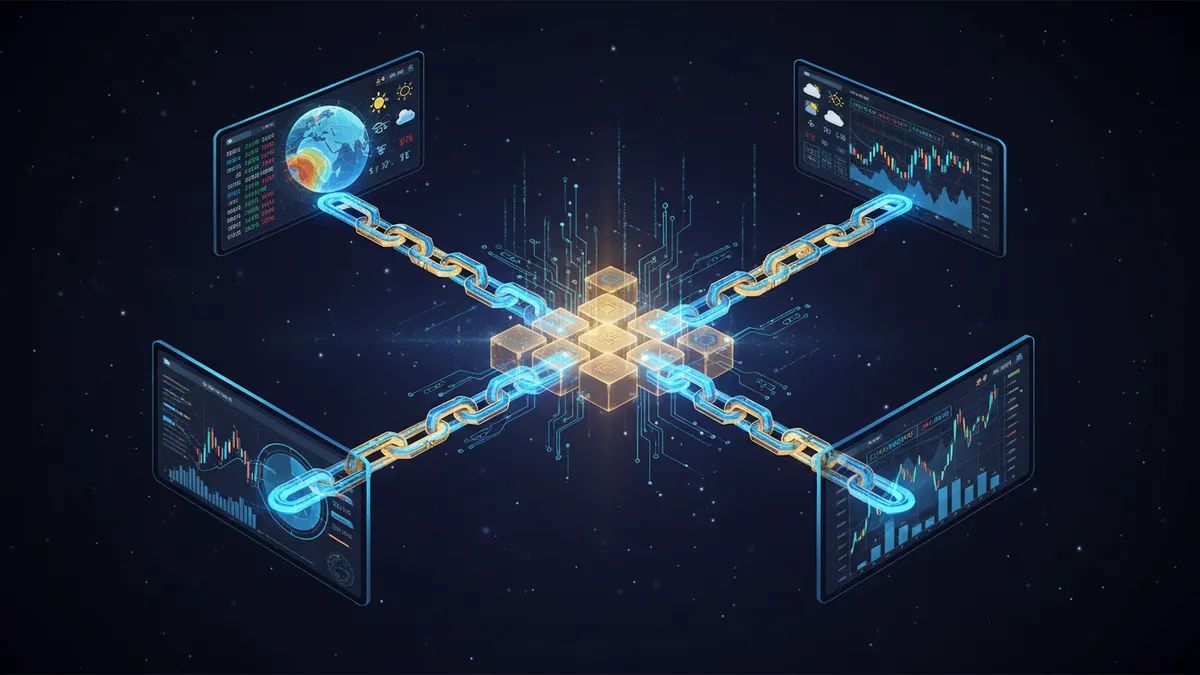
A blockchain oracle is a service that connects smart contracts to real-world data. Think of it like a translator between the blockchain and everything outside of it: stock prices, weather data, sports scores, interest rates.
Without oracles, smart contracts can only work with information that already lives on-chain. They’re powerful, but isolated.
Why Blockchains Can’t Access the Real World on Their Own
Blockchains are deterministic systems. Every node must reach the same conclusion from the same inputs. If a smart contract could pull data from any random website, different nodes might get different answers. The whole system breaks down.
This is called the oracle problem. It’s the gap between what blockchains know and what the world knows. And here’s where it gets dangerous: if you rely on a single centralized oracle to feed that data, you’ve created a single point of failure. One corrupt data feed can drain millions from a lending protocol or enable flash loan attacks.
Chainlink was built specifically to eliminate that risk.
How Chainlink Solves the Oracle Problem
Chainlink, founded in 2017 by Sergey Nazarov and Steve Ellis, takes a decentralized approach to oracle infrastructure. Instead of trusting one data source, it aggregates information from hundreds of independent nodes. The result? Tamper-proof, reliable data that smart contracts can actually trust.
Decentralized Oracle Networks (DONs) Explained
At its core, the official Chainlink platform operates through Decentralized Oracle Networks, or DONs. Each network consists of multiple independent node operators who fetch, verify, and deliver data on-chain.
Over 900 independent oracle nodes power the network today. These aren’t anonymous operators running servers in basements. Node operators include Deutsche Telekom, Swisscom, Vodafone, and Infura. That’s institutional-grade infrastructure backing every data feed.
How Real-World Data Flows Into a Smart Contract (Step by Step)
- A smart contract requests external data (e.g., “What’s the price of ETH/USD?”)
- Chainlink’s Order-Matching Contract selects qualified node operators for the job
- Each node independently fetches the data from real-world sources
- The Chainlink Aggregating Contract reconciles all responses using majority consensus mechanisms
- The verified, aggregated data is delivered on-chain to the requesting contract
No single node can corrupt the result. If one node sends bad data, it gets outvoted and penalized.

Node Operators: The Backbone of Chainlink’s Network
Node operators must stake LINK tokens as collateral. If they provide inaccurate or malicious data, they lose their stake through a process called slashing. This creates a strong economic incentive to stay honest.
The network currently supports 15+ blockchain ecosystems, including Ethereum, Avalanche, Polygon, and several Layer 2 networks.
What Is the LINK Token?
LINK is the native utility token that keeps the Chainlink network running. Understanding its tokenomics is essential if you’re considering an investment.
LINK Token Use Cases: Payment and Network Security
LINK serves two critical functions:
- Payment: Smart contracts pay node operators in LINK for delivering data. More data requests across DeFi means more demand for LINK.
- Collateral: Node operators stake LINK as a security deposit. Bad behavior triggers slashing, so operators are financially motivated to stay honest.
Community members can also participate in staking LINK to support network security and earn protocol rewards. This creates real yield demand beyond pure speculation, which is something I always look for when evaluating a token’s long-term value.
LINK Tokenomics at a Glance
- Total supply: 1 billion LINK tokens
- Market cap: ~$6.5 billion (ranked ~#18 globally as of early 2026)
- Primary demand driver: Every oracle data request requires LINK payment
- Staking: Community staking available for network security participation
Where Chainlink Actually Gets Used: Real-World Applications
This is where Chainlink separates itself from the pack. It’s not a whitepaper promise. It’s live infrastructure powering billions of dollars in value. Let me walk you through the major use cases.
DeFi Price Feeds: The Foundation of Lending and Trading
Aave, decentralized exchanges like Uniswap, and dozens of yield farming protocols rely on Chainlink price feeds to determine fair asset values. Without accurate price data, liquidity pools would be vulnerable to manipulation.
I’ve watched protocols that skipped Chainlink and rolled their own oracles get drained in hours. Accurate, tamper-proof price data isn’t optional in DeFi. It’s the foundation.
Real-World Asset Tokenization (RWA)
Real-world asset (RWA) tokenization is one of the hottest trends in crypto right now, and Chainlink is the infrastructure backbone making it possible. By connecting real assets like bonds, commodities, and real estate to smart contracts, Chainlink enables on-chain verification of off-chain value.
In January 2026, Chainlink Data Streams delivered a major upgrade: near-real-time U.S. stock and ETF prices on-chain. This opened the door for tokenized equities to trade with the same data reliability as traditional markets.
Cross-Chain Interoperability Protocol (CCIP)
CCIP is Chainlink’s solution for secure cross-chain token and data transfers. It facilitates communication across 15+ blockchains, which is critical as the crypto ecosystem grows more fragmented across Layer 1s and Layer 2s.
Think of CCIP as the postal service for blockchains. It ensures messages and tokens arrive safely, no matter which chain they’re coming from or going to.
Institutional Finance: Swift, JP Morgan, and Mastercard
Here’s what really caught my attention. The biggest names in traditional finance are using Chainlink:
- Swift: Tested Chainlink for cross-chain settlement across its global banking network
- JP Morgan: Integrated Chainlink for tokenized asset interoperability
- Mastercard: Partnered with Chainlink to enable 3 billion+ cardholders to buy crypto on-chain via the Chainlink-powered Swapper app
- U.S. Department of Commerce: Now delivers official GDP and inflation data via Chainlink oracles
“Secure oracle mechanisms are the only way to bring established companies onto the blockchain.” — Sergey Nazarov, Co-founder and CEO, Chainlink
When the U.S. government is using your infrastructure to deliver economic data on-chain, you’ve moved well beyond “just another crypto project.”
Chainlink by the Numbers: Why It Dominates the Oracle Space
Numbers don’t lie. According to Chainlink’s live network metrics and Chainlink’s 2025 ecosystem report, here’s where the network stands:
- $95 billion+ in on-chain value secured
- 1,700+ projects integrating Chainlink services
- 1,200+ decentralized oracle networks operational
- 900+ independent node operators
- 15+ blockchain ecosystems supported
No competitor comes close to these numbers. And in infrastructure, network effects compound. Every new integration makes the next one easier to justify.
Should You Invest in LINK? The Bull Case and the Risks
I get asked about LINK at least once a week. Here’s how I think about it, broken down honestly.
The Bull Case: More DeFi and RWAs = More Chainlink Demand
The bull thesis is straightforward: every new DeFi protocol, RWA tokenization project, and cross-chain integration needs oracle infrastructure. Chainlink owns that market. As the ecosystem grows, demand for LINK grows with it.
Staking adds another dimension. It creates real yield demand for LINK beyond speculation. I’ve always said that tokens with genuine utility outlast the ones that only trade on hype.
My favorite analogy: owning LINK is like owning shares in TCP/IP back when the internet was being built. It’s infrastructure. Unsexy, but essential.
Risks to Consider Before Buying LINK
- Competition: Pyth Network is gaining ground in high-frequency derivatives trading. API3 offers a first-party oracle model. Neither matches Chainlink’s breadth, but they chip away at niche markets.
- Token inflation: Node operator rewards add selling pressure over time.
- Smart contract risk: Protocols built on Chainlink inherit its security model. A Chainlink exploit would cascade across DeFi.
- Regulatory pressure: If regulators crack down hard on DeFi, Chainlink’s primary customer base shrinks.
I’ll be honest: I hold a small LINK position. But I size it like infrastructure, not like a moonshot. Risk management first, always.
Chainlink vs. Competitors: Why It Leads the Oracle Race
Let me give you a quick comparison of the oracle landscape so you can see why Chainlink’s moat is so deep.
| Feature | Chainlink | Pyth Network | API3 | Band Protocol |
|---|---|---|---|---|
| Integrations | 1,700+ | ~300 | ~150 | ~100 |
| Node Operators | 900+ | ~90 | First-party APIs | ~70 |
| Institutional Partners | Swift, JP Morgan, Mastercard | Limited | Limited | Minimal |
| Best For | DeFi, RWAs, institutional | High-frequency derivatives | First-party data feeds | Cosmos ecosystem |
Chainlink’s moat isn’t just technology. It’s 1,700+ integrations that create enormous switching costs. Protocols don’t rip out their oracle infrastructure on a whim. The network effects here are real and compounding.
Frequently Asked Questions
Is Chainlink a good investment in 2026?
Chainlink has strong fundamentals as critical DeFi infrastructure, with $95B+ in secured value and growing institutional adoption. However, like any crypto asset, it carries volatility and competition risks. Always do your own research and size positions according to your risk tolerance.
How is Chainlink different from other cryptocurrencies?
Unlike Bitcoin (a store of value) or Ethereum (a smart contract platform), Chainlink is middleware. It connects blockchains to the real world. Its value comes from being essential infrastructure rather than a standalone blockchain.
Can you earn passive income with LINK?
Yes. Chainlink offers community staking, allowing LINK holders to stake tokens, support network security, and earn protocol rewards. This creates real yield beyond price speculation.
The Bottom Line on Chainlink
So, what is Chainlink crypto? It’s the infrastructure layer that makes DeFi, RWAs, and cross-chain communication actually work. Without reliable oracle networks, smart contracts are just code sitting in a sandbox, cut off from the data they need.
Chainlink’s combination of 1,700+ integrations, institutional partnerships with Swift and Mastercard, and the recent push into real-world asset tokenization positions it as one of the most fundamentally grounded projects in crypto. It’s not flashy. It doesn’t promise 100x returns. But it solves a real problem that grows bigger every day.
If you’re building out your understanding of the crypto ecosystem, I’d recommend diving deeper into how DeFi works, understanding smart contracts, and exploring the RWA tokenization trend that’s driving Chainlink’s next growth phase. The more you understand the ecosystem, the better your investment decisions will be.