Best Linux Desktop Environments in 2026: I Tested 5 on My Homelab (One Changed My Workflow)
Tested 5 Linux desktop environments on my homelab in 2026. How GNOME 48, KDE Plasma, XFCE 4.20, and Cinnamon actually perform — plus which one I switched to.

In this article
I’ve been distro-hopping since Ubuntu 8.04 Hardy Heron, and in that time I’ve probably cycled through every major Linux desktop environment at least twice. So when I set out to rank the best Linux desktop environments 2026 has to offer, I didn’t just read changelogs and call it a day. I spun up five Proxmox VMs, each with identical specs, and lived in each DE for a full week. One of them genuinely changed how I work — and it wasn’t the one I expected.
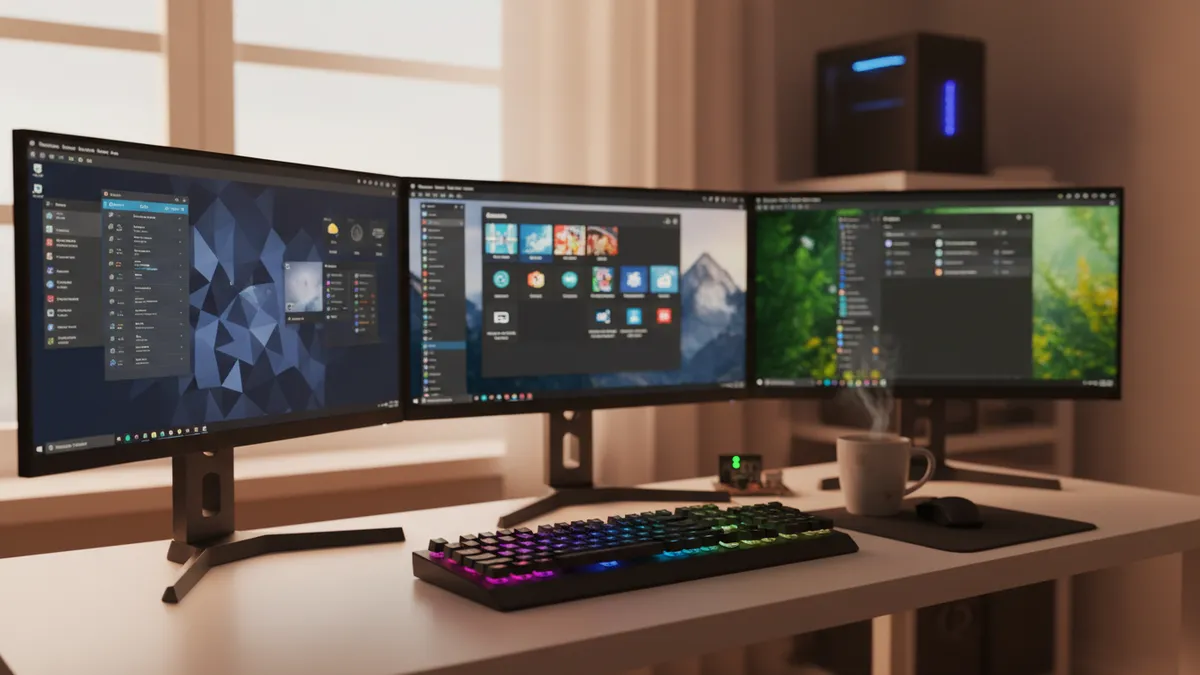
If you’re new to this world, a desktop environment is the entire graphical layer sitting on top of your Linux kernel — the panels, window manager, file manager, settings app, and default applications all bundled together. Choosing one is arguably the biggest decision you’ll make after picking a distro. And unlike the best Linux distro for servers debate, this one is deeply personal. Your DE shapes your muscle memory for years.
Quick answer for the skimmers: KDE Plasma 6.6 is the best all-around DE in 2026 if you want maximum control. XFCE 4.20 wins on efficiency. GNOME 48 is best for distraction-free workflow. Cinnamon 6.6 is the easiest landing spot for Windows converts. MATE still makes sense for ultra-stable legacy hardware.
What I Tested and How
My testing rig is a Proxmox homelab tower I built in 2022 and have been slowly refining ever since. For this round, I provisioned five VMs with identical specs: 8 GB RAM, 4 AMD Ryzen cores, and a 50 GB slice of NVMe. Each VM ran a fresh install with no post-install tweaks — just default settings, default apps, default everything. I wanted baseline numbers, not hand-tuned showcases.
If you want to dig into how I set this up, I wrote more about my stack in my Linux virtualization software review. Some of my lab containers also run through Docker on Linux, but the DE tests stayed on bare VMs to avoid noise.
I judged each DE on five criteria: idle RAM usage, Wayland readiness, customizability, stability under a normal workload, and overall workflow fit. To measure memory, I used the same approach I cover in my check memory usage in Linux guide. For CPU load, I leaned on the methods in my monitor CPU usage walkthrough. For anything deeper, I reached for the stack I recommend in my Linux monitoring tools roundup.
One stat that kept echoing in my head during this test: Linux desktop market share hit 4.7% globally in 2025, and Statcounter shows 3.2% as of March 2026. More people are choosing Linux than at any point I can remember. That means more people are staring at this exact choice — which DE do I live in every day?
1. KDE Plasma 6.x — The Power User’s Playground
If you follow any Linux media in 2026, you’ve seen the headline: “2026 could be the year of the (KDE) Linux desktop.” It’s not hype. Plasma 6 is the most polished, feature-complete KDE has ever been, and the 6.6 cycle this year is the first one where I didn’t hit a single papercut during my test week. Head over to the KDE Plasma official site if you want the official tour.
What’s New in Plasma 6.6 (2026)
Plasma 6.6 brings a surprisingly practical set of upgrades. OCR in screenshots was the one that made me audibly exclaim at my desk — highlight a region, extract the text, done. There’s a new on-screen keyboard, color-blind accessibility filters baked into the compositor, and selective window exclusion from screen recordings. That last one alone justifies the upgrade if you do any kind of live screen sharing.
The bigger story is mainstream momentum. KDE Plasma is now the default DE on the Steam Deck, Bazzite, and CachyOS. That’s not a small thing — it means millions of people are being onboarded onto Plasma without even realizing they’re using a Linux desktop.
Performance Reality: RAM vs. Reward
I measured Plasma 6.6 at roughly 2,670 MiB idle RAM, which makes it the heaviest DE I tested. But here’s the thing — on modern hardware with 16 GB or more, you’ll never feel that weight. My laptop has 32 GB and I couldn’t care less. On my 8 GB test VM, it was noticeable but not crippling.

Phoronix benchmarks on Ubuntu 25.04 showed something fascinating: under Wayland, both GNOME and KDE outperform XFCE and LXQt for Linux gaming. The heavier compositor actually wins here because it’s native Wayland with better GPU handoff.
“KDE Plasma and GNOME 48 are delivering great Wayland desktop experiences on Ubuntu 25.04.” — Michael Larabel, Phoronix
Who KDE Plasma Is Actually For
KDE Plasma is for the person who wants to tweak everything. Activities, KWin scripts, Plasmoids, KDE Connect, global shortcuts that actually respect every input device you own — no other DE matches this scope. If you’ve ever wanted to move a panel to a weird corner of the screen at a custom opacity with a custom blur radius, Plasma just shrugs and asks if that’s all you need. Pair it with Kate and a good terminal — I covered my favorites in my best terminal emulator for Linux roundup — and you’ve got a daily driver that can do nearly anything.
Longevity score: 9.5/10. Plasma isn’t going anywhere.
2. GNOME 48 — The Opinionated Workflow Machine
GNOME is the DE I have the most complicated relationship with. I bounced off it for years because I missed having a system tray. Then I tried GNOME 48 on a fresh Fedora install, forced myself to use it for a week, and had this weird moment on day four where I realized I hadn’t checked any notifications or status icons in hours. I was just… working. For more on the project itself, see the GNOME Project.
What’s New in GNOME 48
GNOME 48 ships in Alpine Linux 3.22 and Manjaro 25.0, and of course it remains the flagship on Fedora Workstation. The interesting architectural fact is that GNOME is Wayland-native by design. Not retrofitted. Not bolted on. Built from the ground up for Wayland. That shows in the smoothness of animations, touchpad gestures, and HiDPI handling.
The Workflow Trade-Off
GNOME is opinionated. The developers have a vision and they stick to it — fewer configuration options, fewer knobs to turn, fewer ways to break your system. For some people that’s heresy. For others, including the me of 2026 apparently, it’s a feature. I didn’t realize how much time I used to waste tweaking panels and applets until a DE took those options away.
Idle RAM came in at about 2,100 MiB, notably lighter than Plasma but still chunky. GNOME pairs beautifully with the default GNOME Text Editor, though I’d still recommend looking through my best text editor for Linux writeup for alternatives depending on your workflow.
Who GNOME Is Actually For
GNOME is for users who want a refined, focused environment on modern hardware. It’s also for anyone prioritizing security — the smaller configuration surface means fewer places for things to go wrong. I talk more about that layered defense approach in my Linux security tools article.
Longevity score: 9.5/10, tied with Plasma. Red Hat isn’t dropping GNOME anytime this decade.
3. XFCE 4.20 — The Efficiency Champion
XFCE is my sentimental favorite. It’s the DE I ran on a 2011 ThinkPad X220 I refurbished during the pandemic, and the machine is still chugging along today. The XFCE official site is exactly as understated as the DE itself — no flashy rotating banners, no “revolutionary” taglines. Just a solid, lightweight, traditional Linux desktop.
What’s New in XFCE 4.20
XFCE 4.20 released in December 2024 and now ships in Xubuntu 25.04 and the Manjaro XFCE edition. The headline feature is experimental Wayland support via the libxfce4windowing abstraction library. This is a careful, measured transition that doesn’t break X11 — classic XFCE philosophy.
Thunar 4.20 got spring-loaded folders, which means you can drag a file onto a folder and it’ll pop open so you can drop the file into a nested location. A tiny quality-of-life feature I immediately started using every single day. The clock applet now supports 24-hour analog mode, week numbers, and an LCD-style inactive segment visualization that my inner nerd absolutely loves.
Performance That Speaks for Itself
I measured XFCE at about 1,360 MiB idle RAM — the most efficient full DE on this list. That’s the difference between “works okay on 4 GB” and “works genuinely well on 4 GB.” For homelab VMs, old laptops, or Raspberry Pi desktop builds, nothing else comes close at this balance of features and weight.
My homelab tip: I run XFCE on every GUI-enabled VM in my Proxmox cluster. It boots fast, stays out of the way, and doesn’t chew through the RAM I’d rather allocate to workloads. Pair it with a good tiling setup and a decent terminal and you honestly don’t miss much from heavier DEs.
Who XFCE Is Actually For
XFCE is for people with older hardware, resource-constrained VMs, minimalists, and anyone who wants a traditional desktop that gets out of the way. It’s not the flashiest and it doesn’t try to be. That’s the point.
4. Cinnamon 6.6 — The Familiar Productivity Powerhouse
If you’ve ever helped a relative switch from Windows to Linux, you probably handed them Linux Mint with Cinnamon. It’s the softest landing pad in the entire Linux ecosystem, and Cinnamon 6.6 (December 2025) is the most polished version yet.
What’s New in Cinnamon 6.6
The application menu got a full redesign — cleaner, faster, more searchable. Cinnamon 6.6 also replaced the old Tweener animation library with native easing-based animations, and you can feel the difference. Three- and four-finger gesture support finally landed properly, covering workspace switching and window tiling. And Alt+Tab now respects multi-monitor setups, which every Linux Mint user has been quietly suffering without for years.
Under the hood, Cinnamon 6.6 boots a desktop session 15–20% faster than the 5.x series on identical hardware. On my VM, the login-to-usable-desktop time dropped noticeably compared to my Mint 21.x reference box.
The Linux Mint Advantage
Cinnamon’s real strength is the distro it ships on. Linux Mint has 3.2 million users as of 2025 — the largest cohort of any distro whose identity is tied to one specific DE. That means better community support, more tutorials, more “why isn’t my printer working” threads for you to search through at 2 a.m.
Idle RAM came in around 1,400–1,600 MiB — sitting nicely between XFCE and GNOME. The main trade-off in 2026 is Wayland. Cinnamon’s Wayland support is still limited, so you’re primarily on X11. For most users this is fine. For gamers chasing the best Wayland performance, this is the reason to look at Plasma or GNOME.
Who Cinnamon Is Actually For
Cinnamon is for Windows converts, traditional-taskbar loyalists, and Linux newcomers. It’s the DE I still recommend first whenever someone asks me where to start. No shame, no gatekeeping — just a solid, familiar desktop that works.
5. MATE — The Classic That Refuses to Die
MATE is a fork of GNOME 2, and it’s the DE most Linux veterans grew up on. I ran GNOME 2 on a battered Dell Inspiron in college, and booting into MATE today gives me an almost eerie flashback — the same muscle memory fires, the same menu positions, the same deliberate pace.
The GNOME 2 Legacy
MATE is extremely stable and extraordinarily light — roughly 1,300 MiB idle, edging out even XFCE on some test runs. The trade-off is obvious: no Wayland support, limited GTK4 adoption, and a slower development pace than the big four. This is not a cutting-edge desktop and it doesn’t claim to be.
Who MATE Is Actually For
MATE is for maximum stability on older hardware, GNOME 2 nostalgics, and anyone running Ubuntu MATE, the Fedora MATE spin, or Linux Mint MATE edition. It’s a time capsule with active maintenance. If you know, you know.
Quick Comparison: Desktop Environments at a Glance
| Desktop Environment | Idle RAM | Wayland Status | Best For | Customizability |
|---|---|---|---|---|
| KDE Plasma 6.6 | ~2,670 MiB | Stable | Power users | Extreme |
| GNOME 48 | ~2,100 MiB | Native / first-class | Focus / workflow | Moderate |
| XFCE 4.20 | ~1,360 MiB | Experimental | Old hardware / VMs | High |
| Cinnamon 6.6 | ~1,500 MiB | Limited | Windows converts | High |
| MATE | ~1,300 MiB | None / minimal | Stability seekers | Moderate |
My Final Verdict: Which Desktop Environment Should You Choose?
After a month of testing, here’s where I landed personally: I’m running KDE Plasma 6.6 on my daily driver laptop and XFCE 4.20 on my homelab VMs. That’s the combo that changed my workflow this year — Plasma’s power where I need it, XFCE’s efficiency where I don’t. Your mileage will vary, and that’s the whole point.
Here’s my honest recommendation framework when people ask me, which happens more often than you’d think:
- If you’re brand new to Linux: Start with Cinnamon on Linux Mint, or GNOME on Fedora. Both are forgiving, well-documented, and won’t overwhelm you on day one.
- If you want maximum control: KDE Plasma is unmatched. Nothing else even comes close to the depth of customization.
- If RAM is scarce: XFCE 4.20, no contest. MATE is a close second if stability matters more than modern features.
- If you’re coming from Windows: Cinnamon is the softest landing. The start menu, taskbar, and system tray will all feel familiar.
- If you want a focused, distraction-free workflow: GNOME 48. Give it two weeks before deciding — the first three days are jarring and the payoff comes later.
One thing I want to hammer home: desktop environments can coexist on the same system. You can install KDE Plasma and GNOME side by side on most distros and pick which one to log into from the display manager. Don’t let picking a DE feel like a permanent marriage. It took me years to find my combo — partly because I didn’t realize I could try them all without reinstalling. Don’t let it take you that long.
Whichever DE you choose, remember that the terminal matters more than the desktop. Your DE paints the surface, but your shell is where the real work happens. I go deep on that in my best Linux shell review and my terminal productivity hacks guide. And if you’re serious about speeding up your workflow, set up a solid Linux bash aliases file — it’ll save you more time than any DE choice ever will.
Happy distro-hopping. I’ll see you in the comments on the next article, where I’ll probably argue about tiling window managers next. BTW, I use Arch.