I’ve watched more crypto projects crash and burn than I care to admit. Some had brilliant technology. Some had massive communities. But when I dig into the wreckage, the pattern is almost always the same: bad tokenomics.
So what is tokenomics exactly? It’s the economic model behind a cryptocurrency. The rules that determine how tokens are created, distributed, and used. And after years of trading crypto (and losing my shirt a few times), I can tell you this: understanding tokenomics is the single most important skill for surviving in this market.
If you’re still getting started with buying your first cryptocurrency, you’ve come to the right place. Today I’m breaking down everything you need to know about token economics. No fluff. No complicated jargon. Just the practical knowledge that separates smart investors from bag holders.
What Tokenomics Actually Is (And Why It Matters More Than the Technology)
The Simple Definition: Token + Economics
Tokenomics is a blend of “token” and “economics.” It covers everything about a cryptocurrency’s economic design:
- How many tokens exist (and how many will ever exist)
- Who holds them (and when they can sell)
- What purpose they serve (and why anyone would want them)
- How new tokens are created (mining, staking, or printing from thin air)
Think of tokenomics like the constitution of a crypto project. It sets the rules everyone plays by. And just like a country with bad laws, a project with bad tokenomics is doomed from the start.

Get a VPS from as low as $11/year! WOW!
Why I Ignore Projects with Bad Tokenomics (No Matter How Good the Tech)
Back in 2021, a friend pitched me on this “revolutionary” Layer 1 blockchain. The tech demos were impressive. The team had Stanford PhDs. The Discord was buzzing with excitement.
But when I checked the tokenomics, I saw that the team held 45% of the supply. With no vesting schedule. They could dump everything on day one if they wanted.
I passed. My friend bought a bag. Six months later, the team sold, the price collapsed 93%, and that “revolutionary” project is now a ghost town.
The technology didn’t save it. Great tech never saves bad tokenomics.
The 53% Failure Rate: Half of All Crypto Projects Die
Here’s a sobering statistic: 53% of listed cryptocurrencies have failed. Over 1.82 million tokens stopped trading in 2025 alone. That’s more than the 1.38 million failures in 2024.
Most of these projects didn’t fail because the code was buggy. They failed because the economic model was broken from day one. Either the team got greedy, inflation destroyed holder value, or the token simply had no reason to exist.
The Three Pillars of Tokenomics You Must Understand
1. Token Supply: Max Supply vs Circulating Supply
Every crypto has supply numbers you need to understand:
- Max Supply: The absolute maximum tokens that will ever exist (Bitcoin: 21 million)
- Total Supply: All tokens created so far (including locked tokens)
- Circulating Supply: Tokens currently tradable on the market
Here’s why this matters. Imagine two coins both trading at $1. Coin A has 10 million circulating out of 10 million max. Coin B has 10 million circulating out of 1 billion max.
Coin B has 990 million more tokens coming. When those hit the market, your investment gets diluted. That’s basic supply and demand. More supply with same demand equals lower prices.
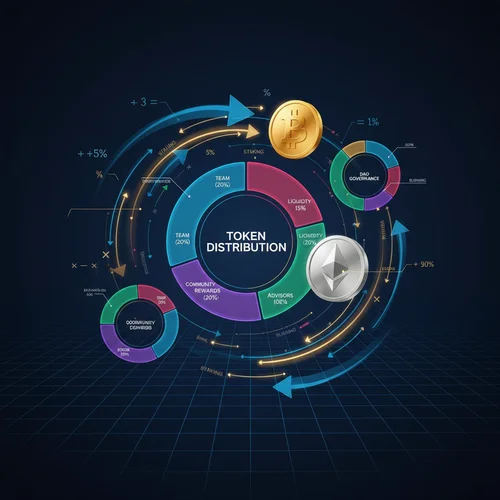
2. Token Distribution: Who Owns What (And When They Can Dump)
Token distribution tells you who controls the supply. This is where I’ve seen so many investors get burned. Including myself, back when I was just getting started and didn’t know to check these things.
Key distribution categories:
- Team/Founders: Should be 10-20%. More than 40% is a major red flag.
- Investors/VCs: Early investors often get discounts. Check their lockup periods.
- Community/Public: The more here, usually the better for decentralization.
- Treasury/Ecosystem: Funds for development and partnerships.
Vesting schedules matter hugely. A team might own 20% of tokens, but if those tokens unlock over 4 years with monthly vesting, that’s very different from all 20% being available immediately.
If you want to learn how to spot crypto rug pulls, start with token distribution. Concentrated ownership plus no vesting equals run away fast.
3. Token Utility: What the Hell Does This Token Actually Do?
This is where most projects fail the smell test. A token needs a reason to exist beyond “number go up.” Solid utility drives real demand.
Legitimate token utilities include:
- Governance: Voting on protocol decisions (like Uniswap’s UNI)
- Staking rewards: Earn yield for securing the network. Understanding crypto staking is essential here.
- Fee payments: Required to use the platform (like ETH for gas)
- Access: Unlocks features, premium services, or discounts
Tokens with strong utility in DeFi yield farming protocols often have better tokenomics. There’s actual demand beyond speculation.
Ask yourself: if this token didn’t exist, could the project work just as well with ETH or stablecoins? If yes, the token probably shouldn’t exist.
Real Tokenomics Examples: Bitcoin vs Ethereum vs Failed Projects
Bitcoin: The Deflationary Model That Started It All
Satoshi Nakamoto designed Bitcoin’s tokenomics with elegant simplicity. The Bitcoin whitepaper established rules that still hold today:
- Fixed max supply: 21 million BTC, forever
- Decreasing issuance: The Bitcoin halving cuts mining rewards every 4 years
- Fair launch: No pre-mine, no VC allocation, anyone could mine from day one
This creates programmatic scarcity. Every halving reduces new supply entering the market. Demand stays the same or grows. Price trends up over time.
It’s not complicated. It’s just good tokenomics.
Ethereum: Unlimited Supply with Burn Mechanisms
Ethereum takes a different approach. It launched with about 72 million ETH: 16.7% to the foundation and 83.3% sold in the crowdsale.
There’s no max supply cap. New ETH is minted forever. But EIP-1559 changed the game. Now, a portion of every transaction fee gets burned. Destroyed. Gone forever.
During high network activity, Ethereum can actually become deflationary. More ETH burned than created. It’s a clever mechanism that ties token value to actual network usage.
Smart contracts on Ethereum need ETH to execute. That creates constant demand. Unlike Bitcoin, Ethereum’s utility extends beyond just being money.
Worldcoin: How Bad Tokenomics Caused an 84% Crash
Now let’s look at what bad tokenomics looks like in practice.
Worldcoin (WLD) launched with massive hype in 2023. Scan your eyeball, get free crypto. Sam Altman involved. What could go wrong?
Everything, apparently. The token crashed 84%, from $11.78 to around $1.80.
The tokenomics red flags were visible from day one. The circulating supply at launch was tiny compared to what was coming. Token unlocks created constant sell pressure. Plus regulatory issues in multiple countries didn’t help.
I remember scrolling past the Worldcoin pitch in my feed and thinking: “This solves a problem nobody has with economics that benefit insiders.” I never bought a single token. Sometimes the best trades are the ones you don’t make.
The Tokenomics Red Flags That Scream “RUN AWAY”
Red Flag #1: Team Holds Over 40% of Supply
When insiders control too much of the supply, they control your investment. At any point, they can decide to sell and crater the price.
Even well-intentioned teams create problems with concentrated ownership. If they have bills to pay, they sell. If they get a better opportunity, they sell. If they just get tired, they sell.
Check token distribution before you invest. Tools like Etherscan show you wallet concentration for any ERC-20 token.
Red Flag #2: No Vesting Schedule or Locks
Vesting schedules force teams and early investors to hold their tokens for a set period. No vesting means they can dump immediately after launch.
Look for:
- 12-24 month cliff periods (no tokens unlock for the first year or two)
- 3-4 year total vesting with monthly or quarterly unlocks
- Clear documentation about who unlocks what and when
If you can’t find vesting information in the project’s documentation, that’s a red flag by itself. Legitimate projects are transparent about this.
Red Flag #3: The Token Has Zero Utility
Ask yourself: does this token need to exist? Or is it just a way to raise money?
Many tokens are solutions looking for problems. They create a token, sell it to retail investors, and never build anything that actually requires it.
No utility means no organic demand. No organic demand means price only moves based on speculation. Speculation eventually ends, and prices collapse.
Red Flag #4: Unlimited Supply with No Burn Mechanism
Unlimited supply isn’t automatically bad. Ethereum has unlimited supply. But Ethereum burns tokens constantly through EIP-1559.
What kills investors is unlimited supply PLUS high inflation PLUS no mechanism to reduce supply. That combination guarantees your holdings get diluted over time.
Always check the annual inflation rate. If a token inflates at 20% per year with no burning, you need 20% price appreciation just to break even.
How to Actually Evaluate a Project’s Tokenomics (My 5-Step Process)
After enough mistakes, I developed a checklist I run through before buying any token. Here’s the process:
Step 1: Read the Whitepaper (Or At Least the Tokenomics Section)
I know. Whitepapers are boring. But the tokenomics section is usually just a few pages. It’ll tell you supply schedules, distribution, and utility.
If a project doesn’t have clear tokenomics documentation, that tells you something. Either they haven’t thought it through, or they don’t want you looking too closely.
Step 2: Check Token Distribution on Block Explorers
Don’t trust what the project says. Verify on-chain. Etherscan, BscScan, and similar tools show you:
- Top token holders and their percentages
- Number of unique holders
- Recent large transactions
If 5 wallets control 80% of supply, you’re not investing in a decentralized project. You’re hoping insiders don’t dump on you.
Step 3: Look for Vesting Schedules and Unlock Dates
Find the token unlock calendar. Many projects publish this. Some don’t, which is itself a warning sign.
Mark major unlock dates on your calendar. Prices often drop before and during unlock events. That’s not a secret; it’s supply and demand.
I once held a token through a major unlock. I knew it was coming but thought the market had “priced it in.” It hadn’t. The price dropped 40% in two days. Lesson learned the hard way.
Step 4: Verify Actual Utility vs Marketing Hype
What does the token actually do today? Not what the roadmap promises. Not what the whitepaper envisions. What does it do right now?
Check if you can store tokens in a crypto wallet and actually use them for something. If the only thing you can do is hold and hope, that’s not utility. That’s speculation.
Step 5: Compare Against Established Projects
Finally, compare the tokenomics to projects that have already succeeded. How does it stack up against Bitcoin’s simplicity or Ethereum’s burn mechanism?
If you’re evaluating a new DeFi token, compare it to Uniswap, Aave, or Compound. What do the successful projects do that this one doesn’t?
Using reputable cryptocurrency exchanges with good research tools can help with this analysis. Most major exchanges provide tokenomics summaries for listed projects.
Common Tokenomics Mistakes That Cost Investors Money
Mistake #1: Ignoring Token Unlocks and Sell Pressure
Token unlocks are scheduled selling pressure. When millions of tokens unlock for early investors who got in at pennies, they often sell. Why wouldn’t they? They’re sitting on 10x or 100x gains.
The market doesn’t always crash on unlock day. Sometimes it crashes weeks before, as smart money front-runs the event. Other times it takes weeks after, as unlocked tokens slowly hit exchanges.
Either way, knowing the unlock schedule helps you make better timing decisions.
Mistake #2: Falling for “Deflationary” Marketing Without Checking Burns
Every other token claims to be “deflationary” now. It’s become a marketing buzzword. But many projects have minimal burn mechanisms that barely offset inflation.
Check the actual numbers. How much is burned per month? How much is minted? If minting outpaces burning, the token isn’t deflationary. It’s just marketing.
Mistake #3: Not Understanding Inflation Rates
Staking rewards sound great. “Earn 15% APY just for holding!” But where do those rewards come from? Usually, they’re printed out of thin air.
If you’re earning 15% APY but inflation is 20%, you’re losing purchasing power. The number of tokens in your wallet grows, but your share of total supply shrinks.
Always check staking rewards against inflation. Real yield matters more than nominal yield.
The Bottom Line: Good Technology Doesn’t Save Bad Tokenomics
I’ve been trading crypto long enough to know one truth: the projects that survive aren’t always the ones with the best technology. They’re the ones with sustainable economic models.
Before you buy any token, run through the checklist. Check supply limits. Verify distribution. Understand utility. Find the vesting schedule. Compare to projects that work.
This research takes maybe 30 minutes per project. It’s saved me from countless bad investments. It can save you too.
Tokenomics isn’t sexy. It’s not as exciting as promises of 1000x gains or revolutionary technology. But it’s the foundation everything else sits on. Build your portfolio on solid foundations, or watch it crumble when the market turns.
Be patient. Be selective. Do your homework. The opportunities aren’t going anywhere.
For more crypto investing fundamentals, check out my guides on spotting rug pulls and understanding how smart contracts work. The more you understand, the harder it is for bad actors to take your money.