Hot Wallet vs Cold Wallet: Which Crypto Storage Is Safest?
Hot wallet vs cold wallet explained: the key differences, real security risks, and which crypto storage strategy makes sense for your holdings.

In this article
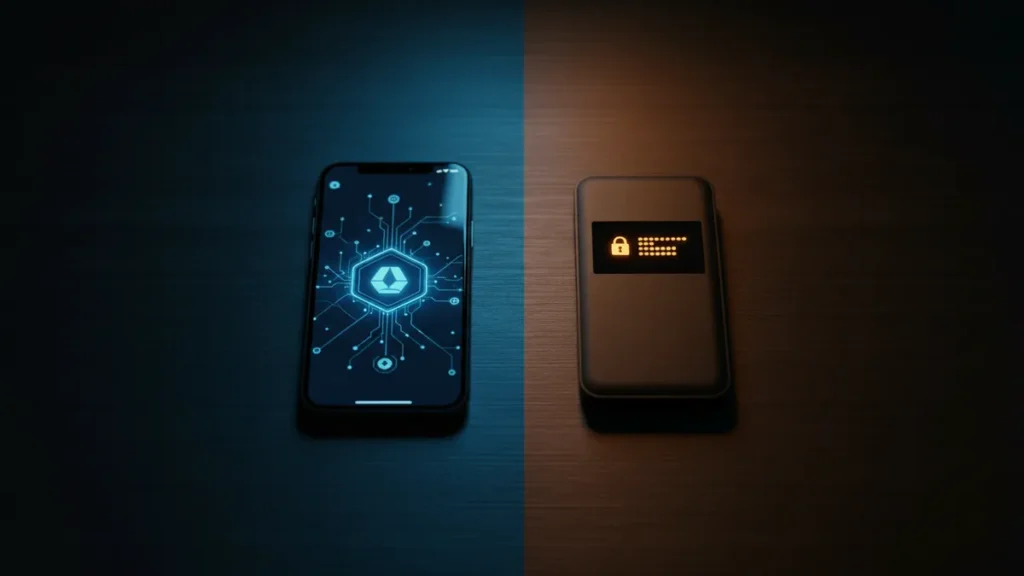
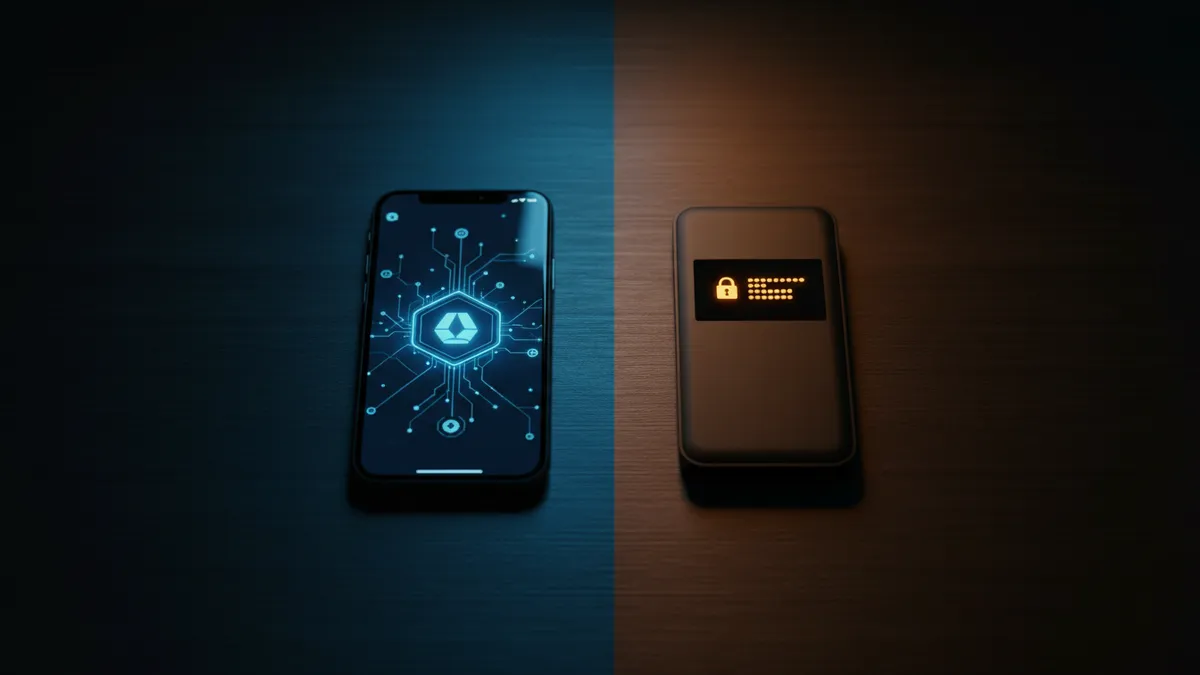
If you own crypto, the hot wallet vs cold wallet crypto question is the single most important security decision you’ll make. Get it right and you sleep through bear markets without checking your phone at 3 a.m. Get it wrong and you join the people who lost roughly $1.7 billion in 2025 alone — almost all of it from hot wallets that should have been cold.
I learned this lesson the hard way. Years ago, when I first started, I kept everything in a single browser wallet because it was convenient. One careless click on a fake airdrop site and a four-figure portfolio was gone in about ninety seconds. That moment is the reason I write articles like this one. Before we dive in, if you’re brand new and want a refresher on what a crypto wallet actually is, start there and circle back.
Quick answer: A hot wallet is software connected to the internet (MetaMask, Phantom, Trust Wallet) — fast, free, and convenient, but vulnerable to hacks. A cold wallet is an offline device (Ledger, Trezor) that signs transactions physically — slower to use, but nearly impossible to drain remotely. Smart investors use both: roughly 80% in cold storage for long-term holdings, 20% in a hot wallet for active trading.
What Is a Hot Wallet in Crypto?
A hot wallet is software that stores your private keys on a device connected to the internet. That’s it. It can live on your phone, your laptop, or as a browser extension. Because it’s online, you can sign transactions in seconds, swap tokens on a DEX, mint NFTs, or interact with DeFi protocols without ever reaching for a separate device.
The convenience is real. So is the risk. The same internet connection that makes a hot wallet useful also makes it reachable by malware, phishing sites, and malicious smart contracts. Your private key is sitting on a device that talks to the world — and the world includes some genuinely sophisticated thieves.
Types of Hot Wallets: Browser Extension, Mobile, and Desktop
Hot wallets generally come in three flavors. Browser extension wallets like MetaMask plug into Chrome or Firefox and are the standard for desktop DeFi. Mobile wallets like Phantom and Trust Wallet are apps you install on your phone — convenient for on-the-go swaps and QR-based dApp connections. Desktop wallets are standalone applications that store keys locally on your computer.
There’s also a critical fork between custodial and non-custodial hot wallets. A custodial wallet (think Coinbase or Binance accounts) means the exchange holds your keys for you. A non-custodial wallet means you hold the keys. The crypto saying “not your keys, not your coins” exists for a reason.
Popular Hot Wallets: MetaMask, Phantom, and Trust Wallet
The big three each shine in a different lane:
- MetaMask: The default for Ethereum and EVM chains. Charges roughly 0.875% on in-wallet swaps. Best if you’re deep in DeFi.
- Phantom: Built for Solana but now multi-chain. Charges about 0.85% on swaps. Clean UX, fast.
- Trust Wallet: Multi-chain across 100+ blockchains with a 0% platform fee on swaps. Owned by Binance, but non-custodial.
Pick one based on the chains you actually use. There’s no single “best” hot wallet — there’s a best wallet for your behavior.
What Is a Cold Wallet in Crypto?
A cold wallet stores your private keys entirely offline. The keys never touch the internet. To send a transaction, you have to physically connect the device, confirm the details on its tiny screen, and press a button. If a hacker on the other side of the world is trying to drain your wallet, they hit a wall: the signing key isn’t on any computer they can reach.
This is the gold standard for any crypto you don’t plan to actively trade. Want to hold Bitcoin for five years? Cold wallet. Just earned a chunk from staking your crypto and want to lock in profits? Cold wallet. The whole design assumes you’d rather wait three minutes to sign a transaction than lose everything to a remote attack.

Types of Cold Wallets: Hardware Devices and Paper Wallets
Hardware wallets are small devices, usually USB-shaped or with a small touchscreen, that hold your keys in a secure chip. They cost between roughly $50 and $250. Worth every penny if you’re holding more than the device costs — which, honestly, is almost everyone reading this.
Paper wallets are an older approach: you print or write down your private key and seed phrase, then store it offline. Technically cold, but practically fragile. Paper burns. Ink fades. House gets flooded. I haven’t recommended a paper wallet in years. If you want a deeper dive, our writeup on the best cold storage wallets walks through current hardware options.
Popular Cold Wallets: Ledger and Trezor
Two names dominate the cold wallet space:
- Ledger: The Nano S Plus and Nano X are the most widely used hardware wallets. Strong app ecosystem, Bluetooth optional, secure element chip.
- Trezor: Open-source firmware, Model T has a touchscreen, transparent security philosophy.
Both are excellent. The choice often comes down to user preference and which coins you hold. For a full breakdown including newer entrants, see our roundup of the best crypto hardware wallets for 2026 and our 2025-specific picks for the best cold wallets for crypto in 2025.
Hot Wallet vs Cold Wallet: The Key Differences
Here’s the comparison at a glance:
| Factor | Hot Wallet | Cold Wallet |
|---|---|---|
| Security | Vulnerable to remote hacks, phishing, malware | Near-zero remote attack surface |
| Accessibility | Instant — sign in seconds | Deliberate — must connect device |
| Cost | Free | $50–$250 upfront |
| Best For | Daily trading, DeFi, small balances | Long-term holdings, large balances |
Security: Internet-Connected vs Fully Offline
This is the whole ballgame. Hot wallet breaches accounted for roughly 62% of all stolen crypto in 2025 — about $1.7 billion lost across more than 34 distinct incidents. The Bybit hack in February 2025 alone drained $1.4 billion from a hot wallet, making it the largest single crypto theft on record. You can verify the broader trend in these 2026 crypto security and fraud statistics.
“Malware scams are impossible to avoid while using a software (hot) wallet, since they store your private keys locally on your computer, making them vulnerable to malware.” — Ledger Academy Security Team
Accessibility: Instant vs Deliberate
A hot wallet feels like Venmo. A cold wallet feels like a safe deposit box. Both are correct designs for their job. You wouldn’t keep your savings in your checking account, and you wouldn’t pay for groceries from a vault.
Cost: Free vs Upfront Hardware Investment
Hot wallets cost nothing. A solid hardware wallet runs $50 to $250. If you have $5,000 in crypto, paying $80 for a Ledger is roughly a 1.6% one-time insurance premium against being wiped out. That’s not a hard decision.
When Should You Use a Hot Wallet?
Hot wallets aren’t bad — they’re a tool with a specific job. Use one when you need speed and connectivity. The right scenarios include:
- Active DeFi participation — liquidity pools, yield farming, lending protocols (and yes, watch out for impermanent loss in DeFi)
- Frequent crypto-to-crypto swaps and DEX trading
- Connecting to dApps, minting NFTs, or claiming crypto airdrops
- Amounts you can genuinely afford to lose — most security pros say no more than 5–10% of your total holdings
One rule that sounds obvious but isn’t: never store your life savings in a hot wallet. I’ve watched friends ignore this and pay six-figure tuition for the lesson. If you’re using crypto leverage trading, the risk compounds — you’re already running a high-risk strategy on infrastructure with a high-risk attack surface.
When Should You Use a Cold Wallet?
Cold wallets are for crypto you want to forget about for a while. Specifically:
- Long-term holdings: Bitcoin, ETH, or any asset you won’t touch for months or years
- Anything above ~$1,000: The hardware cost is trivial compared to the potential loss
- After a large purchase or withdrawal: Just bought a chunk on Coinbase? Move it. Don’t leave six figures on an exchange
- When taking a break from active trading: If you’re stepping away, your funds shouldn’t stay in fight-or-flight mode
- After a big win: Move profits to cold storage. Pay yourself first.
A 2022 survey found nearly 60% of long-term crypto investors keep the bulk of their holdings in cold wallets. That number has grown since. The pattern among people who survive multiple market cycles is remarkably consistent.
How to Use a Hot Wallet Safely
If you do keep a hot wallet — and most active users should — your job is to make it as boring a target as possible. Phishing alone drained $410–411 million in the first half of 2025, mostly from people who entered your seed phrase on a fake site or signed a malicious smart contract. CertiK’s 2025 security report found 59% of Web3 incidents stemmed from access control failures, not smart contract bugs. Translation: humans, not code, are usually the weak link.
Use Non-Custodial Wallets (Not Exchange Accounts)
If your “wallet” is actually a Coinbase or Binance account, you don’t have a wallet — you have an IOU. The exchange holds your keys. If they get hacked, frozen, or hit with regulatory action, your access goes with it. Self-custody with a non-custodial wallet means you control the keys. (For a clean breakdown of custodial vs non-custodial wallets, Gemini’s writeup is solid.)
Protect Your Seed Phrase Like Your Life Depends On It
Your seed phrase is the master key to everything. A few non-negotiables:
Seed phrase rules I never break:
- Never type it into a website. Ever. There is no legitimate reason to.
- Never store it digitally — no photos, no cloud notes, no password managers.
- Write it on paper or steel and store it physically in two locations.
- If anyone — support agent, “wallet developer,” random Discord mod — asks for it, they’re trying to rob you.
I keep mine on a steel backup plate in two separate physical locations. It’s annoying. It’s also the reason a single house fire can’t end my crypto career.
Watch for Phishing Sites and Fake Wallet Apps
Always download wallets from official sources only — MetaMask.io, phantom.app, trustwallet.com. Bookmark them. Never use a Google ad result for a crypto site, ever. Revoke unused smart contract approvals every few months using a tool like Revoke.cash. For ongoing hygiene, Trust Wallet has a useful guide on hot wallet security best practices, and official Bitcoin security guidelines remain a great foundational read.
The 80/20 Strategy: How Smart Investors Use Both
Here’s how I actually allocate my own portfolio, and how most experienced investors I know do it:
“If you’re serious about crypto, two security principles are non-negotiable: your keys must be protected offline, and you must be able to verify exactly what you’re signing.” — Ledger Academy
The standard split is 80% cold storage, 20% hot wallet. A more conservative version is 80/10/10 — cold storage, active hot wallet, experimental new protocols. Use whichever ratio fits your risk tolerance.
Concrete example with a $10,000 portfolio:
- $8,000 on a Ledger — your long-term core (BTC, ETH, blue chips)
- $1,500 in MetaMask or Phantom — for active DeFi, swaps, dApp interactions
- $500 in a separate hot wallet — for new protocols, airdrop hunting, experimental plays
Some investors also park stablecoins in cold storage as a dry-powder reserve between cycles. Treat your hot wallet like a checking account — top it up when you need to spend, sweep profits back to cold storage after big moves. Don’t leave excess sitting in the active wallet just because it’s there.
One more underused setup: the MetaMask + Ledger combo. You use MetaMask as the interface, but Ledger physically signs every transaction. You get DeFi convenience plus cold-wallet-grade signing security. It’s the closest thing to having your cake and eating it too.
Frequently Asked Questions
Is a hot wallet safe enough for everyday use?
Yes — for small amounts and with good security hygiene. A hot wallet is fine for the crypto you actively use, the same way a checking account is fine for daily spending. It is not safe enough for your long-term holdings or any sum you’d grieve losing. The rule of thumb: if losing what’s in your hot wallet would ruin your week, it’s too much.
Can a cold wallet be hacked?
Not remotely, no. A cold wallet’s keys never touch the internet, so there’s no remote attack vector. The realistic risks are physical: someone steals the device and your seed phrase, or you’re targeted in a “wrench attack” (physical coercion). Wrench attacks rose 75% in 2025, which is a sobering reminder that operational security includes not bragging about your holdings online.
What is the difference between a custodial and non-custodial wallet?
A custodial wallet means a third party — usually an exchange like Coinbase or Binance — holds your private keys for you. A non-custodial wallet means you hold the keys yourself. MetaMask, Phantom, Trust Wallet, Ledger, and Trezor are all non-custodial. The tradeoff is responsibility: with self-custody, you can’t get locked out by an exchange, but you also can’t call customer service if you lose your seed phrase. The keys are yours, fully.
The Bottom Line
The hot wallet vs cold wallet crypto debate isn’t really an either/or. It’s a layered system. Use a hot wallet for what hot wallets are for: speed, DeFi, daily activity. Use a cold wallet for what cold wallets are for: protecting the bulk of your wealth from the entire internet. The investors I’ve watched survive multiple cycles all do this. The ones who don’t tend to make great cautionary tales but lousy retirement plans.
If you’re just getting started, our guide to buying your first crypto walks you through the on-ramp safely. Already holding? Pick up a hardware wallet this week, move 80% of your stack onto it, and sleep better tonight than you did last night. Future-you will thank present-you for the boring decision.