
Building a crypto portfolio allocation strategy is one of those things that sounds simple until the market humbles you. I learned this the hard way in 2021 when my “balanced” portfolio quietly transformed into a ticking time bomb.
Here’s the truth most crypto influencers won’t tell you: the allocation that makes you rich in a bull market is the same one that destroys you in a bear market. And without a disciplined strategy, you’re basically gambling with extra steps.
I’ve spent years refining my approach – through blown accounts, recovery, and rebuilding from zero. This guide shares everything I wish I’d known before that first devastating crash.
Why Most Crypto Portfolios Fail (The Overexposure Problem)
Most crypto portfolios don’t fail because people pick bad coins. They fail because of allocation drift – the silent killer that turns a reasonable investment into catastrophic overexposure.
The 2021 Bull Market That Taught Me Everything
I remember the exact moment I realized my portfolio was broken. It was November 2021, and I was checking my allocations after weeks of ignoring them. What started as a “conservative” 15% crypto position had quietly grown to 47% of my net worth.

Get a VPS from as low as $11/year! WOW!
I hadn’t added money. The bull market did it for me. And I felt like a genius – until I didn’t.
This is the trap. When your crypto allocation doubles or triples through appreciation, your risk profile explodes without you making a single decision. That’s not strategy. That’s sleepwalking into danger.
When 10% Becomes 40% (And Why That’s Dangerous)
Here’s a sobering statistic: adding just 6% crypto to a growth-oriented portfolio nearly doubles your overall volatility. Now imagine what happens when that 6% becomes 40% through market gains.
The Terra LUNA collapse taught millions of investors this lesson. People who had “diversified” portfolios discovered they were actually 80%+ exposed to a single ecosystem. When it collapsed, so did their financial futures.
Without a rebalancing strategy, your portfolio allocation becomes whatever the market decides – not what you chose.
How Much of Your Total Portfolio Should Be Crypto? (The Expert Consensus)
The honest answer is: it depends. But let me share what the research actually says, because most advice online is either too aggressive or too conservative.
Conservative Allocation (2-5%)
Matthew Sigel, VanEck’s Head of Digital Assets Research, recommends “a starting position of 1%-3%, dominated by bitcoin” for traditional portfolios. According to Morgan Stanley’s guidance on crypto allocation, limiting exposure to 2-4% works best for moderate portfolios.
This is where I’d put anyone who:
- Is within 10 years of retirement: You can’t afford to watch 20% of your portfolio evaporate
- Has unstable income: If you might need the money, volatility is your enemy
- Is new to crypto: Start small, learn the emotional rollercoaster, then scale up
Moderate Allocation (5-10%)
According to Grayscale’s institutional research, approximately 5% crypto allocation optimizes risk-adjusted returns. VanEck’s research on optimal crypto allocation found that a portfolio with 3% BTC plus 3% ETH alongside stocks and bonds yielded the highest return per unit of risk.
This sweet spot works for most people with stable careers and long time horizons. You get meaningful upside exposure without betting the farm.
Aggressive Allocation (10-20%)
ARK Invest research suggests 19.4% Bitcoin allocation maximized risk-adjusted returns in recent years. But here’s my honest take: that level of exposure requires serious conviction and emotional discipline.
I’ve seen too many people at my local crypto meetups claim they’re “comfortable” with 20% allocation during bull markets, then panic sell at the worst possible moment. Know yourself before you size up.
The Core-Satellite Framework: Building Your Crypto Allocation
Once you’ve decided how much crypto belongs in your portfolio, you need to structure it. The core-satellite strategy is my preferred approach, and it’s saved me from myself more times than I can count.
Core Holdings (60-80%): The Foundation
Your core should be boring. Bitcoin and Ethereum are the only assets I’d put in this bucket. They have the longest track records, deepest liquidity, and – crucially – the highest probability of still existing in 10 years.
I keep my core holdings in cold storage solutions that I don’t touch. This isn’t trading capital. It’s foundation.
Satellite Holdings (20-40%): The Growth Engine
Satellite positions are where you take calculated risks on emerging protocols, sectors, or narratives. These are the positions that can 10x – or go to zero.
When selecting satellites, I always start by evaluating tokenomics and understanding the actual use case. I also make sure I know how to identify red flags by avoiding crypto scams and rug pulls.
Breaking Down Your Crypto-Only Portfolio (BTC, ETH, Altcoins)
Within your crypto allocation, the next question is: how do you split between Bitcoin, Ethereum, and altcoins?
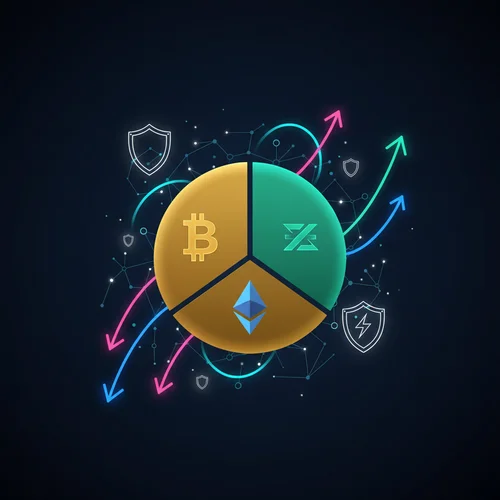
Conservative Crypto Allocation: 70/20/10
VanEck’s analysis suggests “the ideal allocation was 71.4% bitcoin and 28.6% ether” for optimized risk-adjusted returns. For conservative investors, I’d modify this to:
- 70% Bitcoin: Your anchor asset
- 20% Ethereum: Smart contract exposure
- 10% Altcoins/Stablecoins: Small growth bets or dry powder
Moderate Crypto Allocation: 50/30/20
This is my current allocation. It balances stability with growth potential:
- 50% Bitcoin: Still the largest position, always
- 30% Ethereum: Meaningful exposure to DeFi and Layer 2 ecosystem
- 20% Altcoins: Distributed across multiple sectors (more on this below)
Aggressive Crypto Allocation: 30/30/40
I ran a version of this in 2021. It worked spectacularly until it didn’t. If you choose this path, please understand: 40% altcoin exposure can evaporate fast. Position sizing and stop-losses aren’t optional – they’re survival.
Always apply proper risk management principles regardless of your allocation style.
Sector Diversification: Beyond Just Bitcoin and Ethereum
One mistake I made early on was thinking “diversification” meant owning 12 different altcoins. It didn’t matter that they were all Layer 1 chains doing the same thing.
Layer 1 Blockchains (Alternative Smart Contract Platforms)
Think Solana, Avalanche, or Cardano. These compete with Ethereum for smart contract dominance. I typically keep 5-10% of my altcoin allocation here.
DeFi Protocols (Decentralized Finance)
Protocols like Aave, Uniswap, or Maker offer exposure to decentralized lending and trading. Some investors generate yield by staking their crypto holdings.
Layer 2 Solutions (Scaling Technologies)
Arbitrum, Optimism, and Polygon solve Ethereum’s scaling problems. As transaction volume grows, these could capture significant value.
Real World Assets and Utility Tokens
The newest sector bringing traditional finance on-chain. I’m cautiously watching this space develop before making large allocations.
Track sector allocations using real-time market cap data to avoid overexposure to single narratives.
My Personal Allocation Strategy (And How It’s Changed Over Time)
I believe in radical honesty about money. So here’s my actual journey:
2021: The Aggressive Degen Portfolio (Mistakes Were Made)
My allocation was roughly 20% BTC, 20% ETH, and 60% altcoins. I was chasing narratives, aping into new protocols, and feeling invincible. This coincided with my drinking getting worse – the two aren’t unrelated.
When the market crashed, I lost over 70% of my portfolio value. But worse than the money was the psychological damage of watching my “conviction plays” go to zero.
2023: The Conservative Recovery Portfolio
After getting sober and rebuilding my financial life, I swung hard the other direction: 80% BTC, 15% ETH, 5% stablecoins. Zero altcoins. I needed to rebuild trust with myself before taking risks again.
I rebuilt my positions slowly using dollar cost averaging strategy – small weekly purchases regardless of price.
2025: The Balanced Long-Term Portfolio
Today I run a 50/30/20 split with 10% of my total holdings in stablecoins for opportunities. My sobriety taught me that discipline isn’t about perfection – it’s about having rules and following them even when emotions scream otherwise.
When and How to Rebalance Your Crypto Portfolio
The best allocation strategy means nothing without rebalancing discipline.
The Quarterly Rebalancing Rule
I check my allocation every quarter. If any position has drifted more than 5% from target, I rebalance. This forces me to sell winners and buy losers – which feels terrible but works.
The 5-10% Drift Threshold Method
Some investors prefer threshold-based rebalancing. When any asset drifts 5-10% from its target allocation, you rebalance regardless of timeline. This catches rapid market moves that quarterly reviews might miss.
Tax-Aware Rebalancing Strategies
Before selling to rebalance, consider the tax implications. Using crypto tax tracking software helps you understand your liability. Sometimes tax-loss harvesting from losing positions can offset gains from selling winners.
When executing rebalancing trades, use reputable cryptocurrency exchanges with proper security measures.
The Biggest Mistakes That Destroy Crypto Portfolios
After years in the trenches, these are the killers I see most often:
Mistake #1: No Rebalancing Plan
If you don’t have a written rebalancing schedule, you don’t have a strategy. You have hopes and prayers.
Mistake #2: Emotional Allocation Decisions
Buying more of what’s pumping. Panic selling what’s crashing. These feel rational in the moment and destroy portfolios over time.
Mistake #3: Overconcentration in Single Coins
The Terra LUNA investors who lost everything had the same mistake: they let a single asset become their entire portfolio. No single coin – including Bitcoin – should ever represent more than 70% of your crypto holdings.
Mistake #4: Ignoring Risk Management Principles
Even “HODL” portfolios need position sizing discipline. If you can’t stomach a 50% drawdown in a position, you’re sized too big.
Building Your Portfolio Allocation Strategy
If you’re just starting out, consider buying your first cryptocurrency before worrying about complex allocation strategies. Master the basics first.
For those interested in ETF exposure rather than direct ownership, I’ve written about Bitcoin ETF allocation strategies that might fit better in traditional brokerage accounts.
The perfect crypto portfolio allocation strategy doesn’t exist. But a disciplined, rebalanced portfolio that matches your actual risk tolerance? That’s worth more than any moonshot altcoin pick.
I’ve lost money learning these lessons so you don’t have to. Start conservative, build discipline, and remember: surviving bear markets is what makes you wealthy in bull markets.
